Story audio is generated using AI
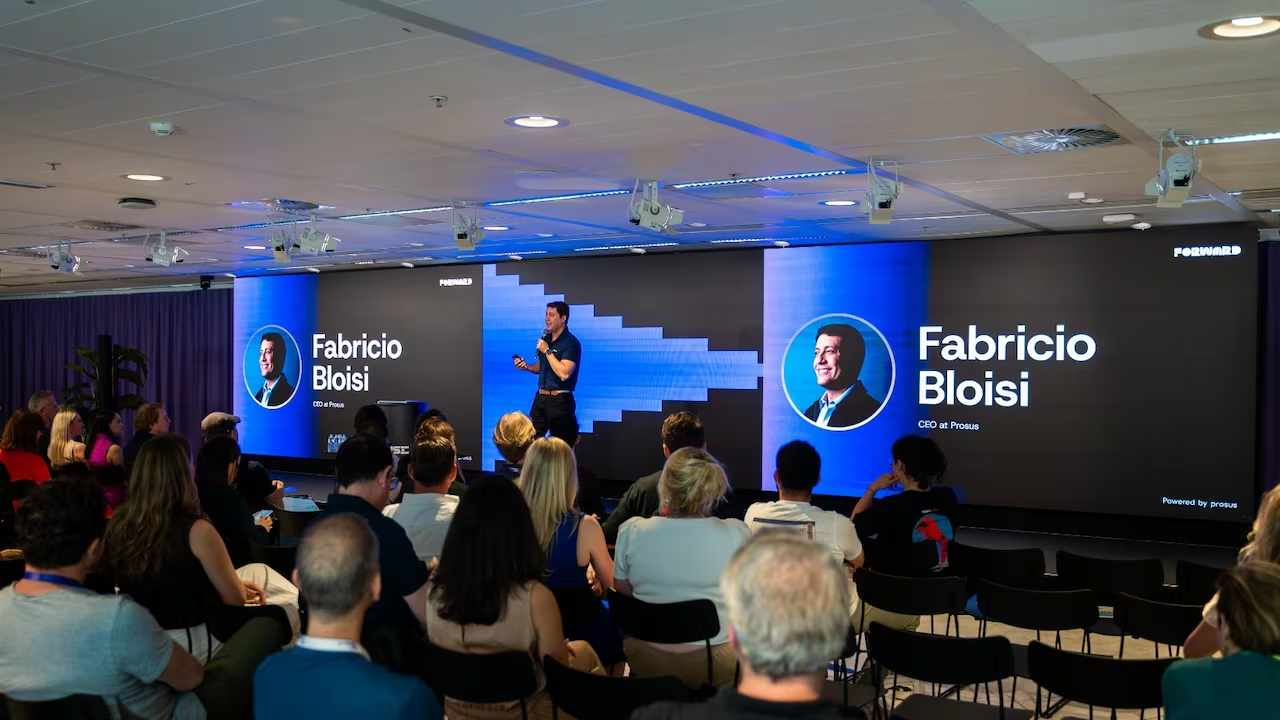
Prosus is setting its sights on sectors such as vehicle dealers, e-commerce and classifieds with its new AI platform, ToqanClaw, which is aimed at simplifying operations and delivering insights for businesses of all sizes.The Naspers-owned technology investor is preparing to bring ToqanClaw to South Africa as part of a broader push to embed AI deeper into its businesses. Prosus is looking to scale the platform beyond its initial rollout in European restaurants, targeting sectors central to its footprint across the world.ToqanClaw is designed to strip away the complexity that has kept many businesses from adopting AI. The platform allows users to build apps, dashboards and automated workflows by simply describing their needs in plain language — without coding or reliance on engineers.Prosus sees this as a critical step in unlocking AI adoption, particularly among small and medium-sized businesses that have struggled to integrate advanced tools into day-to-day operations.“The tools that are out there today are not very easy to use; they’re not plug-and-play,” said Laura Fitoussi, director of strategy and operations at Prosus. “We found that engineering knowledge was still required, and that remains a barrier to making AI accessible for all merchants, especially smaller ones.”She said many businesses remain constrained by fragmented data systems, where sales, staffing and inventory are spread across multiple platforms, limiting their ability to respond quickly to operational challenges.ToqanClaw aggregates this information, generating actionable insights such as identifying staffing shortages, predicting demand patterns or flagging inventory gaps that lead to lost revenue.Prosus-owned local businesses such as Takealot and Mr D Food are expected to be early beneficiaries. “We are very excited by the results we’re seeing in the Netherlands, and we want to replicate that in South Africa very quickly, particularly within Mr D restaurants,” Fitoussi said.The roll-out underscores Prosus’s strategy of using its global portfolio to test and scale technology across markets while tailoring products to local conditions.We are very excited by the results we’re seeing in the Netherlands, and we want to replicate that in South Africa very quickly, particularly within Mr D restaurants.— Laura Fitoussi, director of strategy and operations at ProsusLessons from Brazil — where Prosus operates food delivery group iFood — have already highlighted the need for localisation.“While it’s a fabulous tool, there are subtleties in each market that it doesn’t fully capture yet,” Fitoussi said. “We recognise that localisation and context are specific to every market.”South African businesses can therefore expect a version of ToqanClaw adapted to local regulatory, consumer and operational environments — a key factor in determining whether the platform gains traction.Although initially focused on restaurants, Prosus sees wider applications across its ecosystem, particularly in e-commerce and classifieds, where real-time data and operational efficiency are critical.Fitoussi said sectors such as travel, automotive dealerships and online marketplaces are natural next steps, given their reliance on dynamic pricing, inventory management and customer engagement tools.“I think the next verticals we’ll see emerge will be those within our ecosystem and partner network before expanding further,” she said. As competition intensifies in the AI sector, Prosus is positioning itself around data access rather than the underlying technology.Fabricio Bloisi, CEO of Prosus, noted: “Everyone has a good AI model now — that’s no longer the advantage. What matters is who has the data, the context and the feedback loops that make it useful for a real business.”Fabricio Bloisi, CEO of Prosus. (Picture: SUPPLIED) Prosus is also expanding into consumer AI through its platform Zapia, which the company says already has more than 6-million users, primarily in Latin America.Users can give Zapia conversational prompts to carry out tasks such as booking services, managing schedules and organising digital workflows. “We’re not only building for businesses, we’re also building AI that works for consumers,” Bloisi said.He described AI assistants as the biggest shift in digital interaction since smartphones, with users increasingly expecting seamless, task-based experiences rather than navigating multiple apps.“You will simply tell your assistant what you want, and it will get it done,” he said.Zapia has now been made available globally, signalling Prosus’s ambition to compete across both enterprise and consumer AI markets.Business Times