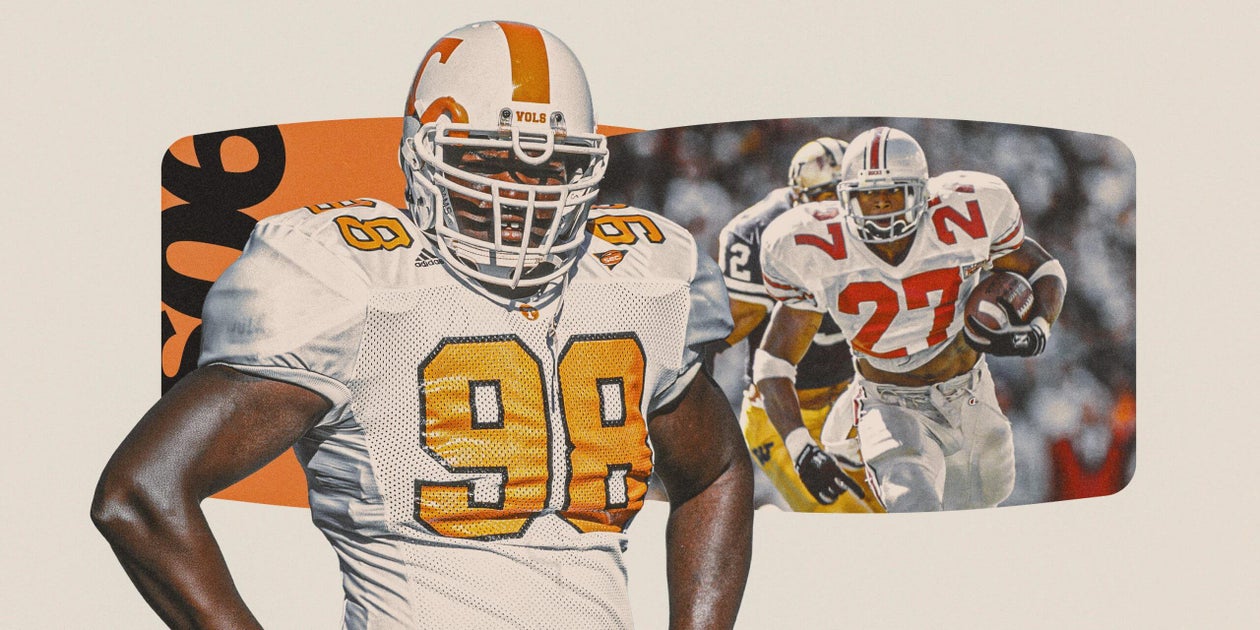
Editor’s note: As the World Cup continues in the United States for the first time since 1994, The Athletic is looking back at college sports in the 1990s and how much has changed since then. Join us for a couple of weeks of offseason football and basketball nostalgia.John Henderson’s hulking, 6-foot-7, 335-pound frame looked even more fearsome when he stacked a pair of giant, bulky shoulder pads and a neck roll on top of it as a star at Tennessee from 1998 to 2001.But one day, he was tempted to downsize. Maybe he could slide through gaps in offensive lines a little easier with smaller pads. Maybe it’d be tougher for linemen to hold him.So he went down a few sizes for a midseason practice.“I felt everything,” he said. “I was like, ‘Nah.’”After practice, he marched to the equipment staff and asked for his old pads back.“‘Ain’t no way in the world I’m wearing that in a game with those big boys coming at me,’” Henderson remembered telling them. “I need all my stuff. I’m in the trenches right now.”In the 1990s, bulky shoulder pads were the norm, whether you were a defensive tackle such as Henderson or a running back such as Heisman Trophy winner Eddie George. When Henderson watches football now, he sees players flying all over the field in pads a fraction of the size he and his teammates wore during his college career, during which he had to settle for a national championship, Outland Trophy and two All-American seasons before he was picked ninth in the 2002 NFL Draft. It’s a trend that hasn’t gone away. Those in the pads industry say slim is in.“I’m like, ‘Are they OK?’” Henderson said. “It’s crazy. I don’t see how these guys now do it. I hope they don’t have shoulder problems.”Coaches see it, too. Georgia coach Kirby Smart brought former Bulldogs tight end Ben Watson back to Athens to speak with his team recently. Before Watson spoke, Smart fired up some highlights of the Super Bowl champion.“Several kids walked out and were like, ‘Golly, those shoulder pads you wore were huge,’” Smart said. “You forget about it until you see it.”When 18-year-old Troy Davis showed up at Iowa State from his hometown of Miami in 1994, he was handed a set of bulky pads. He didn’t ask questions. They were the same size he wore in high school, anyway, and the ones he always saw on TV, where players looked like gladiators strapping armor to their bodies.He assumed they slowed him down a little. But they made him feel safe, even if they made his neck disappear. His chinstrap and the neckline of his jersey were in constant contact, thanks to his shoulder pads.Those uncomfortable shoulder pads and thigh pads that extended down to his knees kept Davis healthy, he said. He carried the ball 747 times over his final two seasons — an average of 34 carries per game — and never missed a game. It’s why he was able to rush for more than 2,000 yards in consecutive seasons, finishing in the top five in Heisman voting both years despite the Cyclones going 3-8 and 2-9.“I love the pads I had,” Davis said. “Because what I did with those pads is still standing. Nobody’s run for 2,000 yards back-to-back since.”Iowa State’s Troy Davis was among the players who embraced their giant pads in college. (Stephen Dunn / Allsport via Getty Images)Back then, nobody asked about customizing pads. Equipment managers handed players their pads and helmets. Players put them on.“Now, they tell you what they want,” said Greg Mazza, the director of sales for Pro Gear Sports. “And they want it small.”What happened?Change didn’t happen all at once. Some in the industry point to the tiny pads Ty Detmer wore during his Heisman campaign in 1990 at BYU, a stark contrast to the full-bodied shoulder pads the previous year’s Heisman winner, Andre Ware, wore at Houston.“Skill positions changed first,” said Kevin Bull, who was an equipment manager at Navy from 1990 to 2000 before joining Douglas Pads, where he works to develop and sell pads. “Linemen took longer to evolve.”Most point to the trend spreading early in the 2000s, beginning in the NFL, where players have far more agency over the equipment they wear. That trend slowly trickled into college football, alongside tighter jerseys.Mike Kurowski, who worked in equipment with the Dallas Cowboys and Louisville and is now director of athletic equipment operations at Missouri, points to Douglas Pads rolling out a slimmed-down quarterback shoulder pad set called the QBK around that time, followed by a slimmed-down set of pads meant for skill position players.Smaller pads and tighter jerseys meant smaller frames, which quickly became en vogue.Mazza said he tells his customers the best shoulder pads were from the 1970s and 1980s. Back then, pads had one size of epaulet — the pad covering the shoulder — and cups that actually contacted the shoulder. Now, there are several different sizes of cups and at least five or six sizes of epaulets.Contrast the shoulder pads on Penn State linebacker LaVar Arrington in the 1990s to the ones on his son, linebacker LaVar Arrington II, in April 2025. (Rick Stewart / Getty Images; Dan Rainville / USA Today Network via Reuters Connect)When large companies such as Douglas and Riddell began mainstreaming plastic pads in the 1960s and early 1970s, a 3/4-inch-thick shell on the main shoulder pads was standard.In the early 2000s, Bull estimates, the 1/2-inch main body slowly grew into the standard at the NFL level, then college. His staff sees it when they visit colleges to fit players. Last year, Pro Gear finally made the 1/2-inch main body its standard.“They all want smaller. It’s down to high schools, too. I live in Jacksonville, and you go to high school games and some of these guys are wearing Pop Warner pads,” Mazza said. “They want to move around more. They feel like they’re moving around more, but that’s not the truth.”Is Bowden vs. Spurrier the best rivalry ever in college football?Joe RexrodeIt’s the tension of everyone involved in fitting players for pads. Manufacturers and equipment managers know players want something smaller. But the reasons, they say, are suspect.The idea that smaller pads make players play faster?“A lot of it is between the ears,” Bull said. “Kids wanted smaller because they felt they could move faster, but at the end of the day, that’s not true. But that’s what they thought.“As a vendor, when we’d fit guys, they started telling us they wanted smaller epaulets, smaller cups. ‘What’s the smallest receiver pads you have?’”Most in the industry concede the smaller pads offer a greater range of motion, but that wasn’t necessarily true in the ’70s and ’80s, when pads were big and jerseys were loose and floppy. But as coaches and players wanted to make it harder for blockers to get handfuls of jersey and uniforms tightened, big pads began to limit the range of motion, especially at positions such as receiver and defensive line, where players wanted to get their hands up to catch balls or knock them down.“It’s like it happened overnight,” Mazza said. “I’m friends with the other vendors, and we talk and it’s absolutely crazy.”On a recent visit to Oklahoma State, Bull found himself wandering through the halls of the Cowboys’ facility at Boone Pickens Stadium. On the walls were running backs such as Barry Sanders and Thurman Thomas.Their pads were, as most were in their day, gigantic compared with what players wear today. And Bull remembered having the thought: “You know, those guys moved pretty good for being in those big pads.”Then there’s the injury risk. Mazza said there’s “no doubt” the smaller pads are causing greater injury at every level of football, leaving shoulder AC joints more exposed and offering less padding and protection.This has caught the attention of the NFL, too: An NFL official said in February that the league plans to study an increase in shoulder injuries this past season to determine whether there’s a correlation to shoulder pads providing less coverage.
Whatever happened to college football players wearing giant shoulder pads?
In the 1990s, bulky shoulder pads were the norm across college football. Over time, slim became in.
1,947 words~9 min read