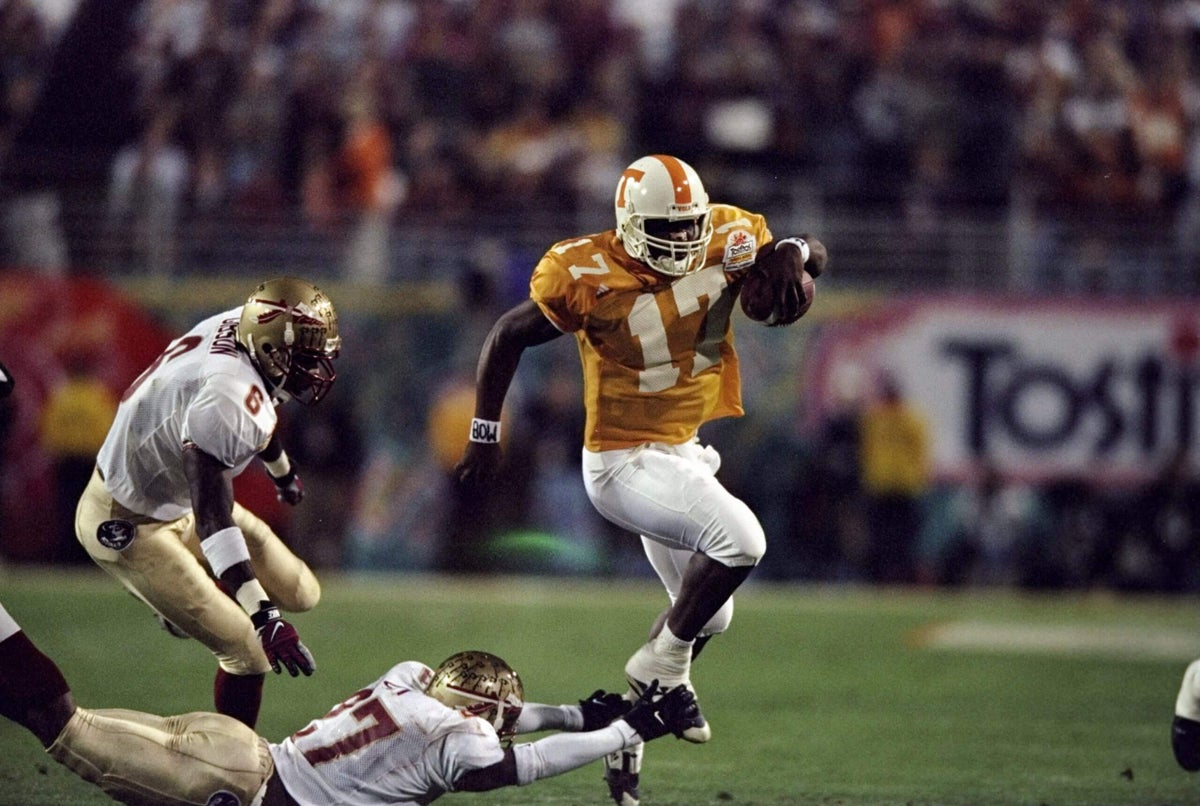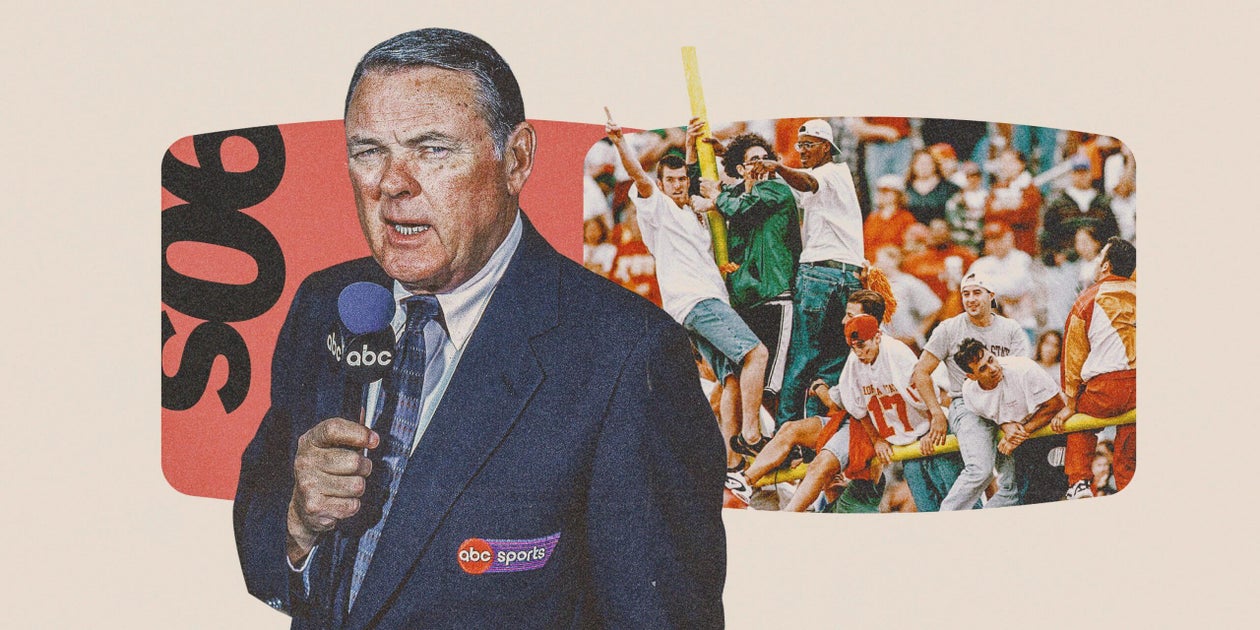
Editor’s note: As the World Cup continues in the United States for the first time since 1994, The Athletic is looking back at college sports in the 1990s and how much has changed since then. Join us for a couple of weeks of offseason football and basketball nostalgia.For anyone born between 1978 and 1986, it is not hard to identify the moment when college football reached its cultural zenith.College football peaked in the latter half of the 1990s, the era of puffy Starter jackets, the voice of Keith Jackson bellowing “Whoa, Nellie!” and the dawn of EA Sports’ NCAA Football video game series on PlayStation. This era provided one of the greatest Heisman Trophy races (Charles Woodson over Peyton Manning in 1997), one of the greatest national championship races (undefeated UCLA and undefeated Kansas State losing within hours of each other on Dec. 5, 1998) and several of the greatest individual seasons: Ricky Williams at Texas, Randy Moss at Marshall, Woodson at Michigan.The case for the 1990s as a golden age of college football is clear to me, an elder millennial. Not everyone sees it the same way. A Reddit thread titled, “What do you consider to be the best era of college football?” produced more than 200 replies but no consensus, with most answers ranging from the 1970s to the 2010s. One poster astutely observed that the responses revealed more about the person answering the question than they revealed about the sport.“Yeah this is literally just a question of when you were between the ages of 12 and 24,” wrote someone called NazRiedfan.Is Bowden vs. Spurrier the best rivalry ever in college football?Joe RexrodeThe Redditor was right: There is no “best” era of college football. The sport began during Reconstruction, boomed in the 1920s and has been a cultural force ever since. Perhaps, in longing for the days of VHS tapes and bean bag chairs, my fellow 40-somethings and I are longing to be 13 again.By many objective measures, the 1990s were not an exceptional time for college football. Fans who enjoyed parity instead saw a decade dominated by a handful of powerhouse programs: Tom Osborne’s Nebraska dynasty, Bobby Bowden’s Florida State teams, Steve Spurrier’s Fun ‘n’ Gun Florida Gators.A 2019 ESPN ranking of college football’s greatest games featured only one game from the ’90s in the top 40 — Kordell Stewart’s Hail Mary to give Colorado a last-second win against Michigan in 1994 — compared with nine from the 1980s and five from the 2000s.Still, I wanted to believe that my fondness for college football in the ’90s involved something more than simple nostalgia. I decided to run this theory past Chuck Klosterman, whose credentials on the topic include a collection of essays called “The Nineties” and another called “Football.”When I mentioned the premise of the story, Klosterman’s first thought was, “That’s crazy.” In thinking about it more, he said, he could see a case for the 1990s as the best era to be a consumer of college football, even if the sport itself peaked earlier, perhaps sometime in the 1960s or 1970s.The argument boils down to this: Football is a sport best watched on television, and the ’90s were the best time to watch college football on TV.Before the advent of multi-camera TV broadcasts, the nuances of most football plays were invisible to the casual fan. In his book “Football,” Klosterman gives the example of a fan occupying one of the 107,601 seats at Michigan Stadium. That fan might get the best view of one play throughout the game, whereas fans watching on TV get the best view of every play.“Football is always, always, always better on television than it is in person,” Klosterman writes.
Did college football peak in the 1990s? The case for a golden age goes beyond nostalgia
Why do so many of us look back fondly at ’90s college football? Perhaps because the ’90s were the best time to watch college football on TV.
1,821 words~8 min read