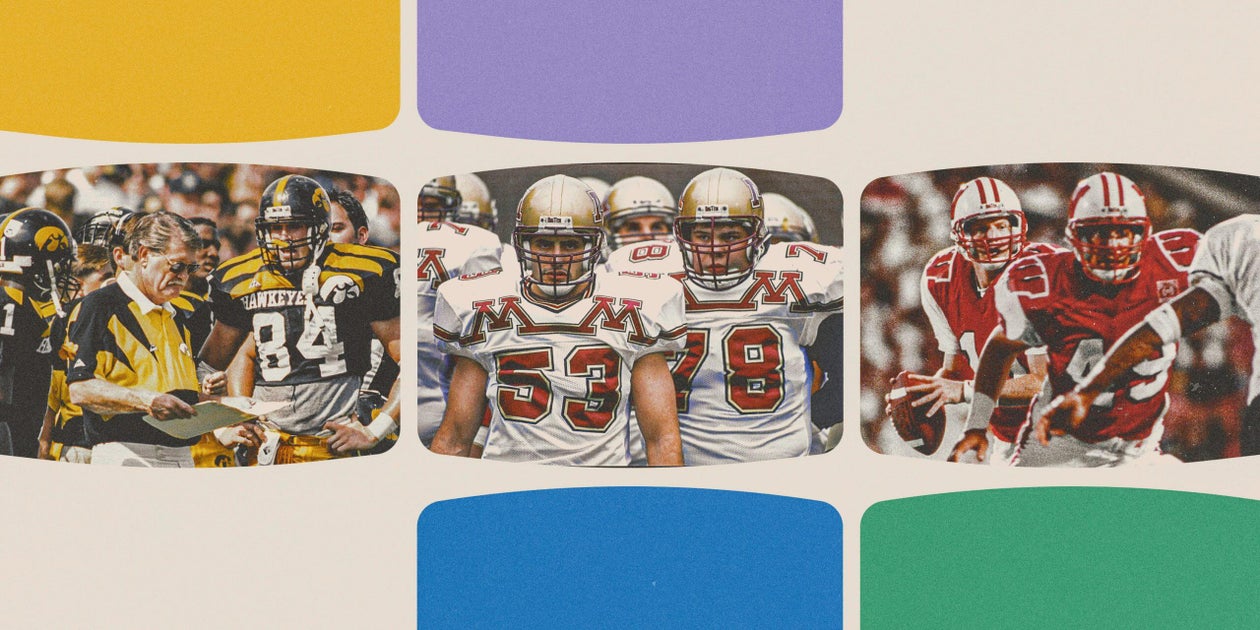
Editor’s note: As the World Cup continues in the United States for the first time since 1994, The Athletic is looking back at college sports in the 1990s and how much has changed since then.Former Arkansas receiver JJ Meadors is remembered in Fayetteville for three things.No. 1 is his game-winning catch on fourth down to beat Alabama early in the 1995 season. No. 2 is being part of the first Hogs team to reach the SEC Championship Game that same year.And No. 3 is a photo of him wearing one of the strangest jerseys in college football history, with two giant Razorback logos on the fronts of his shoulders. It enjoys Internet immortality and a permanent place in the debate of the oddest football fashion choices ever.“Those jerseys were just hella atrocious,” Meadors says with a laugh. But he still has his in storage at his mom’s house in Texas, and he’s not giving it up as its value rises.Before alternate jerseys became commonplace, the 1990s were a time of uniform experimentation across all sports. And before Nike and Oregon changed college football jersey culture, a short-lived company called Apex One shook things up like never before.Arkansas wasn’t alone with giant logos on its shoulders. Minnesota and Wisconsin did the same, while Iowa sported an even more unusual look, all from Apex One. The concepts flew too close to the sun, but they laid the path for the many unusual alternate jerseys that would flood college football in the 21st century.“I always say 1986-96 is the pinnacle of American sportswear,” said Ernest Wilkins, a sportswear collector and writer/host of Gameday Grails on social media.Meadors (1) and the Razorbacks sported eye-catching Apex One jerseys in 1994. (Courtesy of University of Arkansas)Because these mid-90s jerseys emerged right before the proliferation of the internet, with only a few photos easily discoverable via Google search, they almost don’t look real. One of the findable images is Meadors from a photo shoot before the season, which is why he still hears about it.“Every year at some point during the season, that picture will get posted,” he said, “and I get a kick out of it.”Apex One was founded in 1989 by former Adidas executives Joseph Kirchner and Michael Lewis, who had a new strategy: Rather than marketing to consumers first, they would sign with professional teams and see the awareness trickle down. In 1990, they got a licensing deal with the NFL for certain team jerseys, jackets and more. By 1994, they’d added additional pro leagues as well as several college sports teams. Today’s fans may more easily recognize Starter jackets; Apex One was Starter’s main rival.The company leaned into being flashy and different. You might remember those Dallas Cowboys jerseys with the giant stars on the upper shoulders, which were also worn in the movie “Little Giants.” Those were the Apex One Cowboys jerseys, the logo front and center on the movie poster. The company’s sales rose from $9 million to $100 million in five years, according to reports at the time.“It was this rare situation where you had multiple American small businesses all having licenses with the major four leagues going against the global giants,” Wilkins said.Word got to Iowa football coach Hayden Fry that Apex One was interested in college gear. It was Fry who’d moved Iowa to the Pittsburgh Steelers look in 1979, so another change intrigued him. Greg Morris and other Hawkeyes equipment staffers flew to New Jersey on a day trip to get the pitch. Morris was impressed with the company’s energy. The original plan was just sideline gear, but it grew to include jerseys they never could’ve imagined: tapered yellow bars rising across the upper chest and shoulders, a tigerhawk logo at Fry’s insistence and “Hawkeyes” spelled out on the left side of the chest. It made for a busy look.“They’d never been a part of college football,” said Morris, who spent 44 years at Iowa and retired in 2024. “I couldn’t tell you where they came up with that idea.”The ‘banana peel’ jerseys left a lasting impression on Iowa fans and football fashion critics alike. (Courtesy of University of Iowa)The jerseys were revealed on a one-hour local television show and garnered mixed reviews. Morris didn’t like them, but at least they were produced in Waterloo, Iowa.“They may look a little bit wild,” Fry said, according to reports at the time. “But today with the way the young people think, they certainly enjoy them. … Those stripes on the top make them look like they’re flying. What’s really nice is when those linemen get down, lined up shoulder-to-shoulder, they look like three rails on a railroad track.”They would become known, affectionately or unaffectionately, as the “banana peel” jerseys.Minnesota’s Apex One jerseys included two large “M” logos on the front of each shoulder, as part of a three-year deal with the company. Arkansas followed the same model, with two big hogs.“They believe this is going to be the style of the future,” Razorbacks coach Danny Ford said at the time.But stepping on the field in them — especially in the southern heat — proved to be a problem.“I didn’t want to say this, but they were made of the heaviest and thickest material,” Meadors said. “After the first game, they took both my jerseys to a seamstress and cut the sides out into a shimmel shirt to help me out. Three or four guys had theirs altered. … We played Mississippi State, it was pouring raining, and those jerseys felt like they weighed 25 pounds.”Minnesota players also complained they were hot and heavy. The jackets and sideline gear were nice, but the jerseys were an issue. In that 1994 season, Arkansas went 4-7, Iowa went 5-5-1 and Minnesota went 3-8, all slightly worse records than the year before. Meadors remembers opposing fans making fun of them during every road game.Wisconsin also planned to use an Apex One jersey with giant shoulder logos for the Hall of Fame Bowl, but the jerseys weren’t produced in time. It proved to be an omen.In 1995, on the verge of going out of business, Apex One was sold to Converse. Its gear had been popular, but its endorsement deals were too costly, and it didn’t have the infrastructure to keep up with orders. The brand was shut down later that year.That left schools in an awkward position. They still had these relatively new uniforms at a time when schools didn’t change jerseys as often as they do today. Arkansas was able to move back to the normal-looking Apex jerseys they’d worn in 1993, but Iowa and Minnesota wore their new fits for another year, some without the Apex patch on them.Wisconsin, meanwhile, partnered with Starter, which took Apex One’s unused Badgers jerseys, made some slight tweaks and put a Starter logo on them. The Badgers used them for the 1995 opener against Colorado.“The players liked them,” former head coach Barry Alvarez said this June. “That’s who I try to satisfy.”It was Alvarez who had commissioned and selected the still-in-use “Motion W” logo just a few years prior, hoping to change the image and losing culture of Wisconsin football. Now it was prominently on these jerseys in an eye-popping way.Then the Badgers lost 47-3 to Colorado in a Top 25 matchup, and the feelings changed.“We never wanted to wear those again,” said former quarterback Darrell Bevell, now a coach with the Carolina Panthers. “They were horrible, ugly, all those things, but a lot of it was tied emotionally to the win or loss. There’s always a chance if you win that you wear it again, like we did with red pants.”The 1995 Iowa team improved to 8-4, while the Gophers slipped to 3-8. Maybe the uniforms played a role in the lack of success, maybe they didn’t, but the poor play turned fan sentiment against them even more. Either way, Apex One was gone, and Converse wanted to pull out of football, so the schools moved to other brands.These bizarre uniforms have since been lost to history. While pro sports leagues have leaned back into goofy throwbacks, especially those of the 1990s NBA, college football hasn’t done the same.That was, until 2019, when Nike and Iowa brought back the banana peels for one game against Penn State. The yellow jerseys featured black bars at the top and dropped the logo and text of the Apex One originals. Morris, after being there for the originals in the mid-1990s, thought he’d never see them again. (The Hawkeyes, once again, lost while wearing them.)“I was surprised,” Morris said of their return. “But (head coach Kirk Ferentz) is always open to his team. He brought it to the group, and they said let’s do it for a game.”Meadors noticed when Iowa brought those jerseys back. A part of him would like to see Arkansas do the same. In a Fayetteville shop a few months ago, he saw some old Apex One Arkansas gear with a price that shocked him. When Meadors told the collector that he had a bunch of the same gear in storage, the collector asked to buy it from him.“I guess it’s considered vintage,” the former receiver said.Meadors won’t do it. It still means something. Bevell believes he still has his “ugly” Wisconsin jersey as well. Because the Apex One gear had such a brief run, it’s difficult to find, making any pieces much more interesting to collectors like Wilkins. Many fans don’t even believe they were real game jerseys.Maybe they were ahead of their time. Maybe it was too much change for a sport that leans heavily on tradition. Still, in a sport where bizarre outfits have become commonplace, these looks went outside the box before it was cool.“People look back, and it might be gaudy,” Wilkins said of Apex One’s designs, “but it’s iconic.”
The ‘hella atrocious’ history of college football’s most daring uniform designs
Before Nike and Oregon changed college football jersey culture, a short-lived company shook things up like no one had ever seen.
1,641 words~7 min read