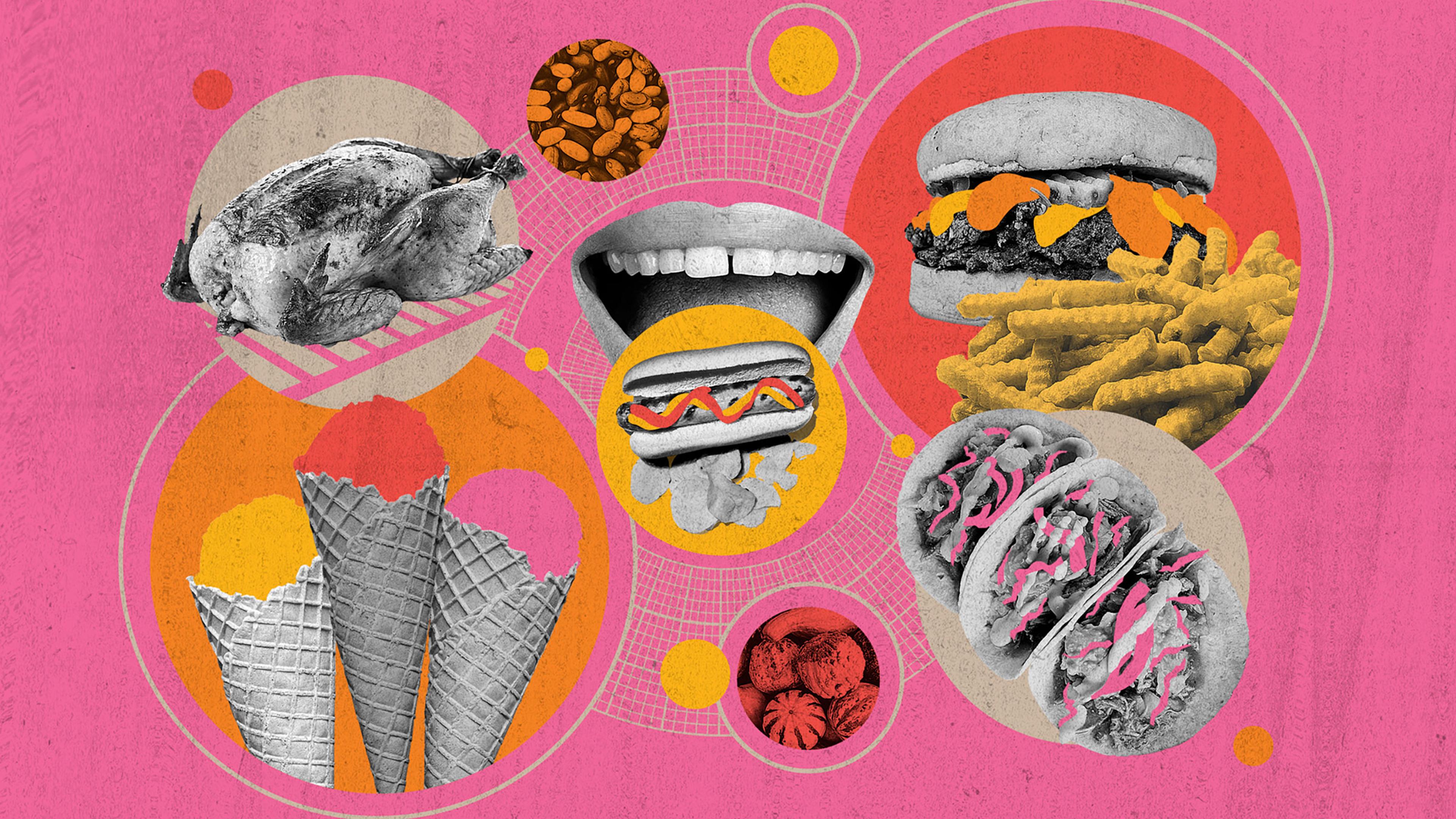
To mark the 250th anniversary of the United States, TIME asked 25 of today's most noteworthy chefs, restaurateurs, hospitality moguls, and culinary voices to tell us about the dishes that they believe speak to the nation at this pivotal moment. From unique fine dining offerings to timeless basics and updated classics, their answers are, taken together, a thoughtful menu of ways to see America now.Fried chicken gizzards and grits at Virtue in ChicagoSelected by Kwame OnwuachiThere’s something meaningful about a dish that can honor the past while confidently shaping the present. The fried chicken gizzards and grits by Erick Williams at Virtue is made with pride and intention. It speaks to a broader shift in American culture that values heritage and what deserves to be celebrated on the plate.Onwuachi is a chef, restaurateur, and author. He recently opened Maroon in Las Vegas, and his next cookbook, All Hours: Crazy Good Food for Whatever, Whenever, will be published Sept. 22.The smashburger Selected by Nick DiGiovanniCrispy laced edges, two thin patties, American cheese, a soft potato bun. The burger has been a national favorite for more than a century, but the smashburger is something different—a regional diner method that spread through screens and set the new standard. It makes me optimistic about how people can come together, inspire each other, and innovate, even on the classics.DiGiovanni is a chef, YouTuber, and judge on the Food Network competition series 100 Cooks. Lew Robertson—Getty ImagesThe hotdogSelected by Alton BrownThe most American of all foods is...the hotdog. No, correction, the hotdog isn’t American; it is America. The hotdog was born of multiple old-world traditions, flavors, and influences. Its popularity grew alongside the rise of urban sports stadiums, during the Industrial Revolution, and the baseball games they were built to house. What’s more, it couldn't really exist without the large-scale mechanization that America is known for. No other food even comes close.Brown is the host of the YouTube series Alton Brown Cooks Food and the touring live event An Evening of Alton Brown.BeansSelected by Sohla El-WayllyFor most of American history, beans were poor people’s food, which meant they were everybody’s food, except the people writing the cookbooks and running the magazines. The last decade's “discovery” of beans by food media, wellness culture, and climate advocates is really just mainstream America finally catching up to what immigrant and working-class kitchens never stopped knowing. No ingredient better captures the contradiction at the heart of this country: Something that fed everyone and got credit from almost no one is now being celebrated loudest by the people who ignored it longest.El-Waylly is a chef, restaurateur, cookbook author, and YouTuber.Chicken and wafflesSelected by Marcus SamuelssonBorn out of Harlem’s late-night jazz scene, this combination reflects a uniquely American moment in which cultures, rhythms, and traditions came together to create something entirely new. That balance of sweet and savory, breakfast and dinner on one plate, mirrors Harlem’s, New York’s, and America’s diverse food history that continues to be shaped by a blend of different cultures and influences.Samuelsson is a chef, restaurateur, and TV personality.The elk machaca with fermented onions at Ursa in TucsonSelected by J. Kenji López-AltAt Ursa, Chef Aaron Lopez’s menu is prepared entirely from Indigenous North American ingredients, including elk, barrel cactus, desert ironwood, and screwbeans. In a country whose food culture is so often framed through immigration and adaptation, it feels deeply meaningful to see chefs like Aaron, or Sean Sherman of Owamni in Minneapolis, helping restore Native ingredients, traditions, and perspectives to the center of the American story 250 years after the nation’s founding.López-Alt is a chef and author of The Food Lab, The Wok, and Every Night is Pizza Night.Slow-smoked brisketSelected by Terry CrewsWhat makes brisket so uniquely American is its versatility—it can be served traditionally as barbecue, but it also finds its way into tacos, stews, and countless other cultural interpretations. That ability to evolve while bringing people together feels very representative of where American culture is headed.Crews is an actor and the host of the new Food Network competition series 100 Cooks. dbvirago/Getty ImagesFried chickenSelected by Carla HallFried chicken reflects both where we’ve been and who we’re still becoming. What started as a Southern staple now shows up in restaurants and kitchens everywhere. Nashville hot, Korean yangnyeom, Japanese karaage, West African spices: each one tells its own story, invites curiosity, and often leads you to someplace new. Every version carries the complexity of who we are and the joy we find in understanding and appreciating one another. In that way, fried chicken becomes a gateway to other cultures and cuisines, and that feels like America.Hall is a chef, author, and TV personality. Her one-woman show, Please Underestimate Me, premieres in June at the Olney Theatre Center in Maryland.Pot roastSelected by Erin O’BrienPot roast reflects so many cultures and traditions that make up this beautiful and diverse country. Versions of it can be found in Mexican, Irish, Italian, Jewish, Southern, and Midwestern kitchens, making it both deeply personal and universally familiar. And as my mom taught me, it's also a meal that evolves, because leftovers can become tacos, burritos, quesadillas, sandwiches, or soup the next day. That adaptability and constant reinvention feel quintessentially American.O’Brien is a digital creator (@erinnobrienn) and cookbook author; her new cookbook is Dig In!The pastrami Reuben at Eric Greenspan’s Mish in Los AngelesSelected by Duff GoldmanNeil Diamond sang a song called “America” about what this country means to people leaving hardship and looking for a future for their children. His story is my story and everyone else’s. We all came here and shared the food our people eat, be it ramen, carne asada, Soondubu Jjigae, or a Reuben. The one from Mish in L.A. represents what my people shared with America—and, let’s face it, a good Reuben is pretty spectacular.Goldman is a television personality, cookbook author, and the executive chef of Charm City Cakes in Baltimore.Viral, “new-stalgic” dessertsSelected by Christina TosiAs a baker with a sweet tooth, I love watching dessert virality these days—the Chocolate Crunch Cake, the Dot cake, and beyond. We want it all, right? Highly glossy, insanely gooey, outrageously crunchy, chocolate to the max. We want something that's simple, low pressure, uncomplicated, but also something that makes us excited, gives us hope, and offers newness and an avenue for self-expression. We want something we can eat with our eyes, then share with our spoons. We are little sparks, looking to light up life with these tiny moments in our day. Dessert is an opt-in course, our reprieve from the rest of the seriousness of life. We want more of it. We need more of it. I am here for it.Tosi is the chef and owner of Milk Bar. rebeccafondren/Getty ImagesBowlsSelected by Padma Lakshmi It’s not very glamorous, but the dish that defines America right now is “bowl food.” I think the reason people love the bowl is because it encompasses exactly what’s wonderful about American food, which is this microcosm of the world’s flavors, due to our immigrant culture. You can have a poké bowl, a taco salad, a rice bowl. That rice can represent many different cultures: Asian, Gullah Geechee, Latin, etc. And on that, you can put anything, from fajitas to falafel to Korean tofu. It speaks to how much we don’t just eat one thing in this country, and how our cuisine doesn’t have a fixed canon of established dishes. It also signifies our capitalist system, where everyone’s always busy and on the go. Lakshmi is a television personality, producer, author, and activist. She hosts America’s Culinary Cup, streaming on Paramount+.Jamaican meat pattiesSelected by Ruth ReichlJamaican meat patties have been creeping slowly into the American diet since the ’70s, mostly as fast food at delis and bodegas. (I first tasted them at the race track.) But in the last year, with the sudden interest in the foods of the West Indies, they have started gaining respect. You can still find them on street corners and in the frozen food aisle, but big-deal chefs are making high-class versions. And why not? They’re the perfect food for this moment: handheld, easy to eat, stuffed with vibrant spices, and wrapped up in colorful pastry. Reichl is a chef, author, and editor. She publishes the La Briffe newsletter on Substack. GumboSelected by Emeril LagasseGumbo is a true “melting pot” dish of Louisiana and the American South that represents many different traditions and cultures coming together to create something new. It combines French, Spanish, African, and Native American ingredients and culinary techniques, all in a flavorful, thick soup using a variety of seafood, poultry, game, meat, and vegetables. Gumbo is constantly evolving, and that’s part of what makes it such an important American dish. For me, it’s always been about honoring culinary history while taking things to the next level with creativity.Lagasse is a chef, restaurateur, author, and TV personality. Claudia Totir—Getty ImagesTacosSelected by Edgar RicoTacos tell the story of who we are: layered, mixed, evolving, immigrant-built, and unapologetic. They came from Mexican roots, but the U.S. made them explode into a language of regional identity, from Texas barbacoa to L.A. al pastor to Baja fish tacos, and beyond. They’re the great equalizer. Rich or broke, construction worker or CEO, Americans have a divine affinity for the taco. A taco can carry memory, migration, survival, celebration, and creativity all in one tortilla. That’s the American story on a plate! Rico is a chef and co-owner of Nixta Taqueria in Austin.Chicken Country CaptainSelected by Mashama BaileyThis dish originated in the South along the coast of Georgia and South Carolina. We define our cuisine at The Grey as “Port City Southern,” and this dish is a perfect example of that, with its curry, eggplant, and okra. All these ingredients tie to the spice trade and the African Diaspora. This one-pot dish is truly a blend of many cultures that represent America and the American South. Bailey is a chef and cofounder of The Grey in Savannah, Ga., and L’Arrêt by The Grey in Paris.Fried chicken sandwichSelected by Junghyun ParkRooted in Southern tradition, the fried chicken sandwich has become a canvas on which different cultures meet and evolve. When approached through a New Korean lens, it can carry the layered flavors that are central to Korean cuisine, while still remaining familiar and accessible. In that way, it reflects America today—a place where diverse immigrant influences come together, creating something new without losing their identity.Park is the chef and co-founder of several New York City restaurants, including Atomix, Atoboy, and Naro.The pierogi at Veselka in New York CitySelected by Daniel HummMost cultures have some form of a dumpling. One form I always find myself coming back to is Veselka's potato pierogies. More than 70 years old and still run by the same family, Veselka is a testament to the hard work it takes to run a restaurant. New York City is defined by its cultures, after all, and this iconic immigrant-owned restaurant—and its pierogi—is a perfect example of that. Its bringing back 24-hour service is an encouraging sign that all-night energy is finally coming back to the city.Humm is a chef and owner of Daniel Humm Hospitality. Slow-roasted chicken with market vegetables and homemade sourdough breadSelected by Meredith HaydenMany people today are pushing back against hyper-processed food, algorithm-driven convenience culture and the corporatization of everyday life. The renewed interest in farmers’ markets, home cooking, sourdough, gardening, dinner parties, and local agriculture reflects a broader desire for something more grounded, participatory, and human. A simple roast chicken with local vegetables and homemade bread embodies this shift in that its value comes not from novelty or efficiency, but from time, care, and presence.Hayden is a chef, cookbook author, and the creator of the lifestyle media brand Wishbone Kitchen. Alla Tsyganova—Getty ImagesOystersSelected by José AndrésThe past, present, and future of America can be represented by the most simple, incredible food that comes with its own biodegradable package: oysters. They have been eaten on this continent for many centuries, even before America was America, and are truly versatile—raw and cooked, fried or grilled, or made into soups and stews and ketchups. And they are one of the most environmentally sustainable foods of all time; they clean the waterways and leave the world a better place. Can't we all hope the same for humanity?Andrés is a chef, restaurateur, humanitarian, and author of the new cookbook, Spain My Way: Eat, Drink, and Cook Like a Spaniard.Harvest chicken Selected by Cat CoraMy harvest chicken, made with grape, pine nut, and balsamic salsa, captures America today: fresh, vibrant, and shaped by global influence. Rooted in Napa Valley yet inspired by Mediterranean flavors, it reflects a culture that values seasonality, diversity, and the blending of traditions. In a moment of complexity, I believe food remains our most natural unifier.Cora is a restaurateur, the first female Iron Chef, and founder of Chefs for Humanity.Two slices of breadSelected by Dan BarberThe first bread is made from modern hard red spring wheat, which was bred for the roller mill and white flour. It’s the result of American agriculture having narrowed thousands of wheats into a handful of commodity varieties optimized for scale and industrial processing. That’s the same logic that exhausted the Great Plains, helped give rise to the Dust Bowl, and left us with bread that tastes strangely lifeless. The second bread is from a new wheat variety bred for fresh milling called Blue wheat. It represents breeders and farmers—and bakers—who are fighting back, not with old heirloom varieties that are expensive and difficult to grow, but with an enviable yield per acre. Like our country, the industrial food system is only a few generations old—young enough to be reinvented.Barber is a chef and co-owner of Family Meal at Blue Hill in New York City and Blue Hill at Stone Barns in Pocantico Hills, N.Y.The first foods of the Americas Selected by Sean Sherman We’re launching a restaurant rooted in our simple philosophy: remove the colonial ingredients introduced by European settlers and return to what has always been here: corn, beans, squash, chilies, sunflowers, game meat, wild plants, fish, and seafood. Our goal is to shift how people understand “American” food, and to make visible what has always been its foundation: the rich, diverse foodways of Indigenous cultures across this continent, predating colonial borders.Sean Sherman is an Oglala Lakota chef, forager, and founder of The Sioux Chef and North American Traditional Indigenous Food Systems. His newest restaurant, Indígena by Owamni, opens this month in Minneapolis.Hot potSelected by Natasha PickowiczIs there a better dish to define the freewheeling, inventive, anything-goes nature of the American mindset than hot pot? This endlessly customizable meal symbolizes the full range of human consumption, from frugality to full-on debauched excess. There’s a reason why hot pot goes viral on social media again and again—it’s a visual spectacle, made for the lens just as much as the stomach. Best yet, once seated at the table, hot pot aficionados and novices alike bump elbows and jostle over bites; becoming best friends feels more an inevitability than a coincidence. We're social creatures, desperate for connection and to get off our screens, and interactive, communal dining, especially hot pot, just feels like a good idea.Pickowicz is a chef and author of the cookbook Everyone Hot Pot: Creating the Ultimate Meal for Gathering and Feasting. baibaz—Getty ImagesIce cream Selected by Brooks Headley The world is terrible right now. Everyone everywhere is sad and angry. So my advice is to acquire some ice cream, stat. Ice cream is unnecessary. You do not need it to survive. Eat enough of it and you’ll get fat and die—same as with anything else worth overdoing. But for a relatively small amount of money, it delivers one of the purest and most democratic pleasures left in American life. A single scoop of vanilla done correctly still feels almost spiritual. A taste of somebody’s overly ambitious seasonal flavor—sweet corn, black raspberry, tortilla, whatever—can briefly restore your faith in human endeavor. We’ll even count Italian ice or, as the Philadelphians insist on calling it, water ice. What matters is that these frozen gifts remain one of the few pleasures still broadly available to almost everybody. Kids understand this automatically. Adults? We need to be reminded. So, go stand in line. Get your scoop (or two). It’ll melt faster than you can eat it, so for the next five minutes, your only responsibility in the world is to prevent it from shellacking your hand. And that, these days, is a noble pursuit.Headley is a chef, musician, cookbook author, and owner of Superiority Burger.Illustration Source Images: Cate Gillon—Getty Images; Claudia Totir—Getty Images; d3sign/Getty Images; Oksana Schmidt—Getty Images; Daniel Lozano Gonzalez—Getty Images; Justin Tsucalas, food styling by Lisa Cherkasky—Both for The Washington Post/Getty Images; fcafotodigital/Getty Images; Cavan Images/Dorene Hookey/Getty Images
25 Dishes That Capture the Flavor of America Today
Brooks Headley on ice cream, Kwame Onwuachi on fried chicken gizzards, Padma Lakshmi on the bowl—and 22 other arguments for the food that speaks to the nation on its 250th birthday
2,802 words~13 min read