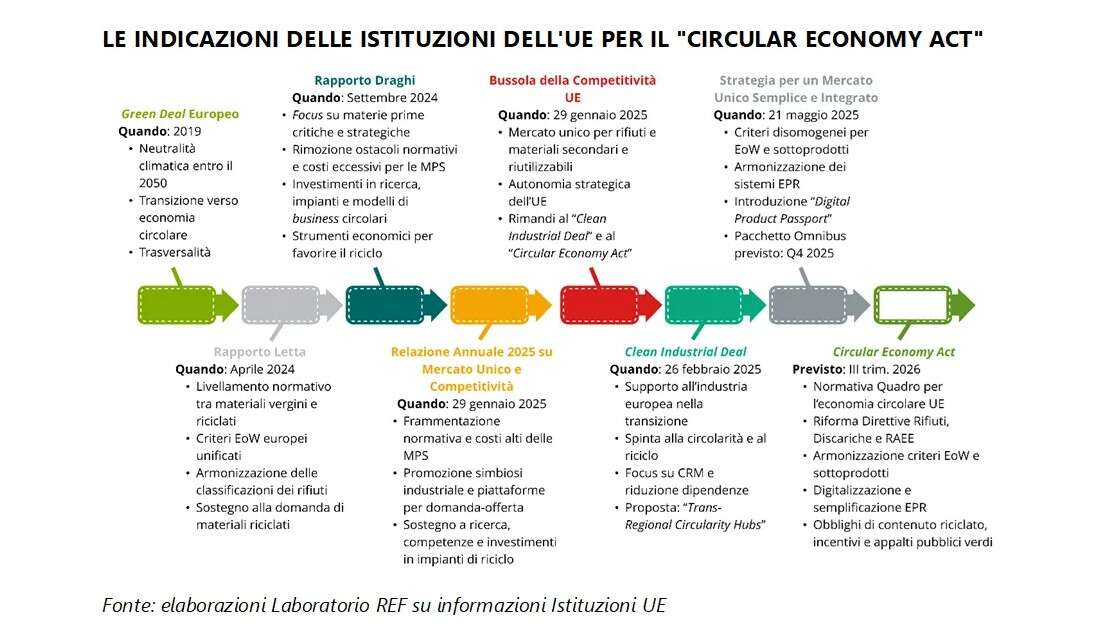
This could be a big year for the circular economy. In autumn, the European Commission is due to adopt the Circular Economy Act (CEA), aimed at supporting the EU in its stated aim to become a world leader in circularity by 2030.There is a clear environmental imperative behind the legislation, but also a geopolitical one. Europe imports the vast majority of all its critical raw materials; for example, 100% of its heavy rare earth metals come from China and 71% of its platinum from South Africa.The bloc is seeking to reduce its dependency on imports of key commodities, energy and materials, and as a result achieve greater self-sufficiency. Circular products are one route to achieving that.Circular ambitionsWhether the EU’s aim is achievable, or not, brings into sharp relief the current state of the circular economy. According to the European Environment Agency, in 2024, secondary recovered materials made up 12% of total material use across Europe. This was only 1.5% higher than in 2010.But, by some estimates, the global circular economy is already worth around $700 billion and could reach several trillion within the next decade. This rate of growth would take considerable support from national governments, starting with something akin to the CEA, which aims to double the EU’s circularity rate to 24% and create a single market for secondary raw materials. The hope is that this will stoke demand from businesses to adopt more circular practices. Carsten Wachholz, business-policy engagement lead at the Ellen MacArthur Foundation, described the forthcoming act as “a critical opportunity to turn circular solutions from a niche proposition into a mainstream market choice,” adding that by harmonising rules across the single market the EU can allow the circular economy to “scale across borders”.From there the argument runs that rules created in Europe will be copied in other markets, shaping global supply chains and standards elsewhere. “The EU can work towards shared international ambition, reducing protectionism risks, and unlocking large-scale investment globally,” he added.Making two ends meetRaising awareness of what is meant by circularity, and being able to identify and treat circular products correctly, is one of the challenges the sector faces.The global economy has been built on a simple linear structure where we source a material, create something out of it, sell it on and then throw it away. This process, sometimes called ‘take, make, use, dispose’ is the opposite of the principles of circularity. The Ellen MacArthur Foundation defines the circular economy as a system where “materials never become waste”. In such a system, products and materials are “kept in circulation through processes like maintenance, reuse, refurbishment, remanufacture, recycling and composting”.Circularity is about the whole life cycle of a product, seeing how it can be used for longer, upgrading when possible, and then potentially using that product to create something else afterwards. The intention with circularity is to increase the use of non-virgin materials, reducing the need to extract more from the ground.Signify: “We believe resilience is becoming more important to businesses right now”Thomas Marinelli, head of sustainable innovation and design at Signify, a global lighting company, said: “I once explained it to a child with Lego. You put Lego blocks together and you can pull them apart again and make something new.” Circular practices also lead to more products - phones, washing machines, lighting - being leased instead of created from scratch. These services cut the need for large upfront investments and reduce environmental impacts.How business is respondingThe next step is to convince businesses it is the right thing to do, from a financial, environmental and product perspective.“Using products for longer and using less material and energy is a topic of interest in our markets,” added Marinelli, while at the same time acknowledging that part of the challenge is “awareness creation”.“We need to prove that products made from non-virgin, or bio-circular materials are at least as good. And that a business’s environmental footprint is much lower when you use non-virgin materials,” he said.Part of the awareness-raising piece is showing that older products can be repaired, refurbished and remanufactured, depending on their condition. Signify takes lighting systems that are up to 10 years old, and makes them new again, saving on material waste and cutting emissions, often at a lower cost than buying a new product.
Can the circular economy win over big business?
Policymakers and businesses are turning to the circular economy in a bid to increase self-reliance and reduce environmental impacts
1,299 words~6 min read