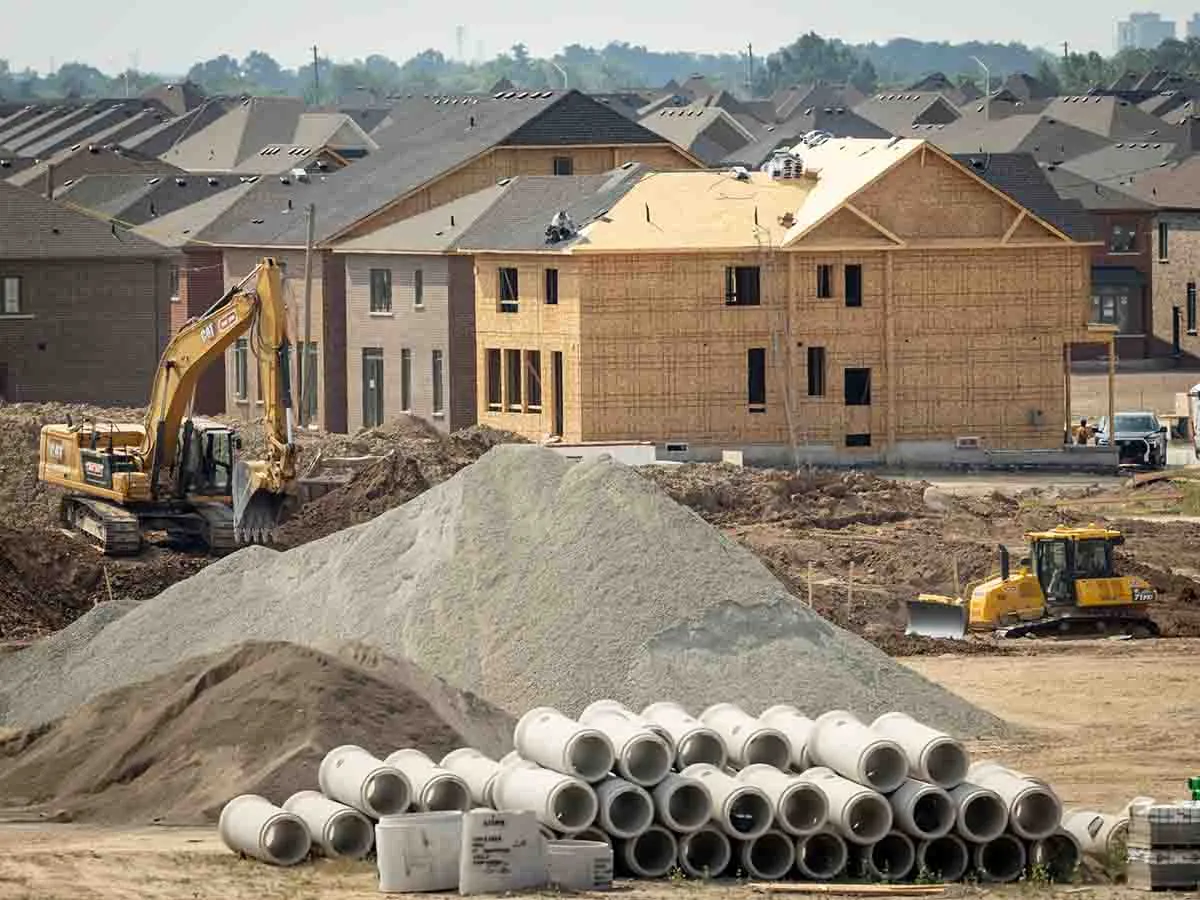
Skip to Content News Archives Economy Energy Oil & Gas Renewables Electric Vehicles Mining Commodities Agriculture Real Estate Mortgages Mortgage Rates Finance Banking Insurance Fintech Cryptocurrency Work Wealth Smart Money Wealth Management Investor Personal Finance Family Finance Retirement Taxes High Net Worth FP Comment Executive Women Puzzmo Newsletters Financial Times Business Essentials More Innovation Information Technology FP500 Podcasts Small Business Lives Told Tails Told Shopping Financial Post Store Obituaries Place a Notice Advertising Advertising With Us Advertising Solutions Postmedia Ad Manager Sponsorship Requests Classifieds Place a Classifieds ad Working Profile Settings My Subscriptions Saved Articles My Offers Newsletters Customer Service FAQ News Economy Energy Mining Real Estate Finance Work Wealth Investor FP Comment Executive Women Puzzmo Newsletters Financial Times Business Essentials HomeNewsReal EstateA 900-home project was ready to go — then it hit a sewer problemPrivate wastewater companies see opportunity as municipalities struggle to keep pace with housing growthLast updated 44 minutes ago You can save this article by registering for free here. Or sign-in if you have an account.Federal and provincial governments continue to promise hundreds of thousands of new homes, but those homes require roads, pipes, pumping stations and treatment facilities long before anyone can move in. Photo by Tyler Kula/PostmediaHousing developer Tom Jarvis has spent more than five years trying to break ground on a 900-home development in Springwater Township, north of Barrie, Ont. The project survived planning hurdles and rezoning battles, but its biggest obstacle wasn’t local opposition or weak demand; it was a lack of municipal sewer capacity.Subscribe now to read the latest news in your city and across Canada.Exclusive articles from Barbara Shecter, Joe O'Connor, Gabriel Friedman, and others.Daily content from Financial Times, the world's leading global business publication.Unlimited online access to read articles from Financial Post, National Post and 15 news sites across Canada with one account.National Post ePaper, an electronic replica of the print edition to view on any device, share and comment on.Daily puzzles, including the New York Times Crossword.Subscribe now to read the latest news in your city and across Canada.Exclusive articles from Barbara Shecter, Joe O'Connor, Gabriel Friedman and others.Daily content from Financial Times, the world's leading global business publication.Unlimited online access to read articles from Financial Post, National Post and 15 news sites across Canada with one account.National Post ePaper, an electronic replica of the print edition to view on any device, share and comment on.Daily puzzles, including the New York Times Crossword.Create an account or sign in to continue with your reading experience.Access articles from across Canada with one account.Share your thoughts and join the conversation in the comments.Enjoy additional articles per month.Get email updates from your favourite authors.Create an account or sign in to continue with your reading experience.Access articles from across Canada with one accountShare your thoughts and join the conversation in the commentsEnjoy additional articles per monthGet email updates from your favourite authorsSign In or Create an Accountor“You can’t build a house without a foundation,” he said. “That house needs to be connected to water and sewer first.”Rather than wait 10 years for the municipality to expand its wastewater infrastructure, Jarvis is bypassing public systems entirely by partnering with Global Environmental Liquid Ltd. (GEL), a startup proposing to finance, operate and own the subdivision’s communal wastewater system. If approved, he estimates construction could begin within two years.SUBSCRIBER EXCLUSIVE: FP West: Energy Insider brings you behind the oilpatch’s closed doors with exclusive insights from insiders every Wednesday morning.By signing up you consent to receive the above newsletter from Postmedia Network Inc.A welcome email is on its way. If you don't see it, please check your junk folder.The next issue of FP West: Energy Insider will soon be in your inbox.We encountered an issue signing you up. Please try againDevelopers, municipalities and policymakers are increasingly noticing that housing growth is colliding with aging water and wastewater infrastructure, forcing difficult questions about how new expensive pieces of infrastructure will be financed, built and, ultimately, owned.For example, a $1.94-billion project in the York region north of Toronto to transport sewage to treatment facilities near Lake Ontario replaced a long-planned local treatment plant, highlighting the growing cost of traditional centralized systems as municipalities try to accommodate new housing growth.The scale of the challenge is reflected in York Regional Council’s request earlier this month for $1.74 billion in provincial government funding to help advance the multi-phase project without placing the full burden on local taxpayers.John Levie, vice-president of engineering at Ottawa-based Clearford Water Systems Inc., which designs and operates communal water and wastewater systems, said interest in decentralized servicing models has increased over the past year.He estimates inquiries from developers and other groups have jumped by roughly 40 per cent to 50 per cent, with calls increasingly focused on how alternative wastewater systems can help unlock stalled projects.Levie said he has also been contacted by several companies that had never previously worked in the sector, but are now exploring communal wastewater opportunities.“It’s usually timing,” he said. “They don’t want to wait. If a municipal plant is at capacity, they don’t want to wait 10 or 15 years; they want to start now.”Levie said municipalities across Canada face significant infrastructure deficits, particularly in smaller and rural communities, since many of the existing systems were built decades ago with government grants and tax revenues that are no longer readily available. Replacing or expanding them can carry price tags far beyond what smaller municipalities can comfortably absorb.“Something needs to be done,” he said. “You can’t have people not have water and wastewater.”Historically, municipalities have typically owned and operated water and wastewater systems. Developers would build the infrastructure to municipal standards, hand it over to local governments and recover their costs through home sales and development charges.GEL is proposing a different model by taking responsibility for financing, operating and maintaining the wastewater system rather than the municipality.The company said rates would be designed to remain comparable to existing municipal wastewater charges, although long-term costs would depend on regulatory approvals, financing arrangements and future operating expenses.“It’s not a different mousetrap,” Jarvis said. “It’s just who owns and pays for that mousetrap.”Colin Hordyk, GEL’s chief executive and a former construction industry executive, said the company was created after he repeatedly encountered similar servicing constraints on development projects.“We just kept running into wastewater capacity and drinking water capacity issues,” he said.The company said it is evaluating projects representing tens of thousands of potential housing units across Ontario, although only a handful have advanced to formal agreements.Supporters of privately owned underground infrastructure say existing regulatory safeguards already address many of the risks associated with private operation. Communal systems typically require environmental approvals and financial safeguards designed to help ensure service continues even if an operator goes bankrupt.For developers, the appeal often comes down less to cost than certainty.Municipal infrastructure expansions can require years of environmental reviews, engineering studies, funding approvals and construction, so developers can spend years carrying land while waiting for servicing decisions.“My biggest issue on two sites was the municipality had no guarantee there was going to be capacity in two, five or 10 years,” Courtland Livesley-James, GEL’s chief financial officer and vice-president of corporate development, said.Municipal officials appear increasingly willing to consider alternative approaches, although not necessarily because they favour privatization.George Cabral, deputy mayor of Springwater Township, said municipalities should retain flexibility to evaluate different servicing models depending on local circumstances.“Every municipality has unique geography, infrastructure and growth patterns,” he said. “The question shouldn’t be whether a model is public or private. The question should be whether it delivers safe, reliable, environmentally responsible infrastructure that supports housing, protects taxpayers and best serves the community.”Springwater has a long history of developers financing and constructing infrastructure that is eventually assumed by the municipality, he said, so alternative delivery models are not entirely new to the community.Communal wastewater systems have also operated for years in parts of the United States and Western Canada, including through utilities such as Epcor Utilities Inc., which provides water and wastewater services in communities across Alberta and the U.S.In Ontario, Bills 60 and 98 passed over the past year to help open the door to broader consideration of privately financed and operated communal wastewater systems. The legislation made it easier for developers to use privately operated wastewater systems in communities where municipal sewer capacity is limited.Levie said the changes reflect growing concern about the cost and complexity of expanding traditional municipal infrastructure.“Part of the reason is logistical and cost-based,” he said. “When you look at the timelines and costs associated with developing or expanding large municipal systems, they’re significant. A small-town wastewater project that might have cost $20 million or $30 million in the past can now cost $130 million or $140 million. For communities with relatively small tax bases, recovering those costs becomes very difficult.”Still, not everyone is convinced private ownership is the answer.Mike Moffatt, founding director of the Missing Middle Initiative at the University of Ottawa, said the underlying challenge is less about ownership and more about governance and risk.Smaller municipalities can struggle to finance large infrastructure projects because they face uncertainty about future growth and may lack the staff and expertise required to manage complex capital investments, but he questions whether private utility companies necessarily solve those problems.“I don’t see what problem this solves that a municipal service corporation wouldn’t,” he said.Moffatt also said private systems still require municipal approvals, environmental reviews and regulatory oversight.“It doesn’t necessarily get built faster because you still need the municipal approval,” he said.That tension highlights the broader debate emerging around infrastructure and housing.Supporters of alternative utility models say municipalities are struggling to keep pace with growth and need additional tools to unlock development. Critics counter that governments should focus on fixing the underlying regulatory and financing systems rather than creating parallel structures.What both sides largely agree on, however, is that infrastructure is becoming a larger part of the housing challenge.Federal and provincial governments continue to promise hundreds of thousands of new homes, but those homes require roads, pipes, pumping stations and treatment facilities long before anyone can move in.Whatever model ultimately prevails, Jarvis said the infrastructure challenge cannot be avoided.“Somebody has to put the capital in the ground first,” he said. Join the Conversation This website uses cookies to personalize your content (including ads), and allows us to analyze our traffic. Read more about cookies here. By continuing to use our site, you agree to our Terms of Use and Privacy Policy.
A 900-home project was ready to go — then it hit a sewer problem
Private wastewater companies see opportunity as municipalities struggle to keep pace with housing growth.
1,738 words~8 min read