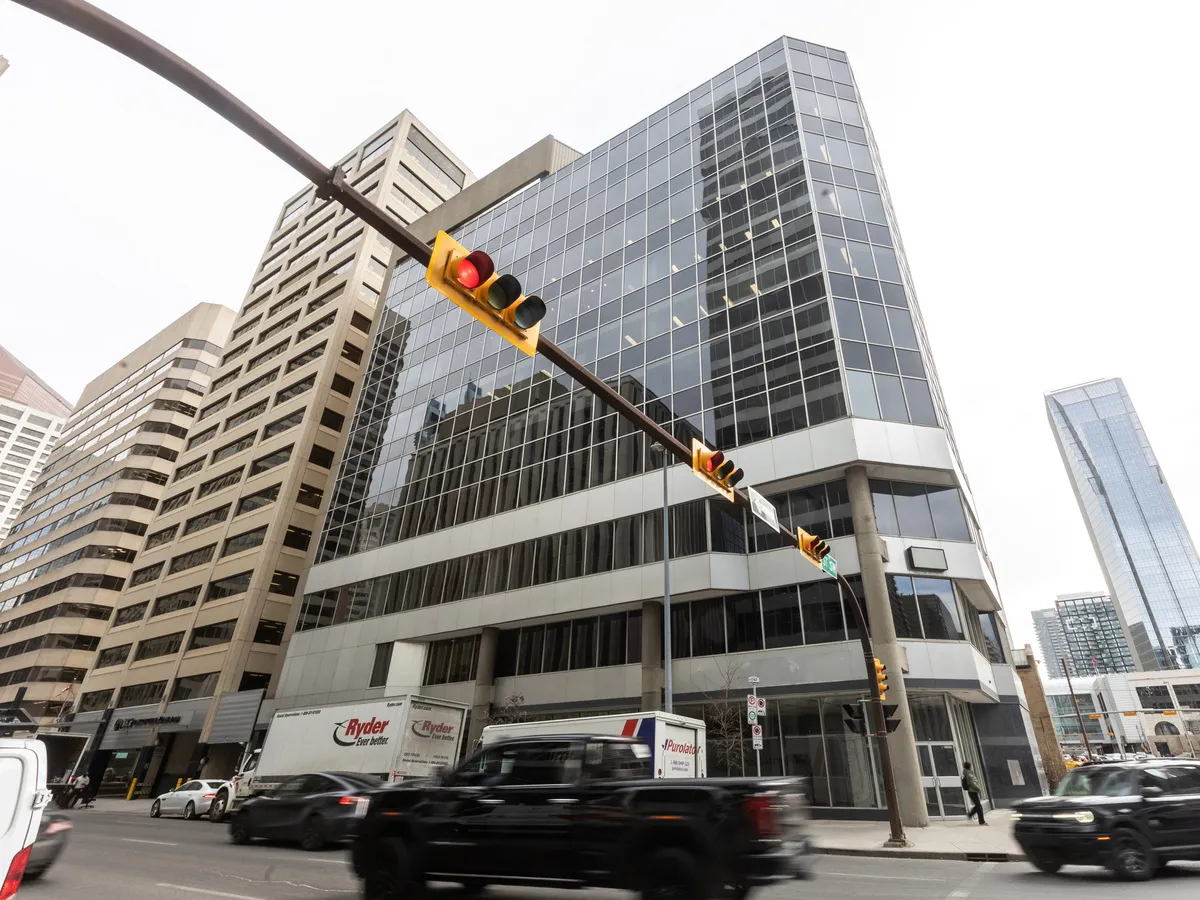
Skip to Content News Archives Economy Energy Oil & Gas Renewables Electric Vehicles Mining Commodities Agriculture Real Estate Mortgages Mortgage Rates Finance Banking Insurance Fintech Cryptocurrency Work Wealth Smart Money Wealth Management Investor Personal Finance Family Finance Retirement Taxes High Net Worth FP Comment Executive Women Puzzmo Newsletters Financial Times Business Essentials More Innovation Information Technology FP500 Podcasts Small Business Lives Told Tails Told Shopping Financial Post Store Obituaries Place a Notice Advertising Advertising With Us Advertising Solutions Postmedia Ad Manager Sponsorship Requests Classifieds Place a Classifieds ad Working Profile Settings My Subscriptions Saved Articles My Offers Newsletters Customer Service FAQ News Economy Energy Mining Real Estate Finance Work Wealth Investor FP Comment Executive Women Puzzmo Newsletters Financial Times Business Essentials HomeReal EstateCommercial Real EstateGarry Marr: Why office to residential conversions may be slowing down, even if they're still a good ideaA slowing housing market could stall projects that needed government backing to work You can save this article by registering for free here. Or sign-in if you have an account.One of downtown Calgary's latest office-to-residential conversions at the corner of 5th Avenue and 4th Street West. Photo by Brent Calver/Postmedia filesIt always seemed like the perfect match: Take older, beat-up office buildings that have been sitting half empty, or worse, since the pandemic and convert them into badly needed residential units.Subscribe now to read the latest news in your city and across Canada.Exclusive articles from Barbara Shecter, Joe O'Connor, Gabriel Friedman, and others.Daily content from Financial Times, the world's leading global business publication.Unlimited online access to read articles from Financial Post, National Post and 15 news sites across Canada with one account.National Post ePaper, an electronic replica of the print edition to view on any device, share and comment on.Daily puzzles, including the New York Times Crossword.Subscribe now to read the latest news in your city and across Canada.Exclusive articles from Barbara Shecter, Joe O'Connor, Gabriel Friedman and others.Daily content from Financial Times, the world's leading global business publication.Unlimited online access to read articles from Financial Post, National Post and 15 news sites across Canada with one account.National Post ePaper, an electronic replica of the print edition to view on any device, share and comment on.Daily puzzles, including the New York Times Crossword.Create an account or sign in to continue with your reading experience.Access articles from across Canada with one account.Share your thoughts and join the conversation in the comments.Enjoy additional articles per month.Get email updates from your favourite authors.Create an account or sign in to continue with your reading experience.Access articles from across Canada with one accountShare your thoughts and join the conversation in the commentsEnjoy additional articles per monthGet email updates from your favourite authorsSign In or Create an AccountorCanada has seen a surge in conversions in recent years as a result, but headwinds from a slumping housing market and a lagging regulatory environment are dampening some of the enthusiasm.CBRE’s latest data shows conversion activity in the second quarter pulled back after a record-setting start to 2026. The first quarter saw just over 1.8 million of office conversion and demolitions country-wide but that had dropped below 300,000 square feet in the second.SUBSCRIBER EXCLUSIVE: FP West: Energy Insider brings you behind the oilpatch’s closed doors with exclusive insights from insiders every Wednesday morning.By signing up you consent to receive the above newsletter from Postmedia Network Inc.A welcome email is on its way. If you don't see it, please check your junk folder.The next issue of FP West: Energy Insider will soon be in your inbox.We encountered an issue signing you up. Please try againMichael Hoffman, a managing director for the real estate firm based in Calgary, said that can partially be chalked up to government funding issues, something that is increasingly part of the equation, especially as rental rates decline.“The second quarter was just a slower period because the other projects that had funding had already started,” said Hoffman.Calgary, which has had some of the worst office vacancy problems in the country, has been the epicentre of the office-to-residential conversion trend in Canada. The city accounts for about 40 per cent of all conversions in the past five years.They’ve offered a grant of $75 per square foot upon completion, which makes some of the projects workable when the buildings are being purchased for $50 to $100 per square foot. Construction is about $300 to $400 per square foot.Calgary just added $25 million in funding for another phase, but in a nod to the need for conversion to other classes, higher incentives are being offered for hotel developments. Hoffman said the grants have also worked, with private capital pouring in, with $4 invested for every $1 of grant money.“I think there has been a spike in population,” said Hoffman, about why the program has worked in Calgary. “And the city providing the grant is making it successful.”While Calgary is a leader, office vacancy has been a problem across the country and is hitting downtown cores in secondary markets too.Steven Paynter, a principal and architect at Gensler, said the funding is an issue, but policy matters too, and cities across the country could be embracing conversion.“The policy here doesn’t really support conversion,” said Paynter, about Toronto. “Right now, you have to go through the rezoning process. You are judged as taking out employment land, which has to be replaced, and the process takes years. No one is going to bother doing it.”He said the three things every city needs to do are put money on the table if its needed, remove red tape and have people at city halls dedicated to the process.London, Ont., has the worst office vacancy problems in the country at 36 per cent, and Shmuel Farhi, owner of Farhi Holdings Corporation, the city’s largest commercial property owner, said revitalization is key to the downtown and can only happen with municipal support.“We can create more housing supply without extensive (new) infrastructure; we are talking millions of savings,” said Farhi, adding London’s subsidy was about $50,000 per conversion but it’s back to $35,000 because funding from the federal government dried up.The drop in funding comes as the federal government continues to commit more money to housing, which could be targeted at conversions. Farhi said the conversions, which require extensive changes to plumbing and electricity, are not feasible without the money.“When municipalities provide incentives, it typically increases property value, and the building is more likely to increase the assessment, and that will mean more taxes,” said Farhi. “The city will make more money. You will get a stronger tax base over time.”Robert Bernard, chief executive of Toboggan Flats, which is looking to redevelop office space in Ottawa, Calgary and Toronto into co-living space, said another key advantage is the timeline.He believes it is possible to convert and occupy a building in two years, a fraction of the time needed to build a new building. That short time window also creates cost certainty in a sector where construction prices have risen steeply.“We are looking for buildings with mechanical and electrical systems we can reuse. We are looking for buildings for young professionals. And the nice thing about these office buildings is they are near employers,” said Bernard, whose buildings take advantage of the interior space in old office buildings with large floor plates by converting that space into community space as part of the co-living model.One things that may have stalled conversions in Canada is that office valuations haven’t corrected enough to make projects work, as they have in New York City.“It’s like the five stages of grief, and right now a lot of owners in Canada are in the denial stage. They went through this stage in New York and Chicago (but in Canada) people say, ‘I know my building is empty, but it will get better’,” said Gensler’s Paynter.New York, meanwhile, is grappling with a different dilemma. In July, a retrofit of a building on East 42nd Street in which additional floors were added led to fears the building might collapse. Two other projects were temporarily halted in the following weeks, as city officials scrutinized other sites. While cities such Calgary still have plenty of vacant space to work with without the need to engage in more complex projects, the New York experience showed there may be limits to how far you can push a conversion.Paynter suggests conversions will continue to be driven by the reality that vacant sites are getting harder to find.But developers like Hugh Gorman, chief executive of Ottawa-based Colonnade BridgePort, said the risk profile for conversion will always attract different players than a new ground-up project, which his company has focused on.“For the risk-reward, we think conversion yields are close to new development, but we know that better,” said Gorman, adding that demolition costs are high enough that empty lots make more sense for development. Tearing down an office building is rarely an option from a cost perspective.The opportunities for conversions are going to be in the older B and C class buildings even if development plateaus for a bit, predicts Mary Rowe, president and chief executive of the Canadian Urban Institute.As more people have continued to work from home, the higher-tier A space has become readily available for companies looking to lease new space.Rowe said the biggest question for people redesigning the buildings is which ones can be converted the most easily.“Those B and C buildings are just up for grabs, and that’s why so many are available.” Join the Conversation This website uses cookies to personalize your content (including ads), and allows us to analyze our traffic. Read more about cookies here. By continuing to use our site, you agree to our Terms of Use and Privacy Policy.
Garry Marr: Why office to residential conversions may be slowing down, even if they're still a good idea
A slowing housing market could stall office to residential conversion projects that needed government backing to work. Find out more.
TL;DRAI
Canadian office conversions fell 83% Q2 2026 (1.8M sqft→300k sqft), with Calgary's $75/sqft grants accounting for 40% of activity. Regulatory delays and housing slowdown are killing momentum despite $4 private capital for every $1 government grant.
1,616 words~7 min read