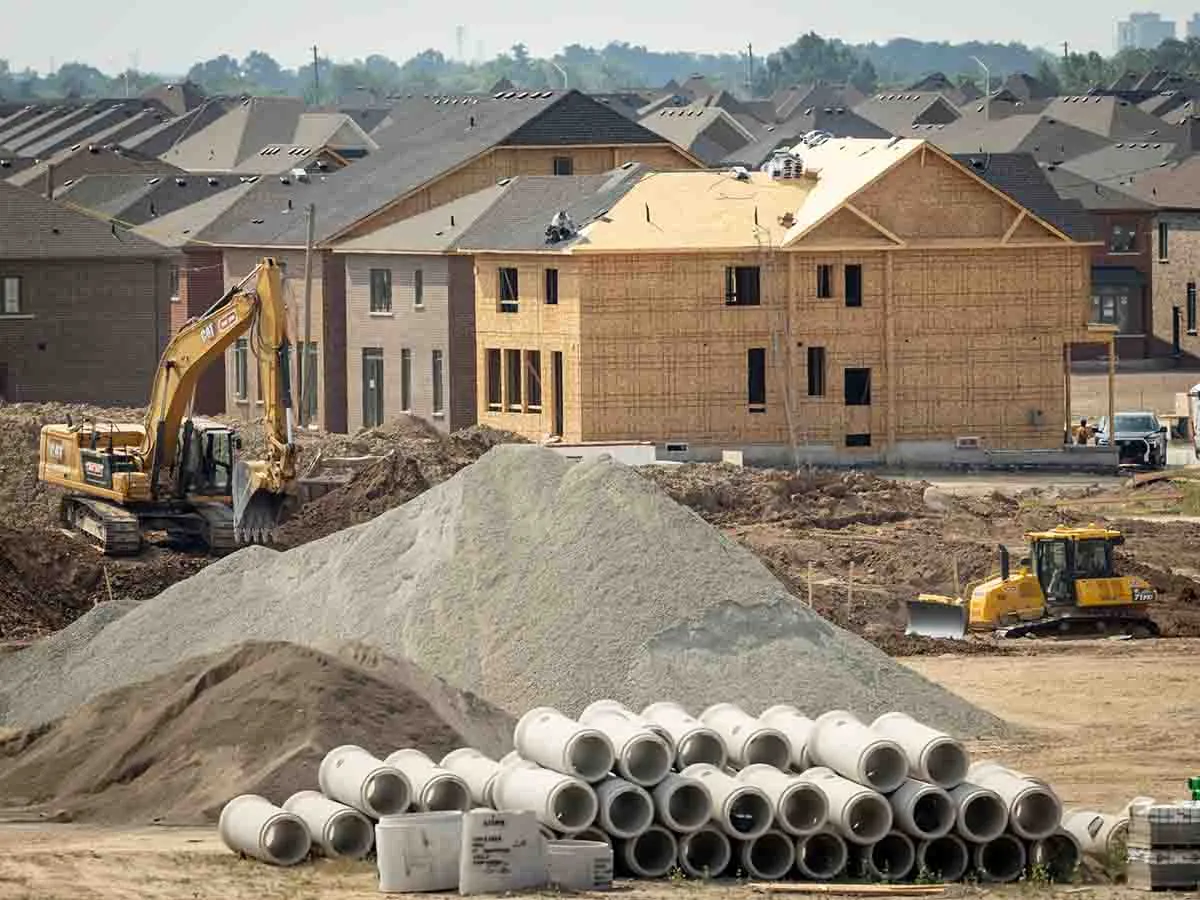
Skip to Content News Archives Economy Energy Oil & Gas Renewables Electric Vehicles Mining Commodities Agriculture Real Estate Mortgages Mortgage Rates Finance Banking Insurance Fintech Cryptocurrency Work Wealth Smart Money Wealth Management Investor Personal Finance Family Finance Retirement Taxes High Net Worth FP Comment Executive Women Puzzmo Newsletters Financial Times Business Essentials More Innovation Information Technology FP500 Podcasts Small Business Lives Told Tails Told Shopping Financial Post Store Obituaries Place a Notice Advertising Advertising With Us Advertising Solutions Postmedia Ad Manager Sponsorship Requests Classifieds Place a Classifieds ad Working Profile Settings My Subscriptions Saved Articles My Offers Newsletters Customer Service FAQ News Economy Energy Mining Real Estate Finance Work Wealth Investor FP Comment Executive Women Puzzmo Newsletters Financial Times Business Essentials HomeNewsHousing projects are piling up across Canada as the pipes underneath can't keep upAging water and wastewater systems are emerging as one of the country’s biggest constraints on housing constructionLast updated 1 hour ago You can save this article by registering for free here. Or sign-in if you have an account.Construction pushes ahead at a housing development in Milton, Ont., but elsewhere across the country developers are hitting roadblocks in the form of out-date-and inadequate infrastructure. Photo by Peter Power /Postmedia NewsQuebec developer Francis Roy has worked for six years toward what was supposed to become one of the province’s largest residential projects. His company, Groupe Humaco Inc., assembled land in Lévis, across the St. Lawrence River from Quebec City, negotiated with the municipality and signed an infrastructure agreement in 2020.Subscribe now to read the latest news in your city and across Canada.Exclusive articles from Barbara Shecter, Joe O'Connor, Gabriel Friedman, and others.Daily content from Financial Times, the world's leading global business publication.Unlimited online access to read articles from Financial Post, National Post and 15 news sites across Canada with one account.National Post ePaper, an electronic replica of the print edition to view on any device, share and comment on.Daily puzzles, including the New York Times Crossword.Subscribe now to read the latest news in your city and across Canada.Exclusive articles from Barbara Shecter, Joe O'Connor, Gabriel Friedman and others.Daily content from Financial Times, the world's leading global business publication.Unlimited online access to read articles from Financial Post, National Post and 15 news sites across Canada with one account.National Post ePaper, an electronic replica of the print edition to view on any device, share and comment on.Daily puzzles, including the New York Times Crossword.Create an account or sign in to continue with your reading experience.Access articles from across Canada with one account.Share your thoughts and join the conversation in the comments.Enjoy additional articles per month.Get email updates from your favourite authors.Create an account or sign in to continue with your reading experience.Access articles from across Canada with one accountShare your thoughts and join the conversation in the commentsEnjoy additional articles per monthGet email updates from your favourite authorsSign In or Create an AccountorIt invested tens of millions of dollars preparing the site for an approximately $800-million mixed-use neighbourhood that would feature about a dozen buildings, including seven multiresidential complexes with roughly 1,800 housing units.Today, the roads are in place, the underground infrastructure has been installed and the development is ready to move forward. The only thing missing is permission to build.Breaking business news, incisive views, must-reads and market signals. Weekdays by 9 a.m.By signing up you consent to receive the above newsletter from Postmedia Network Inc.A welcome email is on its way. If you don't see it, please check your junk folder.The next issue of Posthaste will soon be in your inbox.We encountered an issue signing you up. Please try againBefore Roy’s company could get building permits, the city imposed a moratorium after its wastewater treatment system reached its capacity, leaving his project stalled while officials work on expanding the aging infrastructure needed to serve it.Construction executives, municipal engineers and developers say aging water and wastewater systems are emerging as one of the country’s biggest constraints on housing construction, leaving approved projects to possibly sit idle for years while improvements are made. As a result, new homes do not reach the market and developers face added carrying and financing costs that may ultimately be reflected in consumer housing prices.“It’s a huge impact on developers like me,” Roy said. “We invested a lot of money and now it’s stuck there. Even though I want to take that money and go somewhere else where they have the infrastructure, I just can’t.”We invested a lot of money and now it's stuck thereCanada has about $555-billion worth of wastewater, drinking water and solid waste infrastructure, according to Statistics Canada estimates. As of 2022, roughly $65.6 billion — about 12 per cent — was in poor or very poor condition.In Roy’s case, the moratorium on new developments has dragged on, and could continue to do so for several more years, he said. Following the freeze, Groupe Humaco joined three other developers in a lawsuit seeking more than $30 million in damages from the municipality.In the meantime, Roy’s company is left with tens of millions of dollars tied up in a project it cannot build, preventing it from moving that capital into other housing developments where municipalities have the treatment plants, pumping stations and sewer networks to accommodate a surge in population growth.That might be difficult in Quebec, since 43 municipalities imposed construction moratoriums in 2025 because their water or wastewater systems lacked sufficient capacity, preventing more than 36,000 housing units from being built., according to a report by Quebec economic consulting firm Aviseo in March.The report estimated it would cost $49 billion to replace Quebec’s water infrastructure that is at high or very high risk of failure, including associated road surfaces. It concluded that aging municipal water infrastructure has become a “structural obstacle” to residential development at a time when housing demand has never been higher.The issue is not confined to Quebec. The Region of Waterloo in Ontario last week eased a development freeze affecting roughly 5,000 homes. Halifax is investing billions to expand its water and wastewater infrastructure as rapid growth strains existing capacity. Winnipeg is racing to complete major upgrades before a projected 2029 wastewater capacity deadline that could halt housing development across much of the capital region.“It’s been a problem for many years,” Rodrigue Gilbert, president of the Canadian Construction Association, said. “Everywhere I go, somebody talks to me about the state of their housing infrastructure and the fact that projects are delayed because they just can’t support it.”While the pressures are often greatest in larger cities expected to accommodate more housing, he said the issue is also affecting smaller communities from Atlantic Canada to British Columbia.Housing infrastructure is all underground. It's not sexyGilbert said the Canadian Infrastructure Report Card, which his association co-authored, warned as far back as 2016 and again in 2019 that more than one-third of Canada’s municipal infrastructure was in fair, poor or very poor condition, identifying aging watermains, sewers and wastewater treatment systems as assets approaching a critical point.“We knew that,” he said. “It’s not a surprise for us today.”Gilbert said the issue has remained largely invisible to the public because the infrastructure sits beneath streets rather than above them.“Housing infrastructure is all underground. It’s not sexy,” he said. “We’ve never invested in it.”But the problem extends beyond simply replacing aging pipes, said Zawad Abedin, a director at the Canadian Network of Asset Managers and head of engineering for Lheidli T’enneh First Nation.Many communities, he said, have historically focused on repairing infrastructure after problems emerged rather than systematically assessing the condition of their assets, identifying which are approaching failure and planning years in advance for replacement and expansion.As a result, he said many municipalities are trying to accommodate rapid growth with infrastructure already nearing its limits.“They have the real issue of aging infrastructure and they don’t have enough money to maintain it,” Abedin said. “If something collapses, that’s a real problem. That’s putting communities in the position of not building more houses so the load doesn’t increase on the infrastructure they already have.”In Headingley, just west of Winnipeg, developer Tim Comack said one of his company’s projects has been delayed by about a year because the municipality’s wastewater treatment facility is nearing capacity.Although the subdivision has already been approved and serviced, construction of between 500 and 700 multi-family homes remains on hold until additional wastewater capacity becomes available, while single-family homes continue to move forward.Comack said another of his planned developments involving roughly 3,000 homes in nearby East St. Paul also faces wastewater constraints. But rather than wait years for upgrades, he said the company is working with the municipality to finance a connection to a neighbouring community at an upfront cost of several million dollars.The federal government has also overhauled its long-term approach to municipal infrastructure funding, replacing the decades-old Gas Tax Fund with the new Build Communities Strong Fund.Beginning in the 2026-27 fiscal year, the program will provide $51 billion over 10 years, including $3 billion annually on an ongoing basis, to support a wide range of municipal infrastructure projects, including housing-enabling infrastructure, public transit and climate adaptation.But developers such as Comack say municipalities often struggle to plan major infrastructure upgrades because they cannot be certain when funding will become available or whether it will be sufficient to meet their needs.“There’s got to be a regular stream of federal and provincial monies,” he said. “If there was a certainty of funding then a lot of these municipalities would be proceeding much more aggressively.”He estimates that wastewater and related infrastructure constraints are delaying between 5,000 and 10,000 housing units across the Winnipeg region.“It’s a reactionary process of, ‘Oops, we’re running out of capacity, now it’s time to start planning an upgrade,'” he said. “And that takes multi-years.”Gilbert said the federal government’s new infrastructure program still falls well short of what municipalities actually require.“Not even close,” he said.The deeper problem, he said, is that municipalities are responsible for roughly 60 per cent of the infrastructure needed to support housing, but have limited ability to raise the money required to replace and expand it.“Municipalities are stuck with the problem, but many just don’t have the capacity to raise money to fix it,” he said.Roy said municipalities need to make water and wastewater infrastructure a higher priority, but he also questioned whether many cities have the financial capacity to undertake projects that can cost hundreds of millions of dollars.“It’s urgent to take action,” he said. “We’re talking about hundreds of millions of dollars in cities like Lévis. Where are they going to get that money? They need support from other levels of government.” Join the Conversation This website uses cookies to personalize your content (including ads), and allows us to analyze our traffic. Read more about cookies here. By continuing to use our site, you agree to our Terms of Use and Privacy Policy.
Housing projects are piling up across Canada as the pipes underneath can't keep up
From Quebec to Manitoba, aging water and wastewater systems are delaying developments and exposing decades of underinvestment. Read on.
1,805 words~8 min read