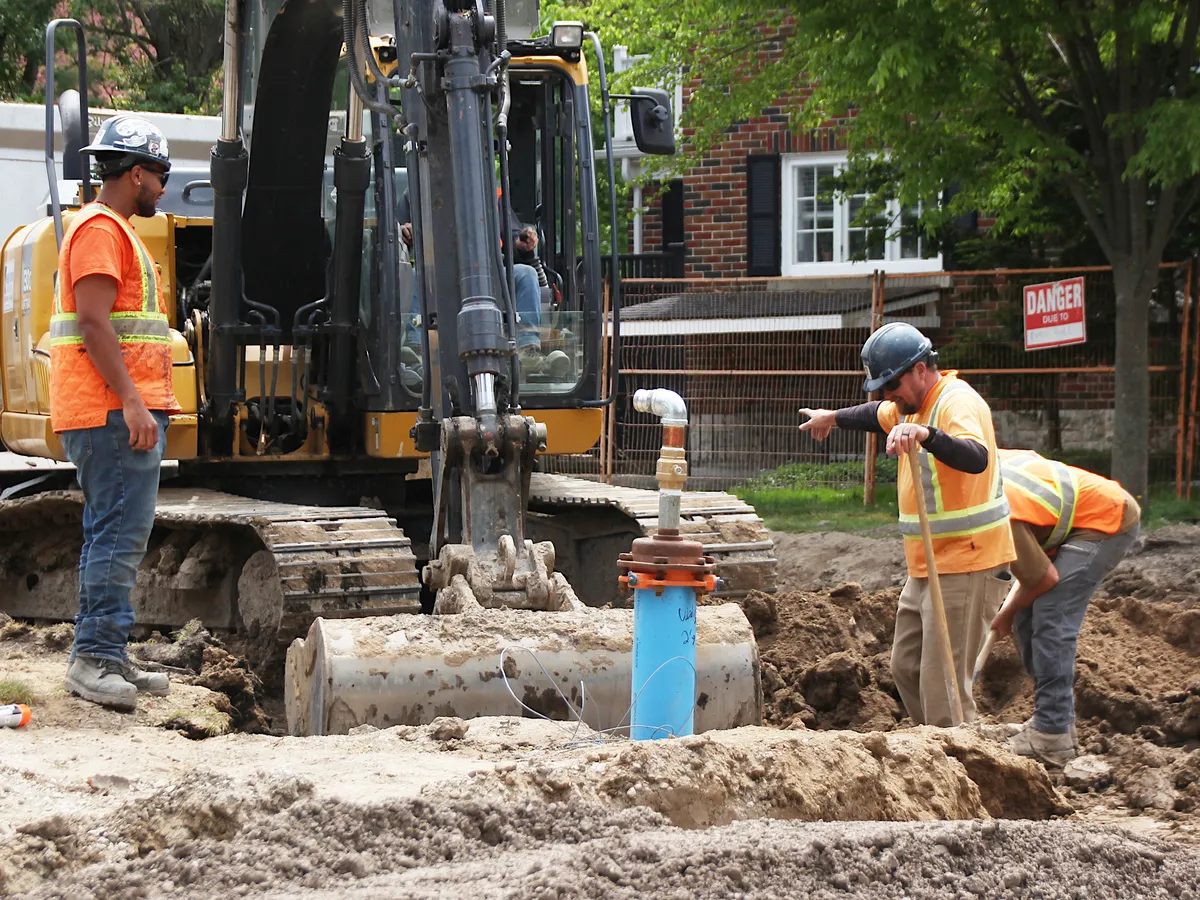
Skip to Content News Archives Economy Energy Oil & Gas Renewables Electric Vehicles Mining Commodities Agriculture Real Estate Mortgages Mortgage Rates Finance Banking Insurance Fintech Cryptocurrency Work Wealth Smart Money Wealth Management Investor Personal Finance Family Finance Retirement Taxes High Net Worth FP Comment Executive Women Puzzmo Newsletters Financial Times Business Essentials More Innovation Information Technology FP500 Podcasts Small Business Lives Told Tails Told Shopping Financial Post Store Obituaries Place a Notice Advertising Advertising With Us Advertising Solutions Postmedia Ad Manager Sponsorship Requests Classifieds Place a Classifieds ad Working Profile Settings My Subscriptions Saved Articles My Offers Newsletters Customer Service FAQ News Economy Energy Mining Real Estate Finance Work Wealth Investor FP Comment Executive Women Puzzmo Newsletters Financial Times Business Essentials HomeFP CommentOpinion: We’re mayors. Faster project approvals are critical for our citiesWe have watched as potential investors have given up waiting for firm, final OKs on their projects and gone elsewhere, often to the U.S.Last updated 6 hours ago You can save this article by registering for free here. Or sign-in if you have an account.For the skilled tradesperson waiting on a project approval, for the local business owner watching foot traffic decline, for the family deciding whether to stay or go, this is not a mere policy debate. Photo by Keith Gosse/The TelegramWe are the mayors of two cities — Sarnia, Ont., and St. John’s, N.L., respectively — whose economies depend on large industrial projects getting built. Our communities are in different parts of the country, but from both our vantage points the view has been the same for too long: seeing capital that could have come to Canada going elsewhere — not because our communities lacked the workforce or resources but because investors could not get a reliable thumbs-up from our regulatory system in a reasonable time.Subscribe now to read the latest news in your city and across Canada.Exclusive articles from Barbara Shecter, Joe O'Connor, Gabriel Friedman, and others.Daily content from Financial Times, the world's leading global business publication.Unlimited online access to read articles from Financial Post, National Post and 15 news sites across Canada with one account.National Post ePaper, an electronic replica of the print edition to view on any device, share and comment on.Daily puzzles, including the New York Times Crossword.Subscribe now to read the latest news in your city and across Canada.Exclusive articles from Barbara Shecter, Joe O'Connor, Gabriel Friedman and others.Daily content from Financial Times, the world's leading global business publication.Unlimited online access to read articles from Financial Post, National Post and 15 news sites across Canada with one account.National Post ePaper, an electronic replica of the print edition to view on any device, share and comment on.Daily puzzles, including the New York Times Crossword.Create an account or sign in to continue with your reading experience.Access articles from across Canada with one account.Share your thoughts and join the conversation in the comments.Enjoy additional articles per month.Get email updates from your favourite authors.Create an account or sign in to continue with your reading experience.Access articles from across Canada with one accountShare your thoughts and join the conversation in the commentsEnjoy additional articles per monthGet email updates from your favourite authorsSign In or Create an AccountorThat is why we feel the federal government’s recently announced consultation on streamlining legislation, regulations and processes for getting major projects approved is a welcome and timely initiative, one in which we need to go far and fast.Get the latest headlines, breaking news and columns.By signing up you consent to receive the above newsletter from Postmedia Network Inc.A welcome email is on its way. If you don't see it, please check your junk folder.The next issue of Top Stories will soon be in your inbox.We encountered an issue signing you up. Please try againOne of our cities, Sarnia, sits directly on the Canada-United States border, with Michigan visible from City Hall. Sarnia is home to multiple industrial facilities and serves as Canada’s eastern energy hub, with 26 — that is not a typo: 26 — pipelines converging on it from across North America. For years now, every investment decision, every plant expansion, every regulatory delay has helped a visible alternative just across the St. Clair River. We have watched those alternatives become more appealing as we made it harder and harder to build things in Canada. For a city of 75,000 people, the downstream consequences — in terms of lost contracts, foregone construction, tradespeople leaving and emptier main streets — are not abstract problems.Our other city, St. John’s, has lived through the full cycle of what resource development can do for a community and what its absence can’t do. Newfoundland’s offshore energy sector has been more than extractive: it has been a platform for genuine innovation, particularly in ocean technologies that are now competitive on a global stage. In recent years, however, even projects that completed the full federal review still faced unresolved uncertainty. That’s not acceptable for communities and industries that have invested appreciable time and capital doing everything the process asked of them.Ottawa’s new proposals could address these underlying failures directly. The commitment to complete federal impact assessments and permit reviews within one year — running them concurrently rather than sequentially — is a structural change that gets to the core of the problem. So are the proposals for a single project decision, a single Crown consultation and assignment of project authority to the regulatory body with the most relevant expertise.These are not shortcuts. They reflect a recognition that a complicated, multi-year approval gauntlet is not necessarily more rigorous than an efficient one, it is simply more costly. That cost ultimately is borne by communities themselves, not by the institutions administering the process.Some might argue that slowing projects down is the responsible choice, especially when important matters like the environment are at stake. Our view is that going slow is not the same as doing something right, and that delay is not the same as diligence. A process that consumes five or more years and still fails to provide certainty is not protecting the environment or advancing reconciliation. It is simply protecting the status quo.Canada should be able to conduct rigorous oversight and fulfill its duty to consult meaningfully with Indigenous peoples and still make decisions on a timeline that reflects the realities of business and capital allocation. Doing so is fundamental to this country’s ability to attract the investment it needs. For industrial communities, being able to build on a stable, regulatory foundation rather than having to relitigate first principles with every new project could change the investment calculus significantly.Our communities care about the environment and support meaningful reconciliation. We also care about creating opportunities here in Canada that allow people and communities to thrive. We do not accept the idea, advanced by some activists, that an unworkable process is more principled than a functional one. Canada can maintain high environmental and social standards and also make timely decisions. Other jurisdictions do that; we need to, as well.The federal government deserves credit for its proposals but is already facing pushback. On behalf of our citizens, we urge it to persevere. This moment calls for legislative, regulatory and policy reforms that are durable, that establish genuine accountability for timelines, and that send an unambiguous signal to the investment community that Canada means what it says.For the local business owner watching foot traffic decline, for the skilled tradesperson waiting on a project approval, for the family deciding whether to stay or go, this is not a mere policy debate. It is about whether the economic foundation of their community is maintained or instead is allowed to erode. We are too familiar with what erosion looks like. Ottawa’s reforms are a necessary and serious step toward reversing it.The government needs to have the resolve to see them through.Mike Bradley has served as mayor of Sarnia, Ontario, since 1988, Danny Breen as mayor of St. John’s, Newfoundland, since 2017. Join the Conversation This website uses cookies to personalize your content (including ads), and allows us to analyze our traffic. Read more about cookies here. By continuing to use our site, you agree to our Terms of Use and Privacy Policy.
Opinion: We’re mayors. Faster project approvals are critical for our cities
We've watched as potential investors give up waiting for firm, final OKs on their projects and gone elsewhere, often to the U.S. Read on
TL;DRAI
Questo articolo **non rientra nel profilo editoriale di Warptech Tech News** — parla di processi di approvazione industriale/energetica in Canada, senza alcun collegamento a AI, tech, startup o decisioni di stack rilevanti per un manager IT/CTO. Non riesco a scrivere una "FRASE 2: perché conta per un manager tech" senza forzare, perché non c'è rilevanza tech. Hai passato l'URL per errore, o vuoi comunque un riassunto generico dell'articolo?
1,359 words~6 min read