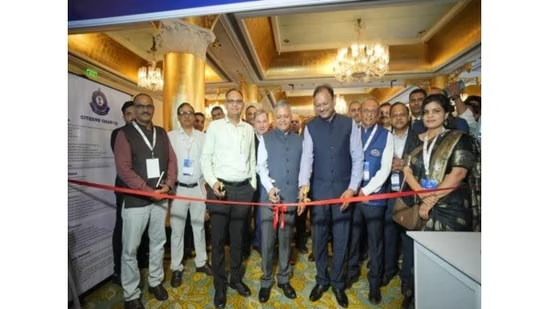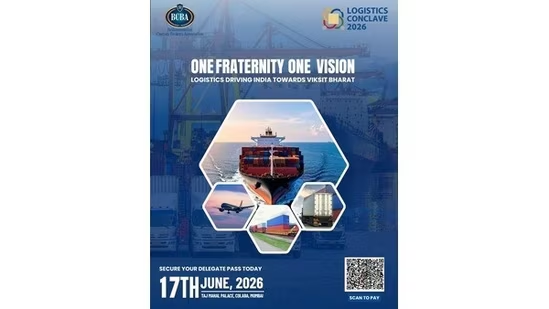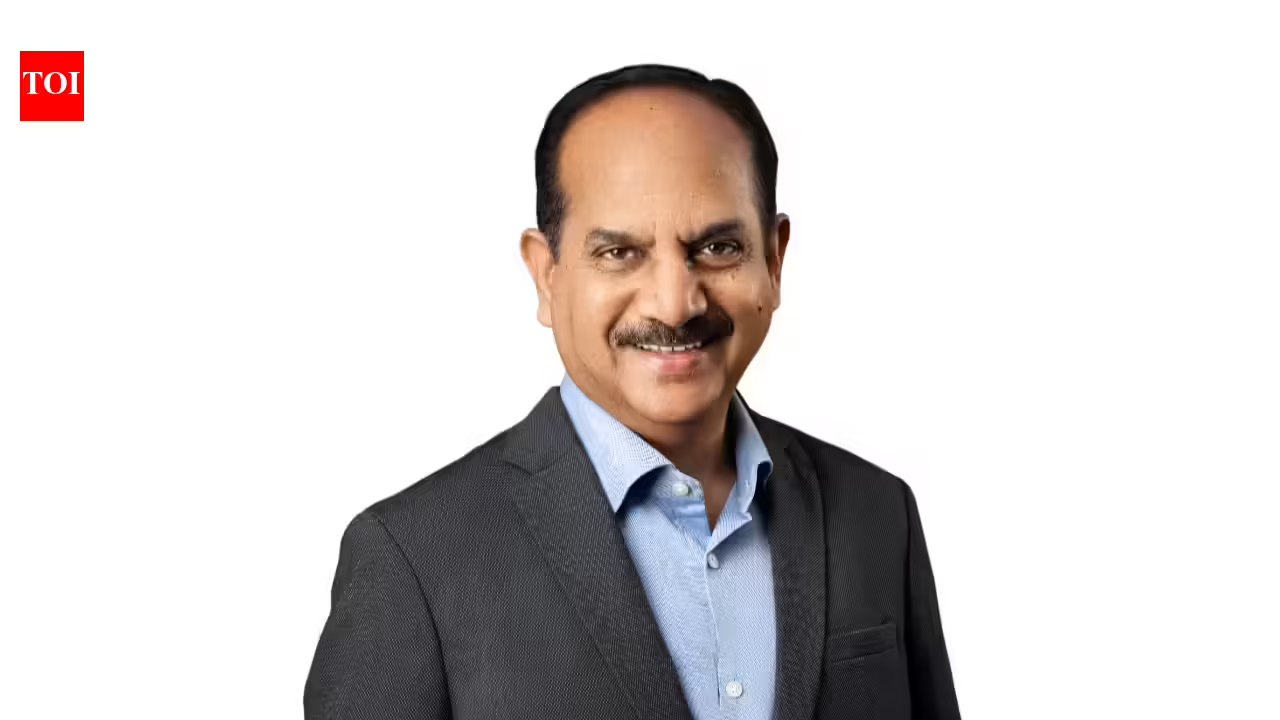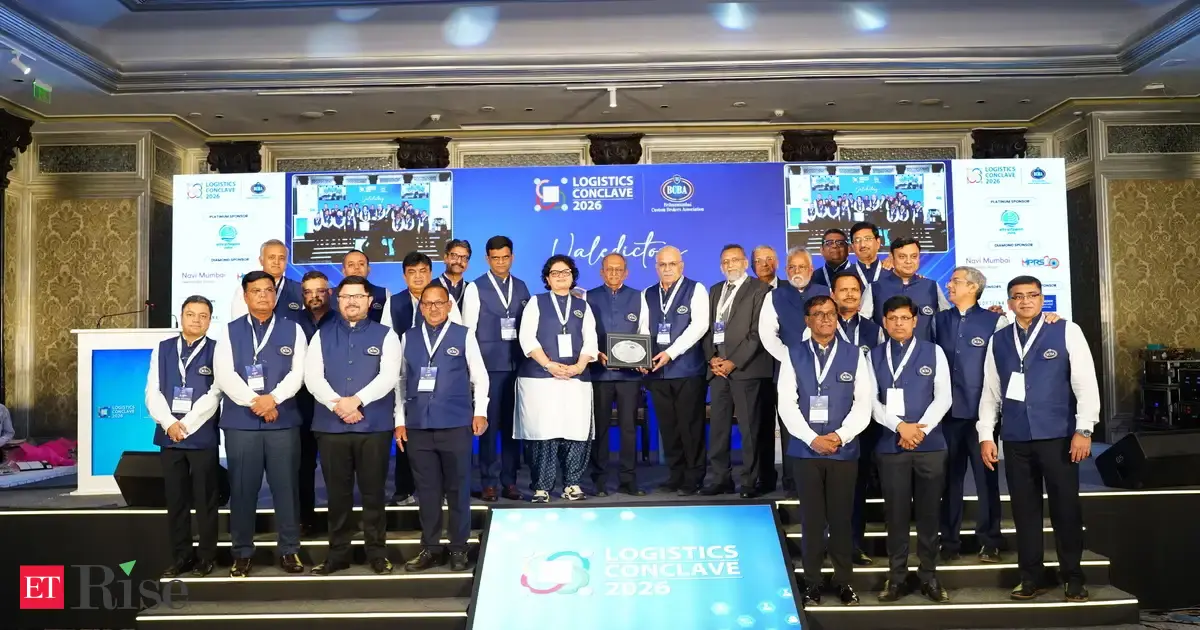
For India to achieve its ambitious export and growth goals, it requires not only top-tier infrastructure but also an efficient logistics and customs system. In a conversation with The Economic Times Digital, Sanjeev Harale, President, Paresh Thakkar, Senior Vice President, and Dushyant Mulani, Immediate Past President of the Brihanmumbai Custom Brokers' Association (BCBA) discuss their views on trade facilitation, digital transformation, policy reforms, and the opportunities and challenges influencing India's EXIM sector. Edited excerpts.Economic Times (ET): The theme of this year's conclave is “One Fraternity, One Vision — Logistics Driving India Towards Viksit Bharat.” What role do you see the logistics and customs-broking ecosystem playing in India's ambition of becoming a developed economy by 2047?Sanjeev Harale (SH): The theme of this Conclave — “One Fraternity, One Vision” — was chosen deliberately, because the road to a developed India by 2047 cannot be walked by government alone. Trade is the bloodstream of any economy, and the customs broker sits at the very point where policy meets cargo, where a nation's intent becomes a consignment that actually moves. For decades our fraternity has been the quiet backbone of India's EXIM trade, ensuring goods cross the border lawfully, swiftly and at the lowest friction. As India aspires to become a developed economy, that role only grows in importance.I see the logistics and customs-broking ecosystem as the connective tissue of Viksit Bharat. We are the interface between the importer and the exporter, the shipping line and the port, the regulator and the trade. When that interface works seamlessly, logistics cost falls, competitiveness rises, and India becomes a more trusted place to do business with.But our role is no longer only to facilitate, it is to partner. We bring ground-level intelligence that helps shape better policy; we are the first to feel where a process is breaking and the first to test what works. At BCBA, established in 1939, we have always believed that when government and trade sit at the same table as partners rather than counterparts, the entire ecosystem moves faster.ET: India has made significant progress in improving its logistics performance and ease of doing business. From BCBA's perspective, what are the biggest bottlenecks that continue to affect trade competitiveness and cargo movement?Paresh Thakkar (PT): India has made remarkable strides. Today, our logistics performance and ease of doing business have improved visibly, and the direction of travel is unmistakably positive. From BCBA's vantage, the bottlenecks that remain are no longer about the absence of infrastructure; they have migrated to the softer, systemic layer that sits on top of it.The first is procedural variation. Practices and interpretations can still differ from port to port and formation to formation, which means a process that is smooth at one location can create friction at another. Harmonisation, a genuinely uniform way of doing the same thing everywhere, is the single biggest efficiency lever still available to us.The second is the handover points between agencies. A consignment passes through customs, the port, the terminal, the shipping line and various participating government agencies. Each link may be efficient on its own, yet cargo waits in the gaps between them. It is at these interfaces, rather than within any single system, that time and cost accumulate.The third is predictability. Trade can plan around a rule it understands; what it cannot plan around is uncertainty. When requirements or assessments feel unpredictable, importers and exporters build in buffers, and those buffers are a hidden cost on competitiveness.None of these is insurmountable. They call for continued close collaboration between the department, the ports and the trade, exactly the constructive engagement BCBA has always championed. Address the seams, and India's cargo will move with the speed its infrastructure now allows.ET: Customs brokers were once seen largely as intermediaries handling documentation. How has the profession evolved, and why should customs brokers now be viewed as strategic trade-facilitation partners?SH: It is true that the customs broker was once seen narrowly-as someone who filed documents and shepherded paperwork through the system. That image belongs to another era. The profession has evolved profoundly, and so has the expertise it demands.Today's customs broker is a compliance specialist, a classification and valuation expert, a navigator of an increasingly digital and regulated border, and an adviser who helps clients structure their trade lawfully and efficiently. The volume and complexity of regulation, across multiple government agencies, free-trade agreements, and a rapidly digitising customs architecture, mean that the broker is now an indispensable knowledge partner, not a clerical one.Why should we be seen as strategic trade-facilitation partners? Because we carry a unique, ground-level view of how trade actually behaves. We are the first to know when a process is faltering, the first to surface a practical problem, and the first to test a reform on live cargo. That intelligence is invaluable to policy that has to work in the real world, not just on paper.Equally, the broker is the trade's first line of compliance. A well-informed, ethical fraternity is one of the most powerful instruments a customs administration has for clean, voluntary compliance at scale. That is why I believe the relationship must be seen as a true partnership. The customs broker is not a cost to be minimised but a partner to be engaged-a partner in trade facilitation, in compliance, and in building India's growth story.ET: The government has invested heavily in initiatives such as PM Gati Shakti, National Logistics Policy, faceless assessment, and digitization of customs processes. Which reforms have had the most tangible impact on trade, and where are the gaps that still need attention?Dushyant Mulani (DM): The government's reform agenda has been ambitious and, in important respects, genuinely transformative. If I had to point to the reforms that have moved the needle most for trade, I would highlight two strands.The first is the digitisation of customs itself. The progressive shift is the roll-out of various digitalisation measures which have touched base at the ground level to reduce processes and help improve timelines. Some of these are Online Goods Registration, online payment of charges and fees, the online module for re-assessment under Section 18A, Auto OOC and the online refund module. A mindset of comprehensive digitalisation is already being seriously pursued, with the Finance Minister's announcement in the Union Budget for the roll-out of the Customs Integrated System (CIS).The second is the strategic, whole-of-government approach to logistics that PM Gati Shakti and the National Logistics Policy represent. For the first time, infrastructure is being planned in an integrated way, with different ministries and modes brought onto a common canvas. That coordination is exactly what a country of India's scale needs, and its effects will compound over the coming decade.Considering the present global situation, it is, in the national interest, most important that we improve our time and cost efficiencies, and setting specific timelines across all processes of export and import customs clearance is crucial. Providing a centralised escalation mechanism would be an important trade-facilitation measure in case of any hold-up or bottleneck, and would also help the government receive valuable feedback from stakeholders.The other gap is participation. Reforms designed with the trade tend to land better than reforms communicated to it. The more the fraternity is brought in to co-design and test these initiatives, the faster they deliver. Get implementation and participation right, and the gains from what has already been built will be very substantial.ET: While digitization has reduced paperwork and improved transparency, many stakeholders argue that procedural complexities remain. What further changes would you like to see in customs and port operations to improve efficiency and reduce dwell times?PT: Digitisation has undoubtedly been a leap forward, less paper, more transparency, and a more honest, trackable process. But efficiency is not only a function of technology; it is a function of how processes are designed around that technology. That is where the next round of improvement lies.My first ask would be true harmonisation of procedures. Digitisation delivers its full promise only when the same rule is applied the same way everywhere — across every port, formation and ICD. Where interpretations still vary, the trade loses the very predictability that digitisation was meant to create.Second, I would focus on the interfaces between the systems, not just the systems themselves. Customs, the port community system, the terminal operators and the shipping lines each run capable platforms, yet a consignment can still wait in the spaces between them. A consignment should move as a single, seamless digital event from gate to clearance — that is what genuinely compresses dwell time.Third, I would streamline the participating-government-agency layer, so that clearances run in parallel rather than in sequence wherever possible. Sequential approvals are one of the quieter contributors to dwell time.And finally, the human dimension: as processes go faceless and automated, clear escalation and resolution channels matter more, not less. When an exception arises, the trade needs a fast, predictable way to resolve it. Get these elements right — harmonisation, interoperability, parallel processing and responsive resolution — and dwell times will fall to match the world-class infrastructure India has built.ET: Global supply chains are being reshaped by geopolitical tensions, shifting trade routes, and growing protectionism. How are these developments impacting India's EXIM sector, and what opportunities do they create for Indian logistics players?DM: We are operating in a world where trade has become statecraft. Geopolitical tension, longer and re-routed sea lanes, and a rising tide of protectionism have made global supply chains more fragmented and less predictable than at any time in recent memory. For India's EXIM sector, this is genuinely a double-edged moment.On the one hand, disruption raises costs and uncertainty. Re-routing adds time and freight, sanctions regimes complicate flows, and volatility makes planning harder for every exporter and importer. None of that should be minimised.On the other hand, this very churn is creating a once-in-a-generation opportunity for India. As global businesses actively diversify their sourcing and de-risk away from over-concentration, India stands out as a credible, scaled and trusted alternative. The wave of free-trade agreements India has concluded adds further tailwind, opening markets and lowering barriers for our exporters.For Indian logistics players, the opportunity is to become the partners of choice in that realignment. The companies that invest now in reliability, in digital capability, and in the ability to move cargo through alternative corridors with confidence are the ones who will capture these durable flows. Disruption rewards those who can offer certainty in an uncertain world.ET: India has set ambitious export targets over the coming decade. Do you believe the country's logistics infrastructure, port connectivity, and regulatory ecosystem are adequately prepared to support this growth?PT: My honest answer is one of confident optimism, tempered by realism. The foundation that has been laid over the past decade is genuinely impressive-dedicated freight corridors, an expanding network of cargo terminals, new port capacity, and a flagship deep-water port on the horizon. The hard infrastructure to support India's export ambition is, increasingly, being put in place.So, on infrastructure and port connectivity, the trajectory is strongly positive, and I believe the physical capacity to support ambitious export growth will be there. The bigger question, to my mind, is the regulatory and procedural ecosystem that rides on top of that infrastructure.This is where the real work remains. Concrete and steel give us capacity; it is the policy, the digital backbone and the predictability of process that convert that capacity into competitiveness. Two consignments, identical in every way, should have the same experience regardless of where or when they move. Achieving that consistency, which includes harmonised procedures, interoperable systems, and dependable timelines, is the decisive factor.I am encouraged that the direction is right and the intent is clear. But preparedness is not a one-time state; it is a discipline of continuous refinement, and it depends heavily on keeping the trade close as a partner in that refinement. We at BCBA see it as our role to keep surfacing where the friction is, so that the ecosystem keeps improving.ET: There is increasing discussion around integrating customs, shipping lines, freight forwarders, terminal operators, and ports through unified digital platforms. How close are we to achieving a truly seamless logistics ecosystem, and what challenges remain?DM: This is, to my mind, the defining project of the next phase, the move from many capable but separate systems to one truly seamless ecosystem. The vision is clear and widely shared: customs, ports, terminals, shipping lines and freight forwarders all speaking to one another so that a consignment flows as a single digital event. The honest assessment is that we have come a remarkable distance, and that the last stretch is the hardest.We are close in the sense that the building blocks now exist. Each major link in the chain runs a capable digital platform, and the national direction, towards integration and interoperability — is unambiguous. What remains is to make these platforms genuinely talk to one another in real time, without the trade having to bridge the gaps manually.Very importantly, the Port Community System has failed to integrate stakeholders over the past decade, and the present version of NLP Marine has also not integrated them as the trade requires. The one comprehensive and encompassing portal is ICEGATE, by CBIC, on which all stakeholders already coordinate statutorily. It is important that a robust ICEGATE platform be built on a war footing, on which every stakeholder — Customs, customs brokers, forwarders, PGAs, banks, shipping lines, ICDs, DGFT, RBI and others — can interact and transact on a single platform.The decisive ingredient, though, is co-creation. A seamless ecosystem cannot be built for the trade and handed over; it has to be built with the trade. The fraternity is ready to contribute its ground-level experience to that design. Get the collaboration right, and a truly seamless logistics ecosystem is well within reach.
India's export ambitions need more than infrastructure, says BCBA
As India pursues its economic ambitions, the customs and logistics ecosystem will play a pivotal role in enhancing trade competitiveness and enabling seamless global commerce.
2,293 words~10 min read