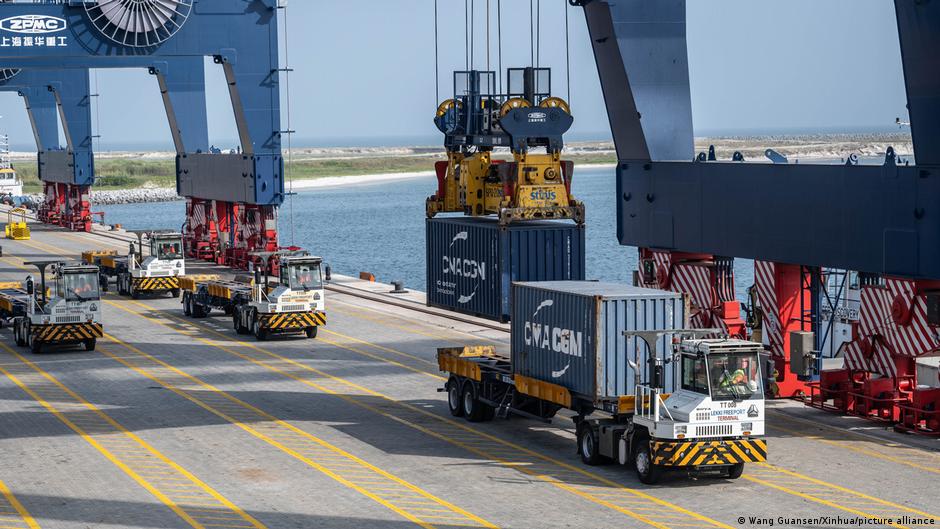
China’s decision to grant zero-percent import tariffs on goods from 53 African countries may well be a new path for strengthening globalisation at a time when it is under considerable strain. President Xi Jinping’s push to deepen ties with the Global South is an unprecedented move, especially as divisions over trade policy are widening. The US has used tariffs aggressively to reduce its trade deficits, with rates reaching as high as 100% in some cases. The result has been trade friction felt across both developed and emerging economies. In 2025, trade between China and Africa reached a record $348bn, representing an 18% year-on-year increase. This volume was heavily driven by Chinese exports, which surged to $225bn, while African exports to China grew to $123bn. This imbalance left Africa with a $102bn trade deficit. This points to the fact that China has made some serious inroads into Africa. Chinese products have become ubiquitous on the continent, while African-manufactured products are at best scant in the Chinese 1.5-billion-strong market. Against this backdrop, China, the world’s second-largest economy, has chosen a different direction, one that should be seen as an opportunity for both Africans and Chinese. Zero import tariffs make African goods cheaper for Chinese buyers, which matters because China needs to diversify its sourcing to sustain its manufacturing sector. Africa, for its part, urgently needs to broaden its export base beyond its traditional commodities. Africa-China trade has historically been concentrated in services and mining. This new policy could create a genuine opening for agricultural products, provided that African policymakers move quickly to seize the opportunity. Young entrepreneurs in particular should take note: it’s now possible to reach one of the world’s largest markets without import tax barriers, which could give many small businesses a real chance to grow. Both sides stand to gain from this collaboration, but realising that potential will require practical groundwork, starting with the establishment of formal trade missions capable of connecting players on both sides. Africa-China trade has historically been concentrated in services and mining. This new policy could create a genuine opening for agricultural products, provided that African policymakers move quickly to seize the opportunity. Not all African countries will be able to capitalise on this opportunity; the more industrialised economies, such as those of South Africa, Egypt, Morocco, Nigeria and Kenya, are better placed to benefit from China’s offering. The fact that these countries are already among the top trading partners with China means they stand to benefit more than others from the zero-percent tariff offer. Sceptics argue that China’s “win-win” proposition invariably means that China wins twice, as many African countries will not be able to meet the required standards to penetrate the well-developed Chinese market. The argument here is that China is banking on its long-term strategy of resource procurement to sustain its development amid the challenges presented by the recalibration of US trade policy with respect to African countries. Furthermore, for a great many African countries that largely depend on agrarian and mineral exports, this arrangement will invariably translate into “business as usual” without much value addition to their products. It is indeed true that even though the zero-tariff policy will assist in making some African industries more competitive for the Chinese consumer, the true battle lies in competing with other industries from across the world, ones that have already succeeded in their bid for brand recognition through years of marketing, subsidies and high-quality standards that appeal to China’s middle class. There is no doubt that this presents African countries with opportunities to rethink their trade policies over the next two years; however, severing ties with their traditional trade partners in the West would be a colossal mistake. Africans should view China’s zero-tariff regime as an opportunity to zone in on their re-industrialisation and to foster intra-African trade. • Makgetla is a political and public policy analyst at the University of Pretoria. He writes in his personal capacity.
ITUMELENG MAKGETLA | Africa must broaden its export base beyond traditional commodities
China’s zero-tariff offer could reshape the continent’s export landscape
655 words~3 min read