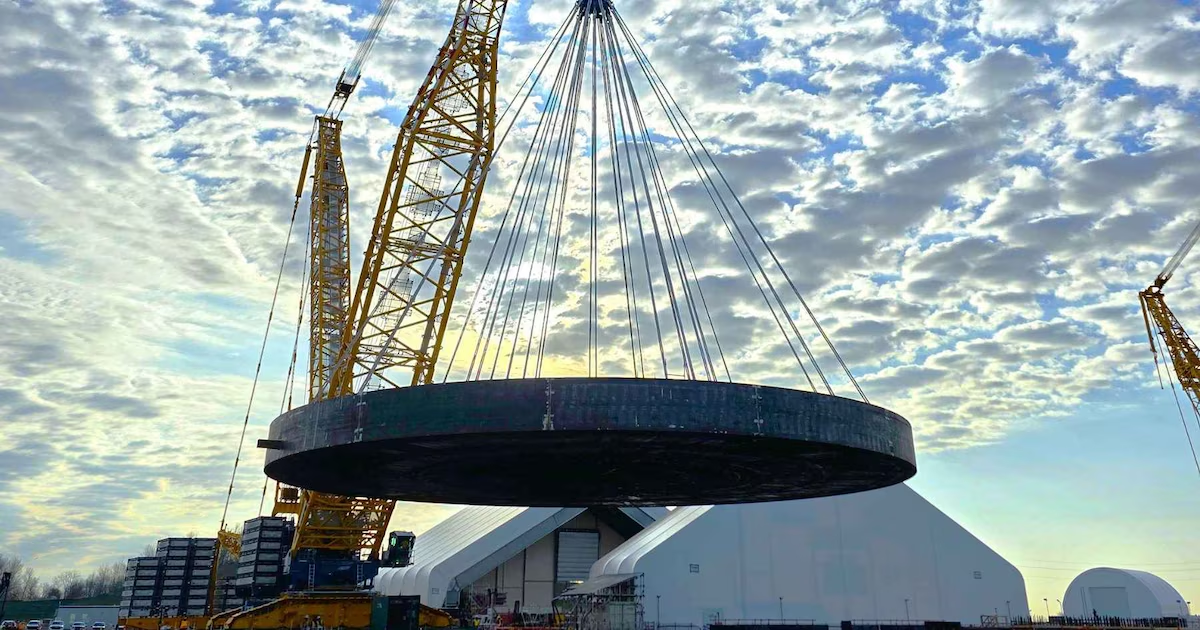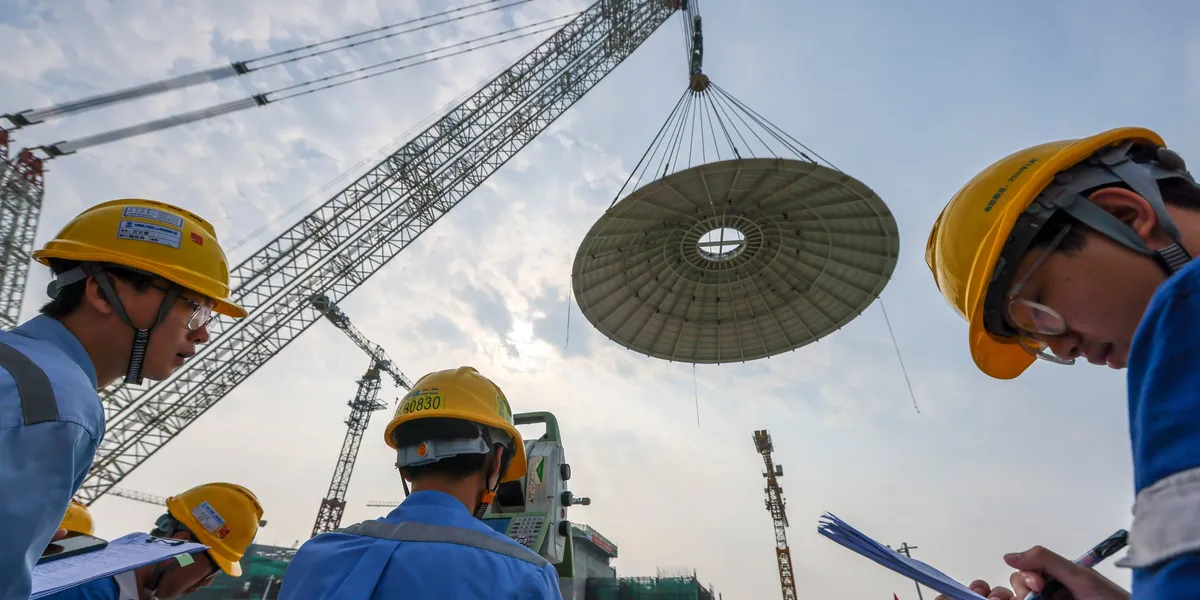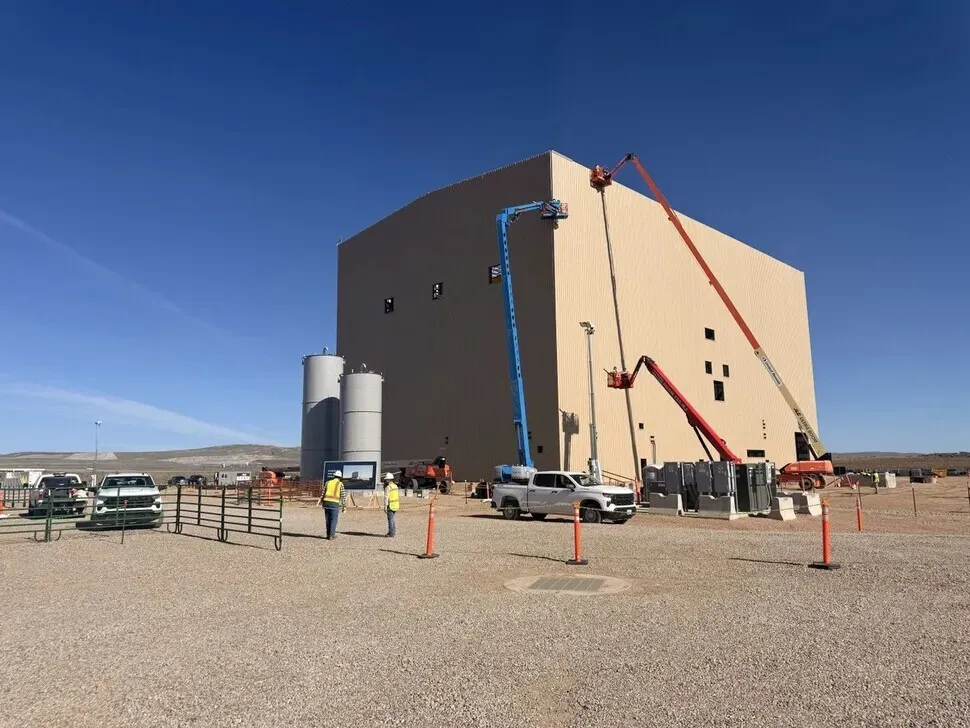
Construction has begun on the Western world’s first grid-scale Small Modular Reactor (SMR), though small is not what comes to mind, considering that the machine will fit on two soccer fields.According to AutoNotion, a 953-tonne slab of steel and concrete was lowered into a 35-meter shaft at Ontario’s Darlington New Nuclear Project site, “ending a decade of talk” about the new nuclear technology and ushering in a period of action.The slab is the base mat of the first BWRX-300 modular plant designed by GE Vernova — formerly GE Hitachi Nuclear Energy. Four units are planned for the site, each with a capacity of 300 megawatts of electricity, enough to power 300,000 homes. By comparison, Darlington’s four conventional nuclear reactors each provide 935 MW.Ontario government support for the CAD$20.9 billion project came after Ontario Power Generation received a Licence to Construct in April 2025 from the Canadian Nuclear Safety Commission. The first reactor is budgeted for CAD$7.7 billion, which includes $6.1B for the unit and another $1.6B for roads tunnels, cooling-water lines and other infrastructure shared across all four units.When completed, it will be the first commercial grid-scale SMR in the West, with an in-service target date of 2030. Russia and China already operate Small Modular Reactors, and Argentina has a pilot under construction. According to AutoNotion, the Darlington New Nuclear Project is the first one a G7 country has built and wired to a major grid.In Canada, SMRs are also considered ideal for deployment to off-grid, remote locations such as mine sites or the oil sands, as well as communities in northern Canada reliant on diesel-fueled generators for electricity.In addition to OPG, Saskatchewan’s SaskPower has expressed interest in building BWRX-300s.Some of the most advanced research on SMR technology is being conducted in New Brunswick.NB Power is currently working with two private-sector partners, ARC Clean Technology and Moltex Energy, to advance Generation IV Plus Grid-sized SMR technology for use in the Maritime province.In 2023, the New Brunswick government signed an agreement with the government of Saskatchewan to further enhance collaboration on the development and deployment of SMRs.A study by X-energy Canada has confirmed the feasibility and benefits of repurposing an existing thermal generation site in Alberta with X-energy's small modular reactors, World Nuclear News reports.In 2023, Emissions Reduction Alberta (ERA) committed $7 million for Cenovus (TSX:CVE), a Calgary-based energy company, to study the use of small modular reactors in the oil sands.While no SMRs have yet been built in the United States, the Department of Energy has announced up to $5.5B in funding.The Tennessee Valley Authority is interested in building BWRX-300s, as are companies in Poland and Estonia, The Globe and Mail reports.Meanwhile, Westinghouse, which built the world’s first commercial pressurized water reactor in Shippingport, PA, in 2023, announced the launch of a smaller version of its flagship AP1000 nuclear reactor. The unit is, like the BWRX-300, able to generate 300 MW of electricity, versus 1,200 MW for the AP1000. It is expected to be available in 2027, at a cost of USD$1 billion per unit — significantly less than the $6.8B estimated to bring an AP1000 online.An increasing number of tech companies are investing in SMR technology with the hopes of powering their high-energy-demand data centers with clean energy. The sector hopes SMR technology will be available to power several data centers by the 2030s, as their power demand grows in line with the rollout of artificial intelligence and other complex technologies. This has led Google to order seven SMRs, and Amazon, Microsoft, and Meta to follow suit.Bill Gates’s Terrapower is one of the US companies currently building SMRs. Terrapower broke ground on its first project in Wyoming in 2024 and is awaiting approval from the Nuclear Regulatory Commission, expected by the end of 2026.Further afield, France announced USD$1.1 billion to develop an SMR design.In 2025, the UK government selected aerospace company Rolls-Royce as the preferred developer of SMR technology, with over $800 million in financing from Britain’s national wealth fund. Rolls-Royce will develop its first SMR project at Wylfa on the island of Anglesey, where plans for a conventional nuclear plant were scrapped in 2020. In June, Rolls-Royce SMR was chosen by the Swedish development company Videberg Kraft to build SMRs in Sweden, marking a major multibillion-pound export deal between the U.K. and Sweden. (OIlprice.com, June 21, 2026)In the Netherlands, the nuclear startup Thorizon announced a new consortium to develop a molten salt-type SMR.The firm is currently building a 100-MW Molten Salt Reactor (MSR), Thorizon One, which it hopes to get running in a pilot plant by the mid-2030s. It expects the first prototype to be fueled by a mix of long-lived radioactive waste from existing nuclear facilities and thorium. This will transform much of the long-lived waste into short-lived waste.Facing stiff emissions reduction requirements, several countries are starting to re-assess nuclear power and are looking at building plants that are not as expensive, risky, or politically unpalatable as conventional nuclear.Generally less than 300 megawatts, SMRs are cheaper and can be built more quickly than large nuclear reactors, which are typically 1,000 MW and have a large footprint.Interest in small reactors is driven by a desire to reduce capital costs and to provide power away from large grid systems.SMRs are constructed with prefabricated modules and can be transported by truck or by rail — making them ideal for remote locations where a conventional reactor would not be feasible. Another important advantage is that they are less likely to overheat, because their small cores produce less heat than those of large reactors. They also have fewer moving parts, including coolant pumps, which reduces the likelihood of failures that could cause an accident. The fuel, steam, and generator are all in one vessel.Their small size and lower cost compared to large nuclear reactors make Small Modular Reactors more versatile, meaning significantly more utilities will be able to use them.Small nuclear reactors are also being eyed by industrial producers as carbon-free sources of heat.MSRs are powered by a radioactive solution that blends fissionable isotopes with a liquid salt. While they can be powered using uranium, they run optimally on thorium, a cleaner, safer, and more abundant nuclear fuel.AutoNotion says the BMRX-300 being built in Ontario runs on low-enriched uranium, versus Canada’s existing fleet of CANDU reactors, which run on unenriched uranium. The country does not enrich uranium domestically, meaning “the new reactors will need a fuel supply it currently has to source from elsewhere. It is a solvable problem. It is not solved yet.”By Andrew Topf for Oilprice.comMore Top Reads From Oilprice.comChina’s Teapot Refineries Cut Operations to Their Lowest Level Since 2017Adani Targets 10 GW Nuclear Power Capacity in India by 2035VLCC Earnings Near $470,000 a Day as Hormuz Hopes Drive Tanker Frenzy
Canada Building West’s First Grid-Scale SMR | OilPrice.com
Construction has begun on the Western world’s first grid-scale Small Modular Reactor (SMR), though small is not what comes to mind, considering that the machine will fit on two soccer fields.
1,121 words~5 min read