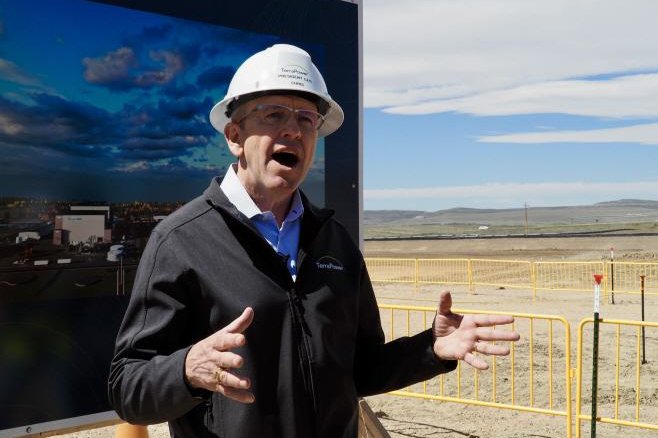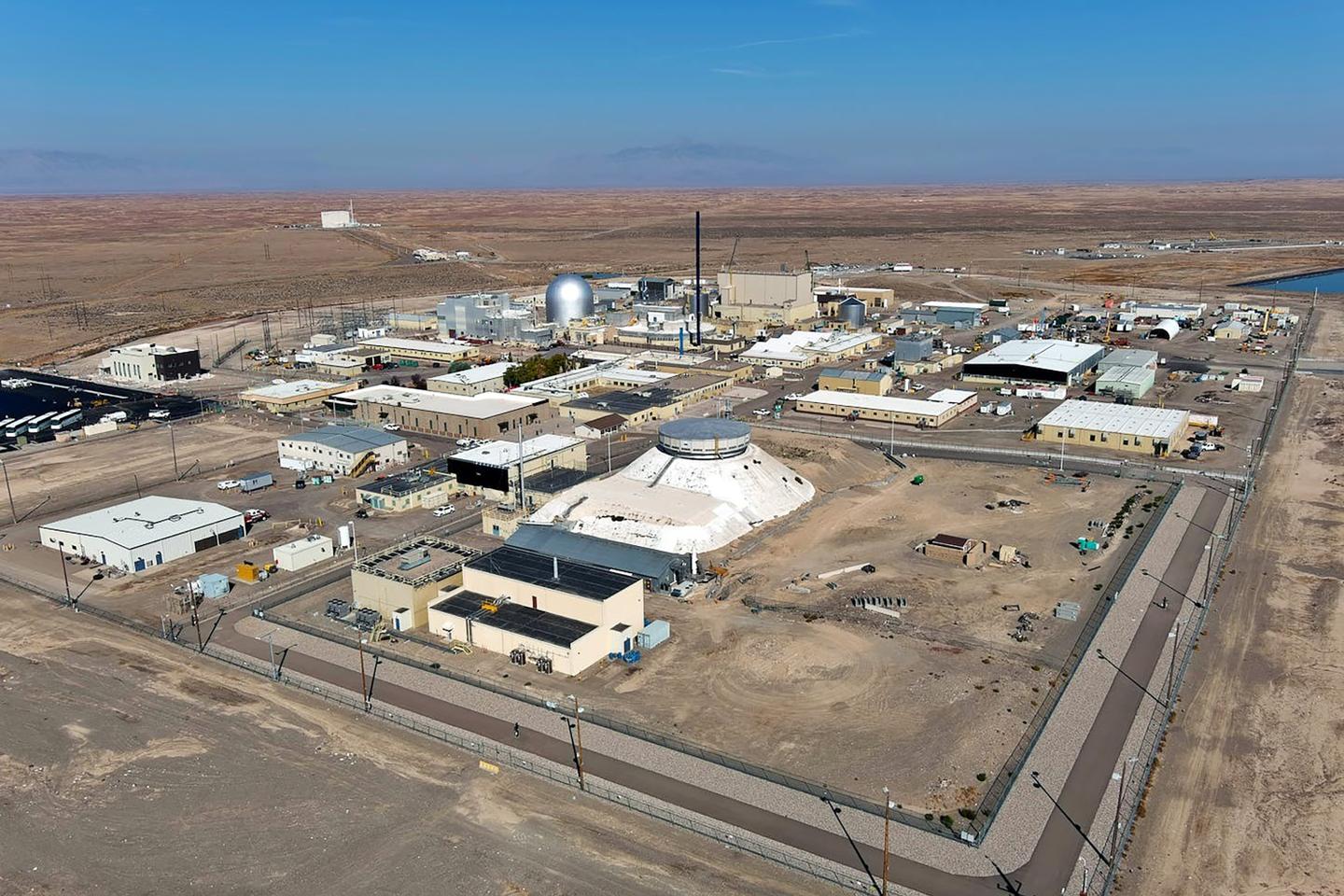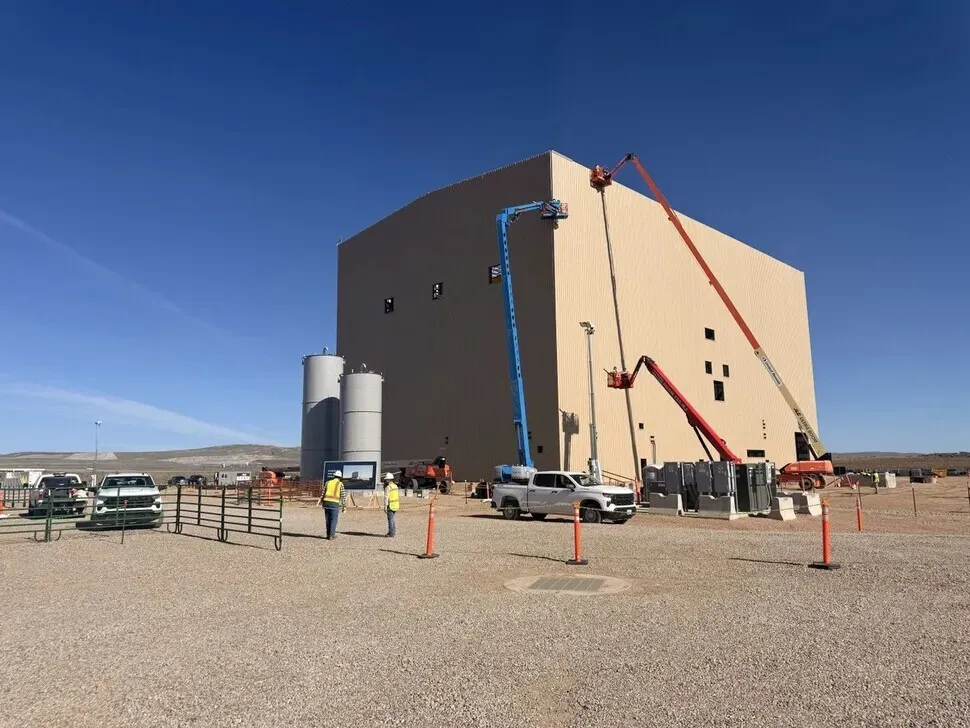
Construction of a sodium test facility was underway in Kemmerer, Wyoming, where a new small modular reactor (SMR) is being built by US nuclear energy company TerraPower. (Kim Won-chul/Hankyoreh)
On May 28, this reporter hopped onto a bus in Salt Lake City, Utah, and traveled more than two hours north to the town of Kemmerer, Wyoming. A gritty wind blew in gusts above barren fields at an elevation of 2,220 meters.A staff member offered a safety briefing on the scene. Reporters were asked to notify staff if they experienced any symptoms of altitude sickness — such as headaches, fatigue, or dizziness — or if they happened upon any arrowheads or any other cultural artifacts.It strangely felt more like a prairie homestead than the construction site of a nuclear reactor.Across the road, smoke was curling up from the stacks of the coal-powered Naughton power plant, which once sustained the local economy. A region that symbolizes the coal era is becoming a testbed for the US’ next generation of nuclear reactors.We were in Wyoming to see the construction site of Kemmerer Unit 1, a small modular reactor (SMR) being built by US nuclear energy company TerraPower. The project represents the US’ answer to the energy costs that have been rising dramatically since the onset of the artificial intelligence revolution.This past March, the company — founded by Microsoft founder Bill Gates — received a permit from the Nuclear Regulatory Commission for the first commercial SMR inside the US. This is also the first time Washington has approved a Generation IV advanced reactor, hinting at the excitement the technology has kindled.On press day, TerraPower CEO Christopher Levesque emphasized that the company’s next-generation reactors are about a thousand times safer than existing models.Levesque’s confidence is based on the fact that the new models dispense with pressurized environments and water cooling, which are the most serious flaws of today’s large reactors.TerraPower’s chosen technology is the sodium-cooled fast reactor, which uses a coolant of liquid sodium instead of water. Current light-water reactors must maintain 150 atmospheres of pressure to keep water from boiling under operating conditions, which exceed 300 degrees Celsius.Another disadvantage of the current generation of reactors is that a malfunction of the coolant system — either through burst pipes or a loss of external power — can lead to a hydrogen explosion. That’s exactly what happened during the Fukushima nuclear disaster in 2011.But since liquid sodium does not boil even at 880 degrees Celsius, it can be utilized in a low-pressure environment of a single atmosphere.TerraPower explained that since the reactor doesn’t have to be built with walls thick enough to withstand high pressure, it can be built underground, which minimizes the chances of radioactive material being released into the atmosphere.Another benefit is that the radius of the emergency planning zone around the reactor, which conventionally extends for 20-30 km, can be shrunk to 300 meters.Given SMRs’ small footprint, it should be easier to build them close to where the electricity is needed. That eliminates another downside of conventional nuclear plants: the necessity of building huge transmission towers.Slimmer and leaner, these reactors enable a shift in construction technique toward modularization.A company official explained that since the modules are manufactured in a factory and assembled on-site, the construction schedule can be shortened and costs lowered significantly. And once the repetitive construction process has been mastered, costs should come down even further.Levesque, the CEO, said that those advantages had already convinced Meta to select up to eight TerraPower reactors for its data centers. He said Meta is currently evaluating potential sites.Korean companies are key partners in TerraPower’s SMR project.In 2022, SK Innovation and SK Inc. jointly invested US$250 million in the company, becoming its second-largest shareholder. More recently, Korea Hydro & Nuclear Power joined the project by acquiring part of SK’s stake, while HD Hyundai and Doosan are among the companies supplying key components.Levesque said that while the technology originated in the United States, both the Kemmerer project and future plants would benefit from Korean manufacturing capability and technical expertise.