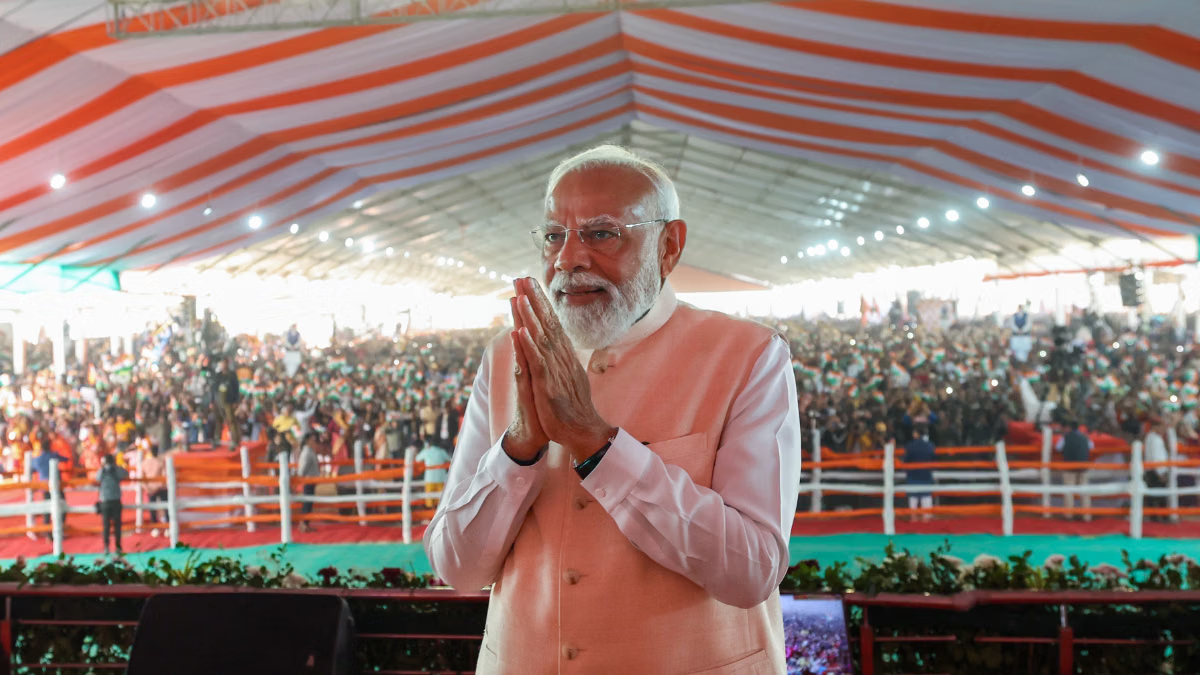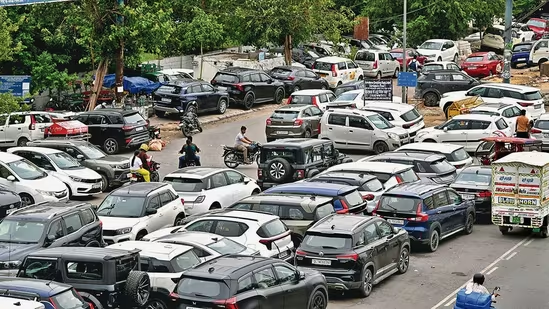
In the wake of the Iran war and surging energy prices, Prime Minister Narendra Modi appealed last month for personal restraint, asking citizens to work from home, pool car-rides, buy less gold, and defer foreign travel as a patriotic duty. A similar reflex drove Mission LiFE in 2022, with its call for mindful consumption. While governments try to avoid backlash for top-down mandates such as “no PUC (pollution under control certification), no fuel” through such appeals to individual virtue, behavioural change is impossible without institutional support. In India’s cities, that support is largely missing. For citizens constantly struggling to cope with air pollution, extreme heat, and flooding, the gap between what is demanded and enabled has rarely been wider.For citizens constantly struggling to cope with air pollution, extreme heat, and flooding, the gap between what is demanded and enabled has rarely been wider. (Sanchit Khanna/HT Photo)Indian cities have implemented monumental projects such as stadiums, sea-link roads and metro rails, but have an abysmal track record in building the essential public infrastructure that fosters sustained environmental benefits. Safe footpaths — which the Supreme Court recently declared a fundamental right — lower emissions by reducing car use and widen access to buses and metros, resulting in better job prospects for low-income workers, especially women. Paved or green kerbs and verges reduce road dust more durably than the water-sprinkling we currently see in several cities.ALSO READ | ‘Amrit Peedhi, creators of opportunities’: Developed India rests on the youth’s well-beingPublic toilets extend women’s mobility and let them hydrate enough to cope with the heat. Public parks and green spaces offer shade, lower local temperatures, reduce dust, and absorb excess runoff during flash floods.These can be termed co-benefit infrastructure. A single investment pays back at once across mobility, public health, sanitation, pollution, heat, flooding, and jobs. The returns are both substantive and expansive, well beyond what departments usually count as value for money. Co-benefit infrastructure should be among the first things a city builds.Yet, it is consistently passed over, even though it is neither expensive nor hi-tech and has already been piloted here. Take the Sanath Road redevelopment in Gurugram, which rebuilt a congested 2.5 km stretch with cycle tracks, footpaths, parking, vending, and better drainage for about ₹10.5 crore, or roughly ₹4 crore per km.In the same city, the Sohna elevated corridor linking NH-48 to the Delhi-Mumbai Expressway cost nearly ₹68 crore per km. This is no argument against expressways or other flagship projects, which a growing city needs. It is about proportion. For a fraction of the ₹10,267 crore approved for one 28.5 km metro line, all 312 km of Gurugram’s arterial and sub-arterial roads could be redesigned to the Sanath standard, at roughly ₹1,250 crore.ALSO READ | OYO-like standardisation needed for exam ecosystemThe real impediments lie elsewhere. Megaprojects are prioritised because they deliver visible financial and political rewards, from ribbon-cutting to rent-seeking, and those rewards are sustained by a mirage.We have imported an image of the world-class city as a skyline of signature projects, refreshed by the endless “exposure” visits to Dubai, Singapore, and London. Incentive and aspiration reinforce the feedback loop of failure.The mirage makes the megaproject worth a ribbon-cutting, and each ribbon-cutting makes the mirage feel more real. Yet, those who live in a city like Gurugram judge it by whether its streets drain, its footpaths are walkable, and its air is breathable. The proof of good governance lies not in the mirage, but in the quality of lived experience.Urban governance is fragmented across agencies at national, state, district and local levels, so citywide infrastructure requires collaboration led by a strong institution. Unfortunately, urban local bodies (ULBs) in India, as currently empowered, lack the mandate and political heft for this. The narrow scope of the National Clean Air Programme (NCAP) illustrates this effectively.Of the ₹13,415 crore released to 130 cities, only ₹9,929 crore has been utilised, of which over two-thirds has been spent on managing road dust through sweeping, sprinkling, paving, and greening. Industry, waste, transport, and other sources where responsibilities are distributed across departments have garnered little attention, with municipalities limiting themselves to what they imagine their capacity and authority allow.The emphasis on nudging individuals puts the onus in the wrong place. It belongs with the city’s institutions, which owe citizens a quality of life befitting one of the largest economies, with ambitions to achieve developed-country status by 2047. With urban populations swelling faster than the institutions and infrastructure meant to serve them, the cost of building the wrong things only compounds the situation.Urban citizens would be far better served if ULBs were redesigned to overcome jurisdictional fragmentation, funded to hire technical expertise, and empowered to prioritise and deliver co-benefit infrastructure. Above all, city governments must be made answerable to residents for everyday outcomes, such as whether the street floods or the bus is within reach. Change what institutions are capable of and rewarded for, and what they build will change with it.Mukta Naik is fellow, Adaptation and Resilience, and Arunesh Karkun is research lead, Environmental Governance and Policy at the Sustainable Futures Collaborative. The views expressed are personal.
Public infrastructure over mega projects: Empower India's cities to build for sustainability gains
Indian cities have implemented projects such as stadiums and metro rails, but have an abysmal track record in building the essential public infrastructure.
850 words~4 min read