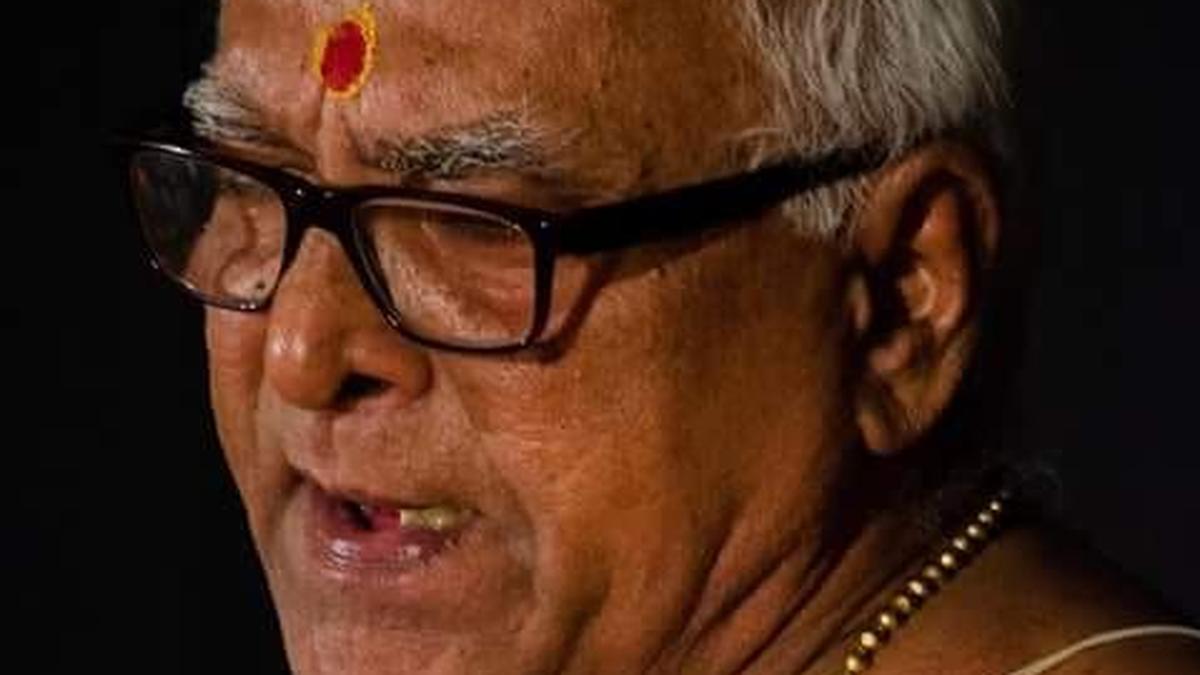
Kathakali music underwent its second wave of key reforms in the 1960s-70s, while young Madambi Subramanian Namboothiri stayed away from a surge of ornamentations his contemporaries infused into the vocals for the dance-theatre. Then in his 20s , Subramanian adhered to the conventional sensibilities of his gurus at Kalamandalam. This charted a quiet revolution against the grain. By this century, Subramanian had earned a wide reputation as a purist’s delight. According to him, Kathakali vocals do not adhere to Kerala’s Sopana Sangeetham that relies largely on plain notes. This view negates the general perception that Kathakali music primarily evolved from the Kottippadi tradition, which flourished in the state’s temples during the feudal era. “I doubt if Sopanam is a genre,” says Subramanian, without being argumentative.
Subramanian singing for Kalamandalam Gopi with Shanmukha Das.
| Photo Credit:
Special Arrangement
Subramanian cites instances of how Kathakali music, for the last 100 years, has been essentially built upon the Carnatic idiom. This substantiates certain scholarly observations that Kathakali music shares a fair degree of resemblance with the Sampradaya bhajan system of Tamil Nadu. It isn’t uncanny. After all, Subramanian’s chief tutor — Neelakantan Nambisan— pursued his advanced studies under a classical musician with ancestry in the Cauvery belt.Venkitakrishna Bhagavatar (1881-1957), who lived in the riverine Mundaya village near Shoranur across Kalamandalam, traces his familial roots to Thanjavur. His forefathers were exponents of namasankirtana renditions. Neelakantan had, as a teenager, learned under Venkitakrishnan (whose younger brother Palakkad Rama Bhagavatar was a renowned Carnatic vocalist). Soon, Carnatic music, with microtone-laden south-Indian classical loops, found their way into Kathakali music. Nambisan also trained many disciples, one of them being Madambi Subramanian, i who joined Kalamandalam as a 16-year-old in 1957. His batchmates and juniors were Sankaran Embranthiri, M. Hyderali and Venmani Haridas, who emerged as young Turks of Kathakali music, infusing a rush of romanticism that continues to define the art form’s basic spirit to this day. None in that famed trio is alive today. Madambi Subramanian, known by the name of his house at Sreekrishnapuram in Palakkad district, heads the present-day Kathakali musicians wielding the handy gong. At 85, the patriarch occasionally appears on the stage. His beats on the metallic chengila imply an anchoring quality like none other. The laghu units of the rhythmic cycles find apt enunciation with light taps in contrast to the bold beats that herald the pure-dance passages along the songs. “ Musicians lead the show. It’s a delicate task to keep time,” he points out. “The vocalists aren’t subservient to the dancers. Even so, we shouldn’t be overbearing.”