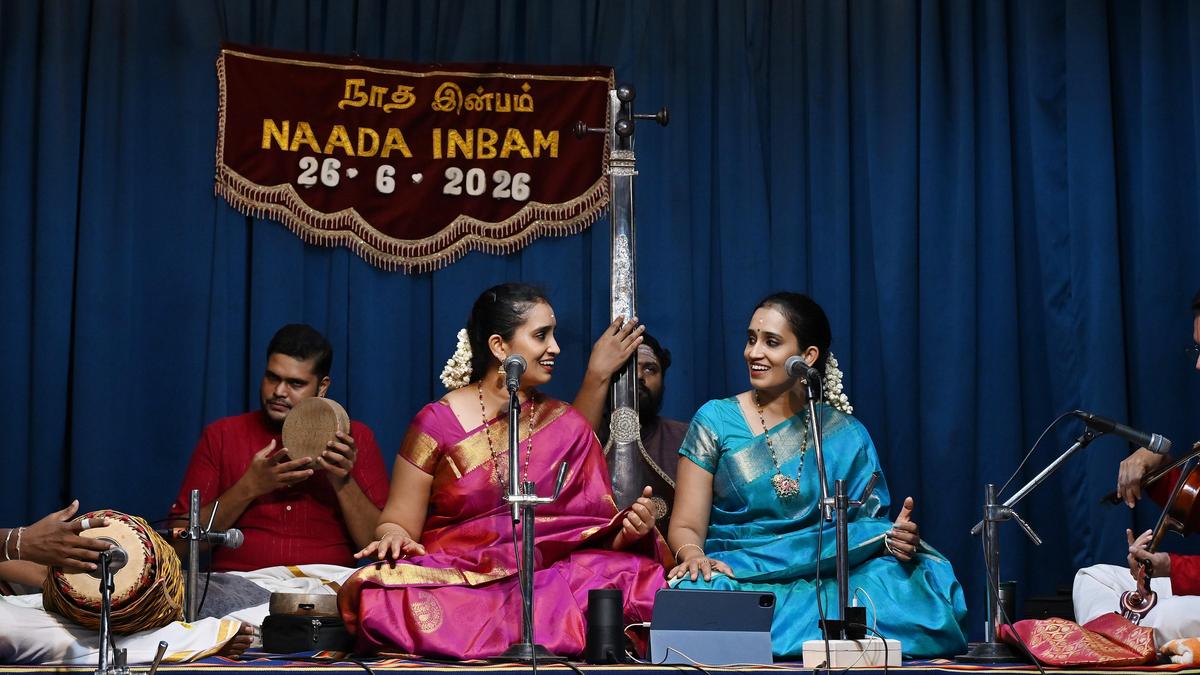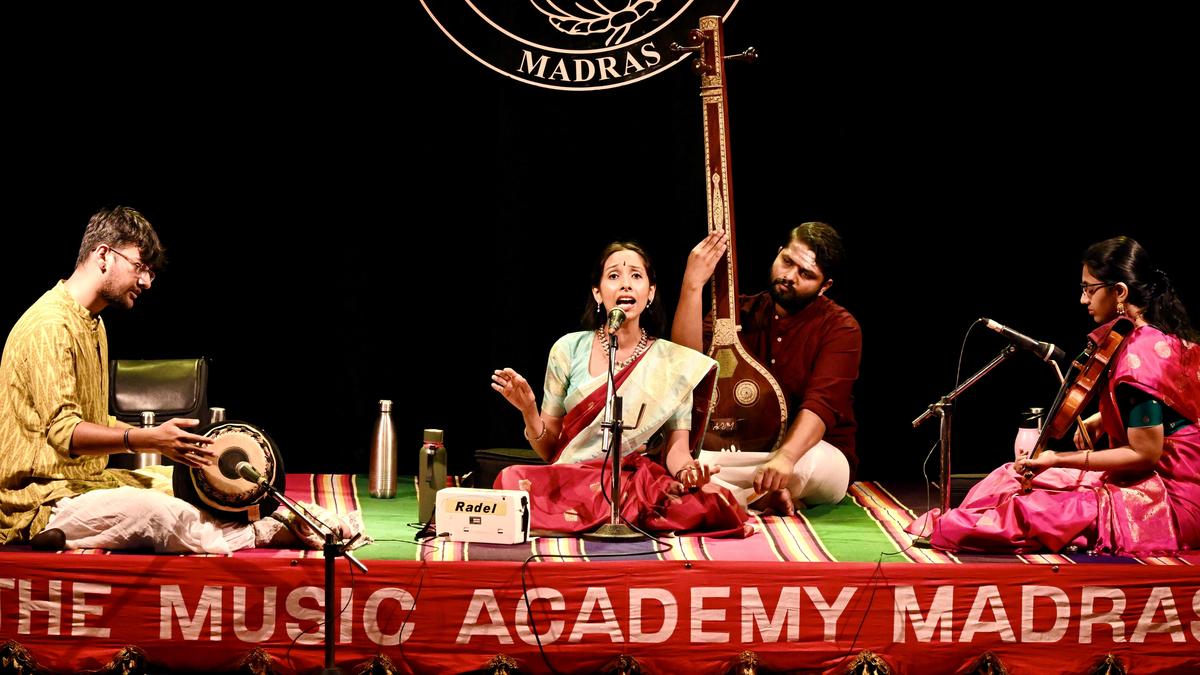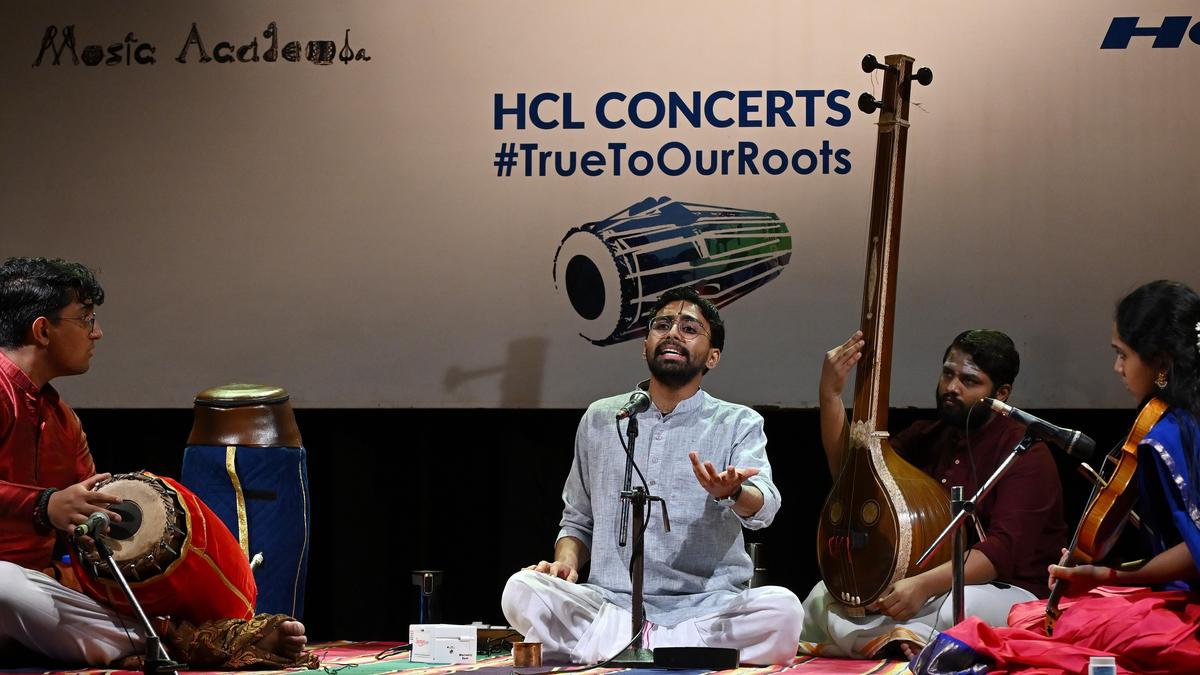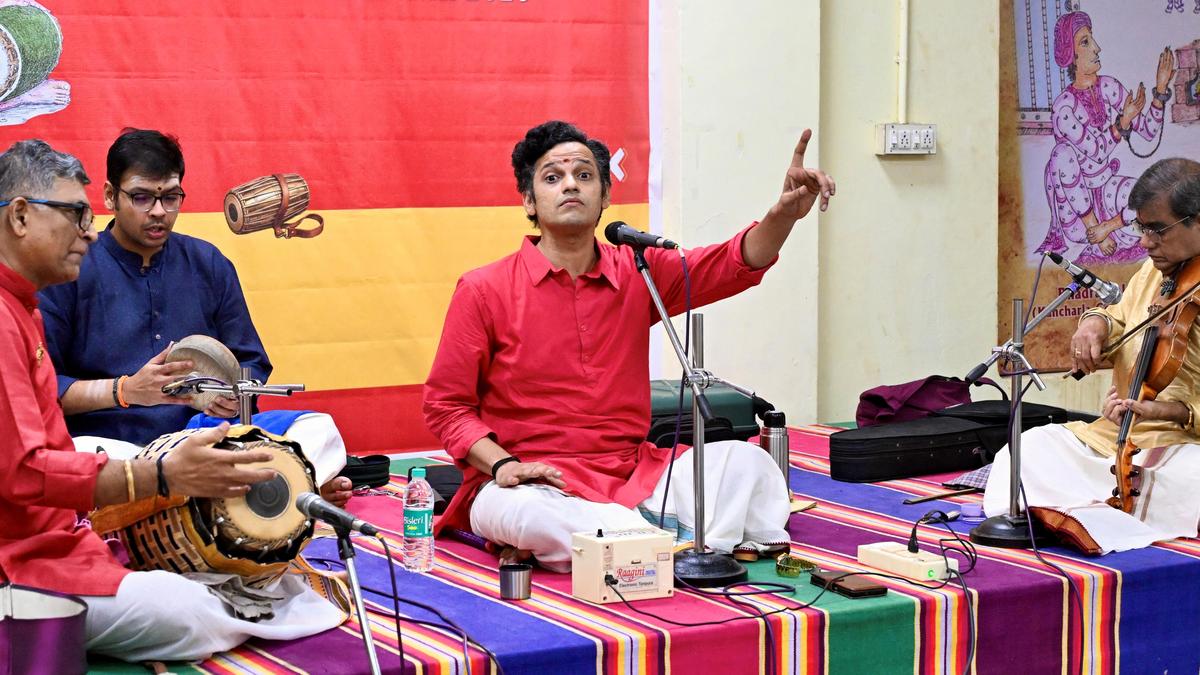
Mahadevan Sankaranarayanan (vocal) accompanied by M.R. Gopinath (violin), Melakaveri Balaji (mridangam) and Anirudh Athreya (kanjira).
| Photo Credit: S.R. Raghunathan
Pedigree can be a boon or bane. For some, it is a lifeline; for others, a burden. Most often, it is a mid-ridge from which the desired destination is visible, yet distant. T.V.S. Mahadevan, son and disciple of the legendary T.V. Sankaranarayanan, showcased the upside of his lineage through much of his vocal concert for the Chennai Fine Arts at Srinivasa Sastri Hall, in Chennai. He presented an energy-laden recital in the company of senior artistes — M.R. Gopinath on the violin and Melakaveri Balaji on the mridangam — and Anirudh Athreya on the kanjira. Mahadevan sang five of the seven kritis with striking confidence, especially in the kalpanaswara segments. But that was too many, given the contrast: there was a solitary niraval of barely three avartanams. He would also do well to curb his tendency to frequently turn away from the microphone.‘Pranatosmi devam’ on Vinayaka, a composition by Thulaseevanam, ushered in an off-beat opening, and Mahadevan capped it with a swara sequence of unhesitating flair. Swati Tirunal’s ‘Paripalaya maam’ in Ritigowla raga, Rupaka tala, followed. A kriti, whose spacious gait in the opening of the charanam and brisk ending thereof provide a pleasant contrast. A second swara burst, with glimpses of his father’s trademark passages in the top octave, completed the kriti. Kasiramakriya, the 51st raga in the asampurna mela paddhati, was the first raga explored by Mahadevan, and he developed it with clarity and elan. It was a well-rounded effort, despite a voice strain in the upper registers. Gopinath’s response was short and sweet. Dikshitar’s ‘Visalakshim visvesim’ (in Mishra Chapu tala) was the kriti chosen. Like many of the songs by the composer, this one is in the dwiteeya vibhakti (objective case), but the whole composition was sung in the nominative case as ‘Visalakshi visvesi’ (dropping the terminal ‘m’ which stands for the objective case). The pallavi is an exhortation to the mind to ‘always worship goddess Visalakshi, the ruler of the Universe’. Here, the verb leans on the object, making the use of the nominative case grammatically incorrect and contrary to authentic sources. It is surprising that even some of the well-known artistes have adopted this version. The snappy niraval at ‘Kasi rajnim kapalinim’ in the samashti charanam also followed the same course, without the ‘m’.