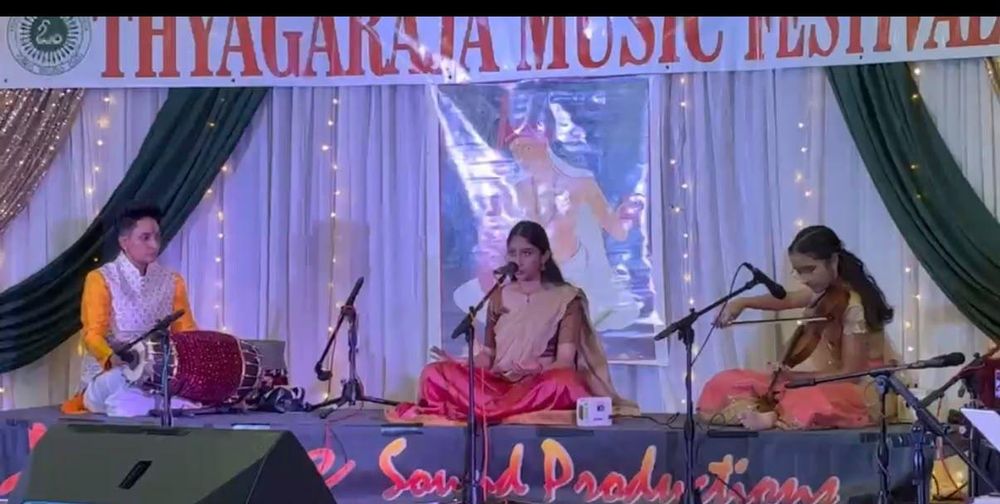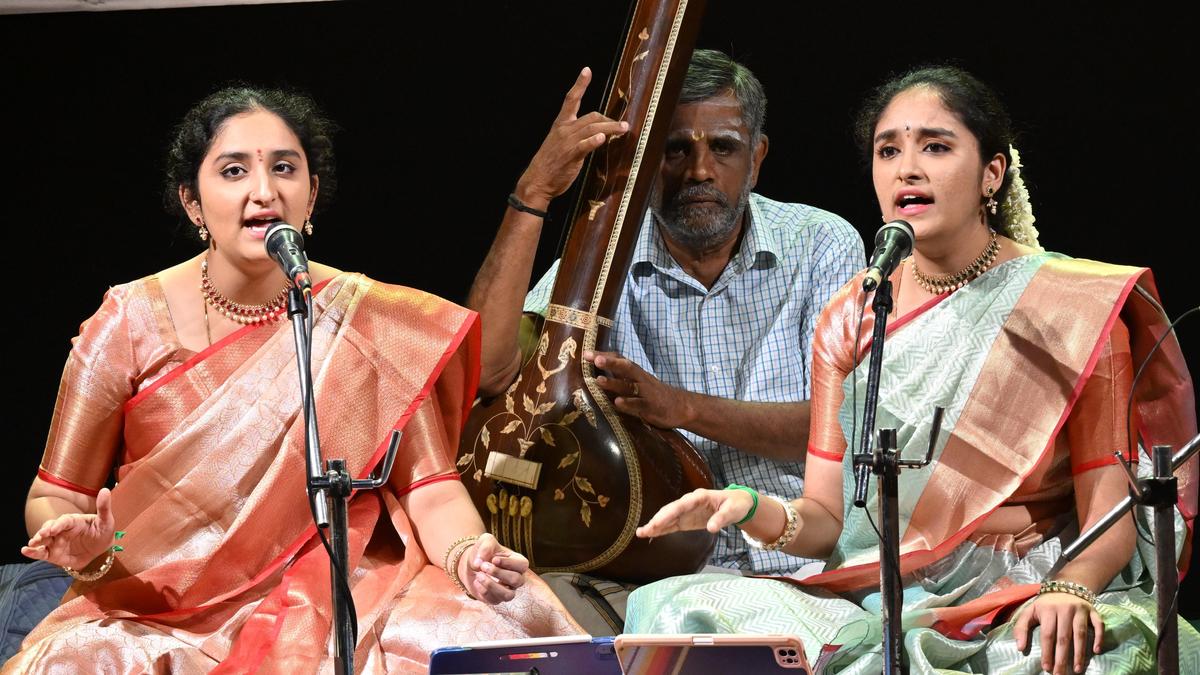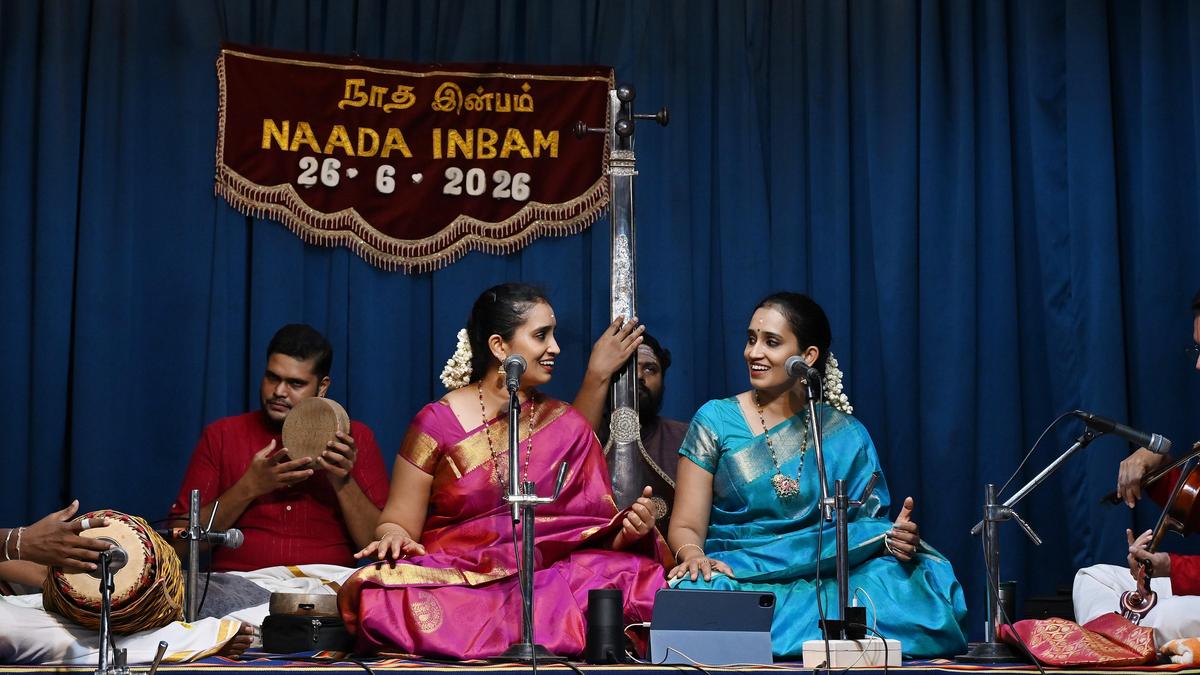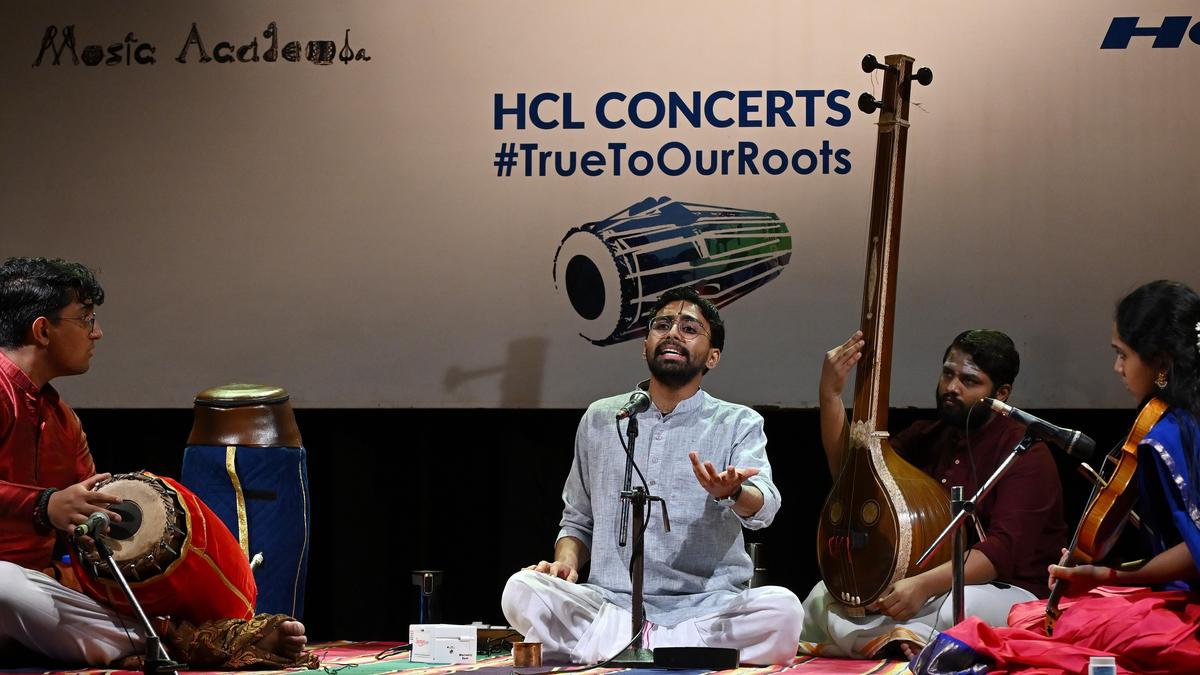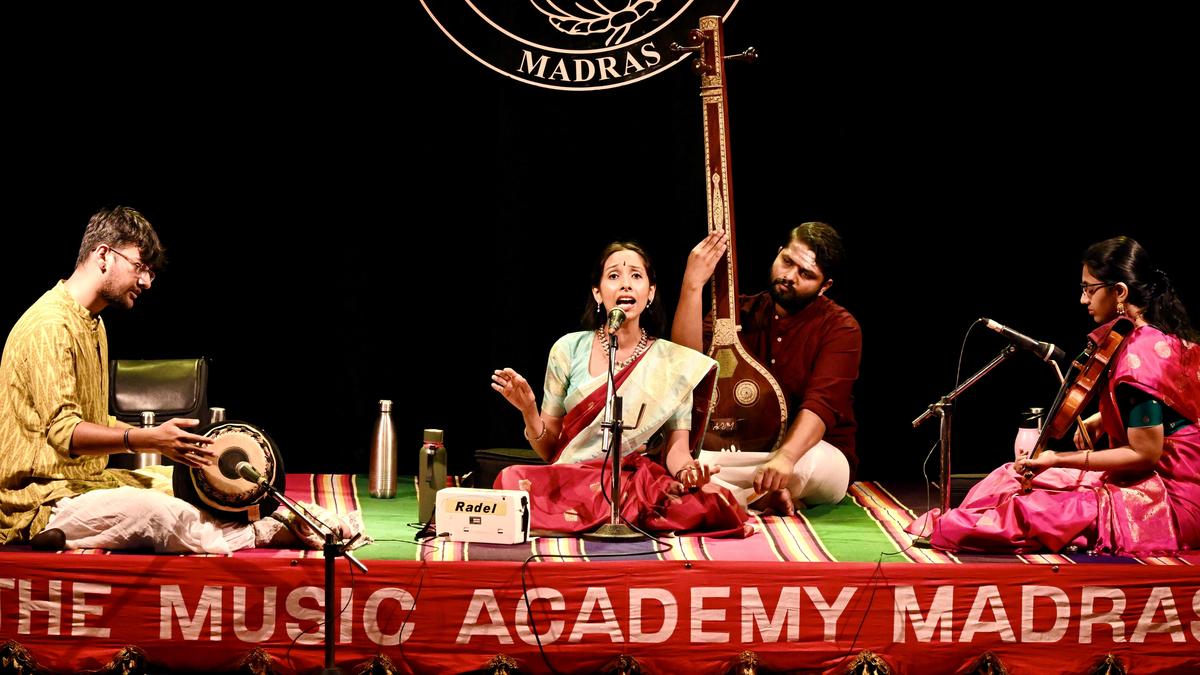
V. Subasri, with Mantha Sriramya on the violin and Kaushik Sridhar on the mridangam, performing at The Music Academy.
| Photo Credit: S.R. Raghunathan
The Music Academy became the stage for a carefully-curated thematic concert by V. Subashri, dedicated to the compositions of Purandaradasa — a 16th-century saint-composer hailed across generations as the Sangita Pitamaha.Born Srinivasa Nayaka, a prosperous but tight-fisted moneylender in Karnataka, he transformed into a wandering saint-poet after being moved by his wife’s deep devotion to Vittala. Renouncing his wealth, he went on to compose works marked by a rare depth and immersiveness. He did not write from mere piety, but as someone who wrestled with the grip of material life. That tension—between worldly attachment and spiritual surrender —echoes through many of his kritis.Subashri, accompanied by Mantha Sriramya on the violin and Kaushik Sridhar on the mridangam, opened her recital with ‘Sharanu siddhi vinayaka’ in Sowrashtram — an invocatory plea seeking Ganesha’s shelter through the word sharanu (refuge, surrender). Purandaradasa often began his compositions with an act of surrender. Subashri set the tone without over-elaborating. The violin was restrained and Kaushik’s playing was clean in sollu delivery.‘Nimma bhagya doddadho’ in Begada followed. The kalpanaswaras were taken from Rama Nama — within the devotional frame of the piece. The violin contributed well in the swara passages. The mridangam support was unhurried. The piece concluded with the Mudra charanam. The briga-rich ‘Dayamado ranga dayamado’ in Kalyani sustained the concert’s momentum. A brisk Atana alapana then introduced ‘Sakala graha balaneene’, providing a welcome shift in the mood and energy. The niraval, at ‘Pakshi vahana deena’, saw the violin functioning almost as an extension of the vocal line, responding with sensitivity to the contours of the phrase. Kalpanaswaras were concise and purposeful, that once again, was followed by the mudra charanam.‘Rama rama rama rama rama enniro sita’ in Vasanta moved quickly through mel kala swaras, the mridangam registering the raga’s character in its tone. Bhairavi formed the centrepiece of the concert. The alapana unfolded, traversing the raga’s expansive landscape. While some voice breaks were noticeable in the lower register, the overall exploration retained its emotional coherence. The composition ‘Odi barayya vaikunta pathi’ followed, with niraval at ‘Nodi mathadi’. The subsequent kalpanaswaras were well-mounted, and the violin held its own charm throughout. Kaushik Sridhar’s tani was earnest. The concert’s final arc moved through the quietly meditative world of ugabhogas: ‘Anuvige anuvagi’ in Desh, and ‘Hari embodhe’ in Kalyana Vasantam and Durga, praising Hari across the shifting colours of the two ragas.These led into ‘Mandamatiyu nanu’, a composition of frank self-deprecation and complete surrender to Purandaravittala. It belongs to a long tradition in Bhakti poetry of the dasya disposition, the stance of the servant, where the devotee approaches the divine not with any claim to worthiness but with the bare fact of longing. After the emotional weight carried through the evening, it arrived with the force of a quiet conclusion.The concert came to a close with the famous ‘Bhagyada lakshmi baramma’ in Madhyamavati. The audience received ’s readiness to receive each of these with warmth spoke for Dasa’s enduring place in every Carnatic music listener’s musical memory. Published - May 29, 2026 12:28 pm IST