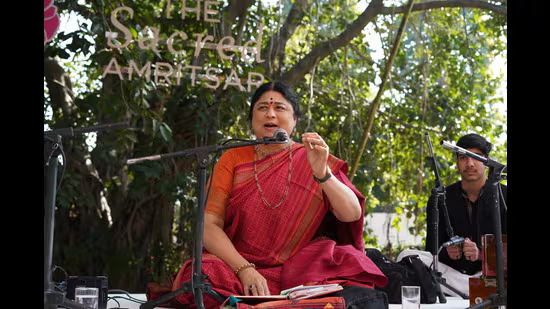
Whenever I listen to your father Kumar Gandharva’s rendition of the Kabir poem Sunta Hai Guru Gyaani, a stillness descends upon me and I become acutely conscious of the need to shut up and listen. Since you often sing it at concerts, how would you describe the role of listening in an artist’s life?Classical vocalist Kalapini Komkali (Courtesy The Sacred Amritsar Festival)(Laughs) What an excellent question! I think that listening is of utmost importance. When you truly listen, you listen not only to the words that are spoken but also to what lies beyond them and remains unsaid. Listening gives you a solid awareness of where you stand. It keeps you grounded. It also gives you a sense of direction. It strikes a note of caution about the path that you must not take. At the same time, it gives you an opportunity to learn from others and appreciate how beautifully they are able to string together and put forth their thoughts. Listening makes you humble.There are days when the mind calms down easily, and days when it feels agitated. Sometimes, you feel blessed with grace just before you start singing. Sometimes, you are restless for a while until you settle into a more balanced mental state. Ups and downs are inevitable. I am not a saint, or someone who has cut off ties from the world, but my musical training teaches me to stabilize myself before going up on stage.During a short period in Kumarji’s life, his voice was severely affected because of health issues and doctors advised him against singing. That must have been so frustrating. What did the silence teach him about listening?It is true that the period of silence gave him an opportunity to go deep within and contemplate. But I would say that he knew the importance of listening even before he fell ill. In fact, I would say that he was able to develop a unique style of singing precisely because he listened to the stalwarts and legends of that time with great respect and affection. Fayyaz Khan, Kundan Lal Saigal, Hafiz Ali Khan, Jagannathbuwa Purohit, Vinayak Rao Patwardhan, Narayan Rao Vyas, Anjanibai Malpekar, and many other names come to mind. Listening to them was an education in itself. But, yes, you are right, when he lost his voice, he got a chance to reflect on what he had learnt.Tell us about one of your fondest memories of Kumarji at home.There is a gurudwara near my house in Dewas, Madhya Pradesh. I have some beautiful memories of waking up early in the morning and finding my father completely still, listening to the recitation of the Gurbani. He used to be immersed in it. This is how artists draw inspiration. For them, even the chirping of a little sparrow can evoke a lot of emotion. Inspiration does not have to be like a massive rock, or a dramatic event demanding your attention. It can be like a silken thread, pulling you gently towards itself. Inspiration is like a seed. It disappears into the soil, and grows when the time is right.When I visit Amritsar, I always make it a point to pay my respects at Harmandir Sahib. Words seem inadequate to describe the peace that I find there. People from every strata of society are welcome there. Apart from the vibrations and the architecture, what I like is this inclusive spirit. That is something beautiful for everyone to follow.Please help us unpack the meaning of the Sikh shabad, Ab Main Kaun Upaay Karun, that you sing? Did you learn it from your father?Yes, I heard him singing it quite often, so I learnt by listening. In this shabad, the speaker is in direct contact with the absolute one. There is no pujari-pandit or mantri-santri functioning like an intermediary or a gatekeeper. He is praying for a solution to drive away the confusion that has clouded his mind. He wants spiritual guidance to be able to navigate this material world, which is compared to an ocean.Your repertoire shows that songs about the formless need not always be serious. They can be playful. Kaachi chhe kaya thaari, for instance, has this beautiful image of a person relishing mangoes and tamarind. What do you think?Yes, I agree with you. These are songs of bliss. Not everything needs to be dissected because you run the risk of ruining it for yourself and others. Enjoy the beauty that is to be found in these songs. Live a little. Let the songs breathe and delight you.You are usually spoken of as Kumarji’s daughter. Your mother, Vasundhara Komkali, was also a legend in her own right. Tell us about her role in your musical education.I am glad that you asked about my mother. Her role in my musical education is huge, and honestly a little bigger than my father’s role. When my father was alive, I would rarely sing on my own. I used to accompany him. But, after he passed away, my mother was the one who trained me for individual performances. I owe a lot to her.What is the importance of riyaaz in Hindustani classical music?Oh, it is extremely important! No singer should think that they can achieve a lot without riyaaz. It is a practice, a discipline, a commitment to your art. What matters is not the number of hours. That can vary depending on a person’s bodily structure and their mental makeup. It is not possible for everyone to sit and do riyaaz for eight to 10 hours every day. What counts is how you do it, and the intention behind what you do. It should be done with understanding, not aimlessly, and always under a guru’s guidance.Hindustani classical music is quite exacting in its expectations from students in terms of discipline and commitment. With reducing attention spans in the age of Instagram, what qualities do you look for when you take on a student?The fact that there are students even in these times is something to celebrate. (laughs) When they are under pressure to become doctors, engineers, and computer scientists, but they still choose music, I applaud them. I can assure them that their commitment to music will transform their personality and their life completely. I welcome them but I also ask them to be patient. One cannot learn in a day or two. It takes time.Chintan Girish Modi translated the singer’s responses from Hindi to English.Chintan Girish Modi is a writer, journalist, and educator who enjoys getting artists to talk about their creative process. He can be reached @chintanwriting on Instagram and X.
Kalapini Komkali: “When you truly listen, you listen also to what is unsaid”
Ahead of World Music Day on 21 June, the Hindustani classical singer talks about her father Kumar Gandharva, her mother Vasundhara Komkali, and the role of listening and riyaaz in a musician’s life
1,097 words~5 min read