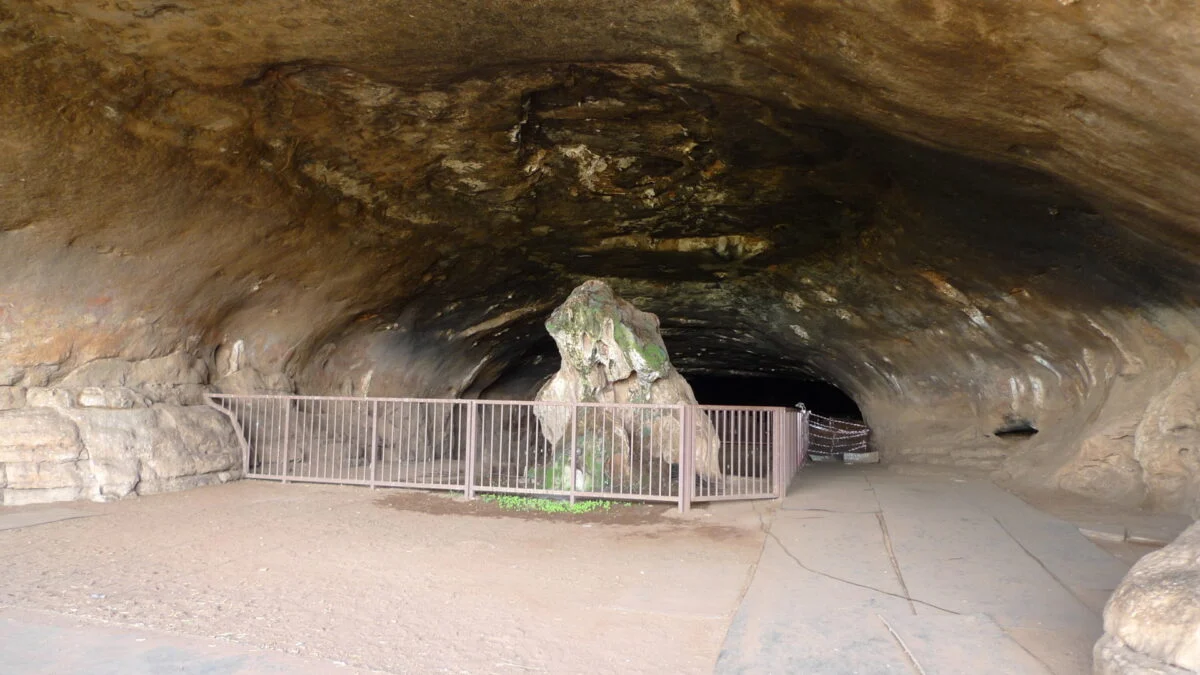
When it comes to phenomena that may have changed the course of human history, fire has to be near the top of the list.Unchecked, it's devastating – but when harnessed by humans, fire became a tool like no other.It provides warmth in the cold, cooks our food, powers engines, and transforms raw materials into everything from pottery and glass to metal.Yet exactly when our ancestors first began using fire remains one of archaeology's biggest questions.Now, an investigation into the detritus left behind in a cave by our ancient human ancestors has pushed the timeline back by hundreds of thousands of years.Early humans living in South Africa's Wonderwerk Cave – likely Homo erectus – left behind signs of repeated fire use in deposits dated to between 1.07 and 1.79 million years ago, according to a team led by paleobiologist María Dolores Marín-Monfort of the National University of the South in Argentina.The researchers found evidence of fire alongside other signs of occupation tens of meters inside the cave – far deeper than a natural wildfire would be expected to penetrate.The entrance to Wonderwerk Cave. (Wonderwerk Cave Project)"These discoveries show that early humans were not simply passive observers of natural fires," says archaeologist Liora Kolska Horwitz of the Hebrew University of Jerusalem."They were actively engaging with fire and incorporating it into their lives."Wonderwerk Cave, located deep in the Kalahari Desert, is an invaluable time capsule of early human history.Previous research had already identified it as one of the oldest archaeological sites in the world, with habitation dated to around 1.8 million years ago – the earliest known evidence of indoor living.Those investigations had also identified evidence of fire use in sediments dating back to around 1 million years ago.The excavation site in Wonderwerk Cave. (MNCN)Now, a clever, non-invasive technique has revealed much more.Amid the finds excavated from the cave is quite a large collection of animal bones. And, just as heating can alter sand and stone, so too does it change the chemical structure of bone.This, in turn, changes how the bone interacts with light.Imagine you have two bones in front of you. One was heated by fire, the other was not, but after 1.5 million years buried in a cave, they don't look much different from each other.However, when you shine a blue light onto both bones and use a filter to block reflected blue light, one of the bones emits a red glow.A comparison of two bones under blue light (left), showing the way fire-altered bone re-emits a red glow (right). (Marín-Monfort et al, PLOS One, 2026)That's because heating changed the bone's structure. It absorbs the blue light and re-emits it as red – a phenomenon known as fluorescence – while unheated bone remains dark."The methodology we have developed allows us to distinguish burnt fossils from those that have undergone chemical alterations during fossilization, such as fluoridation or manganese deposition, which can visually mimic the effects of fire," explains geologist Yolanda Fernández-Jalvo of the National Museum of Natural Sciences in Spain (MNCN)."We have improved the resolution with which we can identify burned fossils in very ancient contexts."The bones themselves were not necessarily brought in by the H. erectus occupants – many of them were microfossils that were probably transported in by owls that puked them up as pellets.The researchers also had to show that early humans were likely involved, rather than the burning being the result of natural processes.Related: What Actually Is Fire? The Answer Is Stranger Than You'd ThinkThe locations of the burnt remains in the cave provided the major clue. They were found close to other evidence of early human presence, far from the entrance. The evidence was also not widespread enough to indicate a wildfire.This does not mean that the cave's inhabitants knew how to create fire – but it does suggest they knew how to make use of it."Fire was not a one-time occurrence because it appears in different stratigraphic layers, separated by tens of thousands of years, which reinforces the idea that they already knew how to transport and maintain fire in protected spaces," Fernández-Jalvo says.The research was published in PLOS One.
Human Ancestors May Have Used Fire Far Earlier Than We Thought, Study Reveals
When it comes to phenomena that may have changed the course of human history, fire has to be near the top of the list.
686 words~3 min read