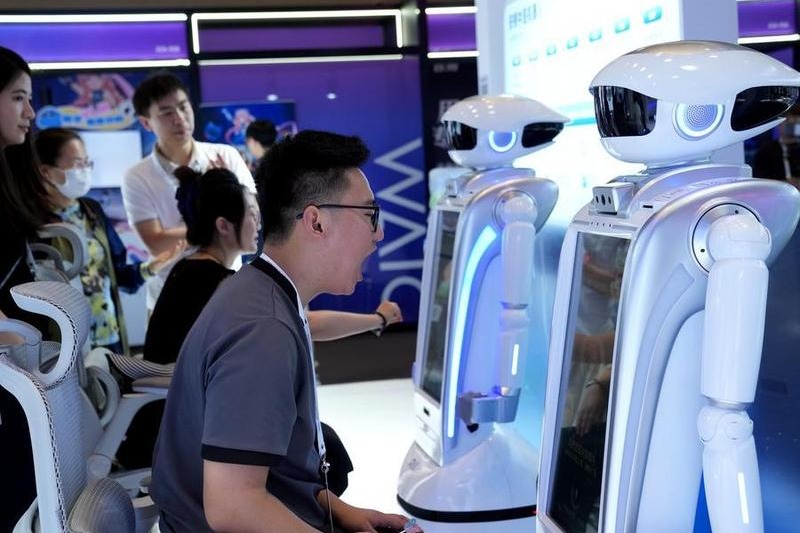
At first glance, Que Tang Yu Fang in the Chinese city of Nanjing looks like any other milk-tea shop offering freshly brewed drinks. But step inside, and every order begins with a traditional Chinese medicine diagnosis carried out entirely by artificial intelligence-powered devices. Customers have their levels of yin, yang, and qi assessed with an automated tongue scanner and a sensor-based pulse reader before receiving custom tea blends.
As generative AI adoption grows quickly in China in sectors including manufacturing, education, and automotive, the technology is also being embedded in TCM, transforming the centuries-old practice. Providers are using AI in clinical diagnostics and prescriptions, while robots deliver acupuncture, and labs build AI agents to cater to the growing number of users who go online with their queries.
“With this modern technology, TCM now has the chance to experience significant breakthroughs in treating patients, curing diseases, and discovering more accurate scientific explanations,” Zhou Bin, deputy director of TCM at Pudong Gongli Hospital in Shanghai, told Rest of World. “If we leverage this … traditional Chinese medicine can have just as profound an impact [as Western medicine].”