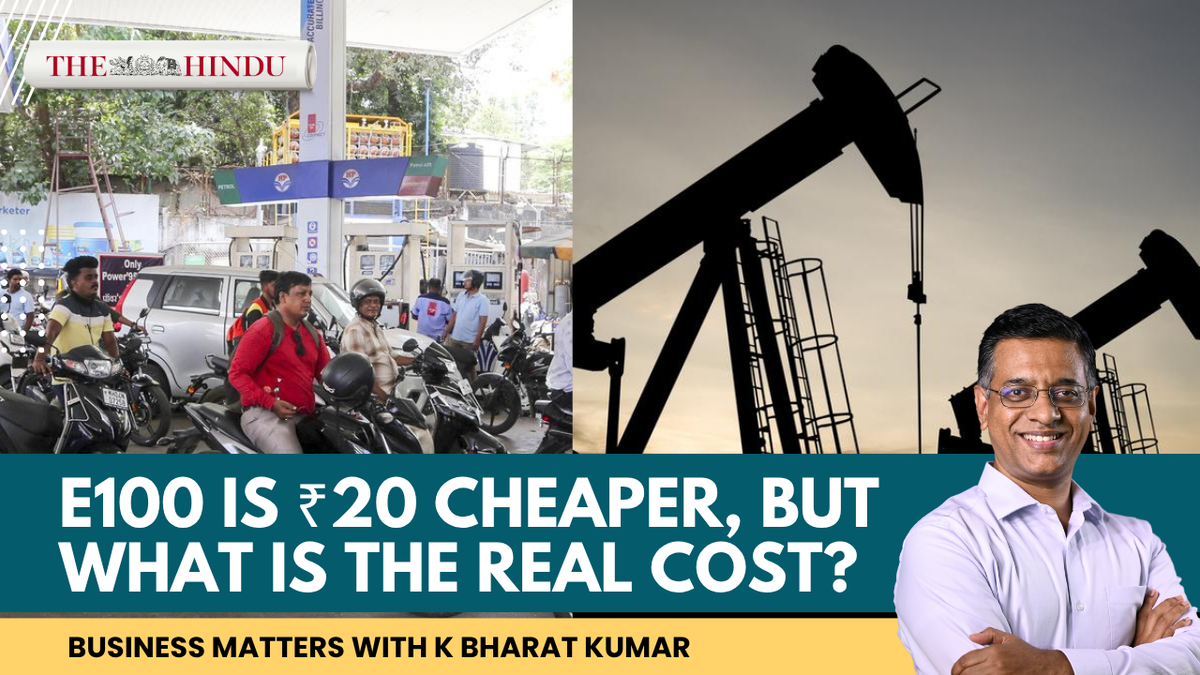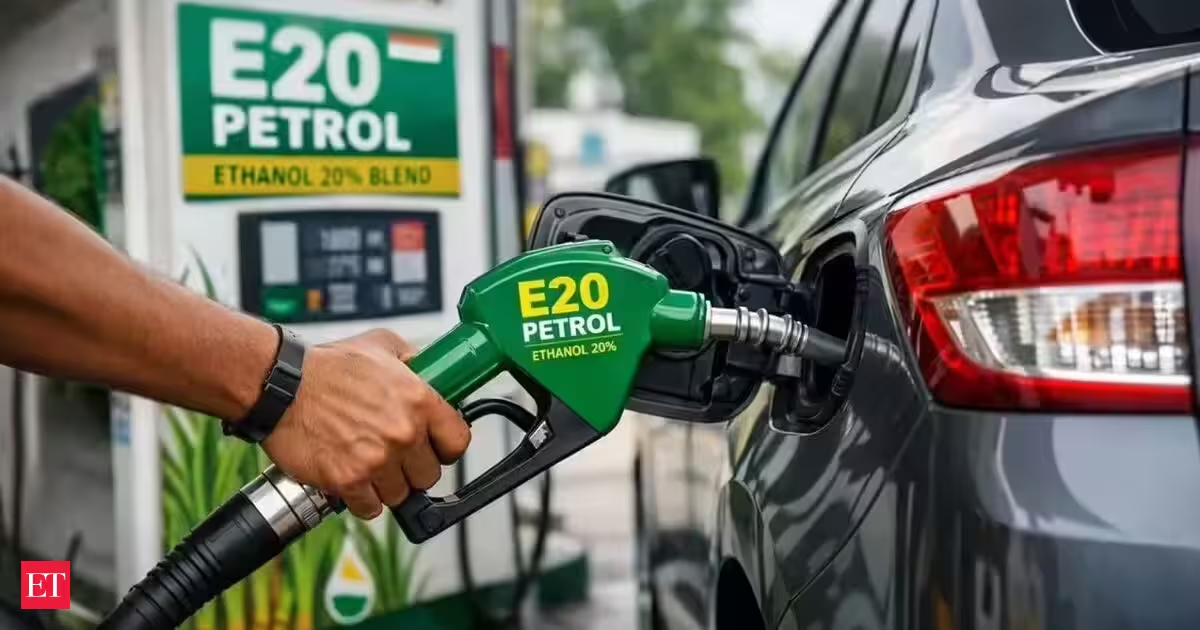
Ethanol may need to fall to around ₹60-65 a litre before India’s E100 push wins mass-market adoption, according to industry executives, analysts and automakers who say consumer economics, not government policy, will determine whether motorists switch from petrol. As policymakers look beyond blending targets towards direct ethanol use in vehicles, a new challenge is emerging — creating consumer demand.The Price ProblemAfter years spent building production capacity, fuel infrastructure and flex-fuel vehicles, the success of India’s E100 transition may ultimately be decided at the fuel pump. The question comes as India enters the next phase of its ethanol programme. Much of the supply-side groundwork has been laid and automakers are working through the technology. What remains is the harder task — convincing millions of motorists that ethanol is worth choosing over petrol every time they refuel.Toyota Kirloskar Motor, which has sold hybrid flex-fuel vehicles in Brazil for years, says fuel-price differentials and tax incentives, not technology, were the key drivers of ethanol adoption there. “The customer will ask a simple question: is the vehicle affordable, is the fuel easily available and does the running cost beat petrol?” said Randheer Singh, former director of electric mobility at NITI Aayog and chief executive of ForeSee Advisors.India’s first higher-blend ethanol fuel, E85, sells for ₹82.12 a litre in Delhi, about 20 per cent below petrol. Brazil typically sees motorists switch once ethanol reaches roughly 70 per cent of petrol’s price, which would place India’s figure near ₹78 a litre at Mumbai’s current petrol price of ₹111.31.Several industry participants argue India may need a steeper discount, closer to ₹60-65 a litre, to offset ethanol’s lower fuel efficiency and make the economics compelling for consumers. Industry executives say the discount must be sufficient to compensate for both the higher upfront cost of flex-fuel vehicles and ethanol’s lower energy density compared with petrol.India is pursuing multiple objectives through ethanol: reducing oil imports, lowering emissions and strengthening energy security. Yet, industry executives increasingly view ethanol as a complementary pathway alongside electrification rather than a direct substitute for EVs.Industry executives note that India is simultaneously pursuing three strategic imperatives — energy security, emissions reduction and consumer affordability. While electrification remains the most comprehensive pathway to address all three, ethanol is increasingly being viewed as a complementary solution that can strengthen energy security, provided fuel economics, infrastructure and policy support evolve in tandem.EV PlaybookIndia spent more than ₹71,000 crore over the past decade building its EV ecosystem through FAME subsidies, PM E-Drive, charging infrastructure, GST concessions and manufacturing incentives. Every subsidised EV automatically consumed electricity. Every rupee of public spending moved the policy objective forward.A flex-fuel vehicle can run on petrol, E20, E85 or E100. A subsidy on the vehicle does not guarantee ethanol consumption. A consumer can buy an FFV and continue filling petrol if it remains cheaper or more convenient. That is the gap the EV industry never had to close.The government has approved the E100 framework and the technology pathway is largely understood. Automakers point to India’s successful transition to E20 fuel as evidence that the industry can adapt to higher ethanol blends. However, executives caution that moving from E20 to E85 or E100 will require a more gradual roadmap involving fuel availability, standards development and supply-chain readiness.Hero MotoCorp has launched the Splendor+ Flex Fuel and HF Deluxe Flex Fuel motorcycles, while Maruti Suzuki, Hyundai, Tata Motors and Toyota have demonstrated flex-fuel passenger vehicles ranging from hatchbacks to SUVs.Industry executives say the challenge extends beyond simply modifying engines. Higher ethanol blends require changes to materials, fuel systems and engine calibration to handle ethanol’s different chemical properties. Supporting multiple blends ranging from E20 to E100 also increases testing and validation requirements across vehicle platforms.Flex-fuel technology could add ₹35,000-45,000 to a passenger vehicle and ₹5,000-8,000 to a two-wheeler, according to industry estimates. Across the industry, recurring annual costs could reach ₹22,000-30,000 crore, with an additional ₹15,000-20,000 crore required for testing facilities, supplier localisation, corrosion-resistant components and factory retooling.“Unlike a transition to a single fuel standard, this is not a one-time engineering exercise. Multiple platforms, variants and fuel blends require continuous validation, creating recurring development costs across the product portfolio,” said an official familiar with product development at one of India’s largest automakers.“The cost burden of flex-fuel adoption for E100 will be significant,” said Sridhar V, Senior Partner at Grant Thornton Bharat. “This places enormous pressure on margins in a market where affordability is critical, particularly for two-wheelers and entry-level cars.”Maruti Suzuki’s Wagon R Flex Fuel, for example, carries a premium of about ₹85,000 over the standard petrol version, highlighting the additional cost consumers may need to recover through lower fuel bills.Fuel availability is expected to improve rapidly. E85 stations are projected to rise from roughly 50-100 today to around 500 by the end of 2026 and as many as 5,000 by the end of 2027.“Unless the consumer sees a clear running-cost advantage, this kind of annual cost will be difficult for the industry to absorb,” Singh said.The CAFE III CatchThe investment burden becomes heavier because flex-fuel technology does little to reduce the need for EV spending. Even after billions of rupees invested in E100 readiness, automakers will still need to spend heavily on electrification to meet emission targets under the proposed CAFE III framework.Under the current proposal, E100-compatible vehicles earn a super-credit multiplier of 1.1, compared with 3.0 for battery-electric vehicles.“Flex-fuel primarily addresses energy security, whereas CAFE is calibrated toward CO₂ reduction outcomes. Even if manufacturers invest heavily in E100 readiness, they will still need EVs and other low- and zero-emission technologies to meet future fleet targets,” said an official involved in product planning at one of India’s largest automakers.Amit Bhatt, India Managing Director at ICCT, said ethanol can reduce fossil-fuel dependence and support emissions reduction, but should not be viewed as a substitute for vehicle electrification in the long term.Randheer Singh agreed, arguing that flex-fuel credits should not weaken incentives for deeper electrification. “CAFE should push genuine fleet-level emission reduction and electrification. If FFV and hybrid credits are made too generous, OEMs can meet targets on paper while delaying deeper investment in zero-tailpipe-emission vehicles,” said Singh.Toyota’s experience in Brazil offers perhaps the clearest real-world test of what drives flex-fuel adoption.
India’s ethanol dream hinges on affordability, not policy push
Ethanol may need to fall to around ₹60-65 a litre before India’s E100 push wins mass-market adoption, according to industry executives, analysts and automakers who say consumer economics, not government policy, will determine whether motorists switch from petrol. As policymakers look beyond blending targets towards direct ethanol use in vehicles, a new challenge is emerging — creating consumer demand
1,634 words~7 min read