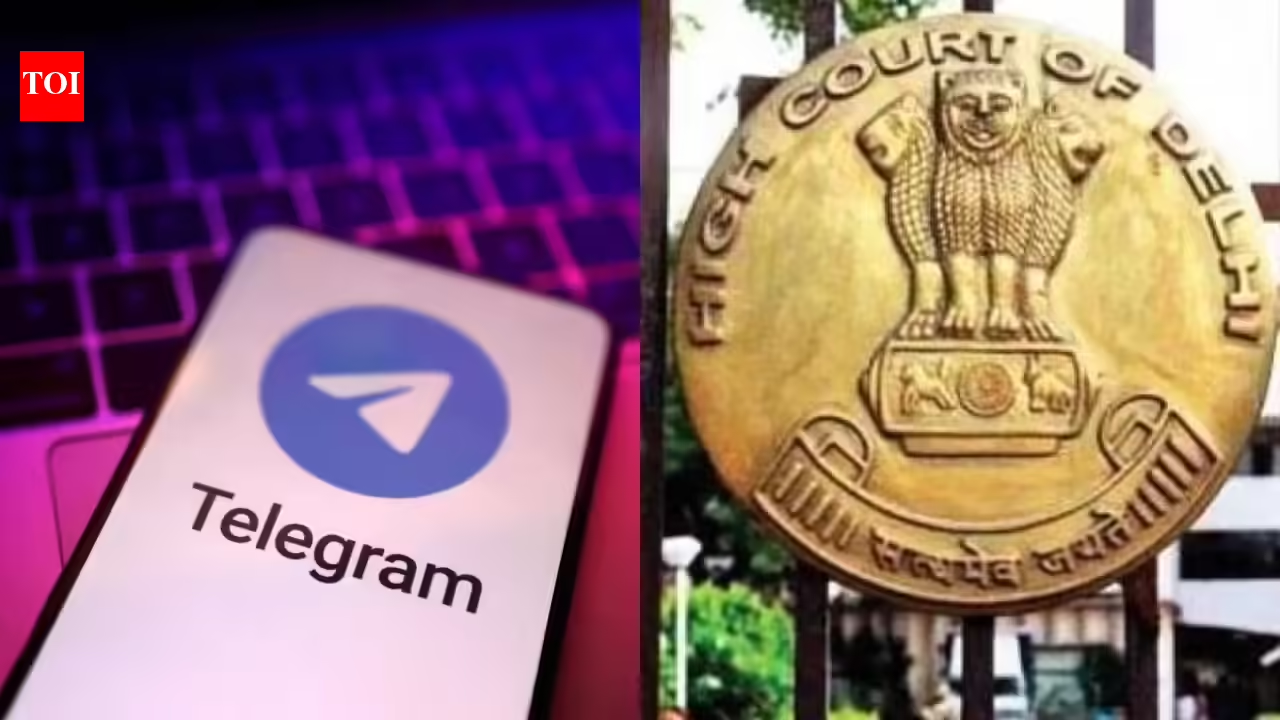
The Delhi High Court on Friday refused to stay the government's six-day block on Telegram ahead of the NEET-UG re-test, with Justice Tejas Karia dismissing the messaging app's challenge to a June 16 order that temporarily restricted its access across India.The ministry of electronics and information technology (MeitY) issued the order on blocking Telegram under Section 69A of the Information Technology Act. (Reuters/Representative)The single-judge bench held that the block satisfied the constitutional test of proportionality and that the government had followed due procedure under Section 69A of the Information Technology (IT) Act, 2000.The ruling clears the way for the Telegram block to stay in force through Sunday's NEET-UG re-test. The government had restricted access to Telegram till June 22 — a day after the re-test — and separately required the app to disable, till June 30, its message-editing feature on posts already published.NEET-UG 2026, the medical entrance exam originally held on May 3, was cancelled the following week after the National Testing Agency (NTA) confirmed with enforcement agencies that the question paper had been compromised. About 2.27 million students had appeared for it across 551 cities before the cancellation. A re-test was subsequently scheduled for June 21.Earlier this week, the government invoked Section 69A to order the nationwide block of Telegram, citing the need to prevent further leaks and protect the integrity of the re-test. Telegram challenged the order in the Delhi High Court, calling it "unconstitutional, arbitrary, and unlawful", and sought that either the temporary block be quashed or the order be stayed till the case was being heard.Also read: 20-year-old due to reappear for NEET dies after falling from Indore buildingThe court's refusal to grant that stay rested on three key findings:Did the block pass the test of proportionality?Under Indian constitutional law, any government action that restricts a fundamental right — here, access to a communication platform — must clear what is called the proportionality test. Under it, the action must serve a legitimate aim, be a suitable way of achieving it, represent the least restrictive option available, and not last longer than necessary.The Delhi high court held that the block cleared this bar on every count: "Test of proportionality is satisfied ... The government's measures are least restrictive. It cannot be held that the order is disproportionate."In its affidavit submitted to the court before Friday's ruling, the government had said Telegram's features created a “unique ecosystem” that can be exploited for “exam leaks, cyber-enabled frauds, terrorist propaganda and other unlawful activities”.On legitimacy, the court accepted that protecting 2.2 million candidates due to appear for the NEET re-test, and averting disruption to public order, was a valid aim.On suitability, the court agreed with the government that Telegram's "platform architecture" was "conducive to amplification and mass dissemination of content", capable of helping unlawful material "reach a substantial number of users within a short span of time".The high court extended this reasoning to the parallel government action, which had disabled Telegram's message-editing feature. The court said the feature could otherwise be misused to falsely claim that question papers had leaked before the exam.On whether a less restrictive option existed, the government had argued before the court that it had already tried targeted takedowns, but failed.Channels such as 'Private Mafia', with thousands of followers, had kept operating despite being flagged, and Telegram's bot infrastructure let automated accounts run "without continuous human intervention", the government had said in its affidavit opposing Telegram’s challenge. More than 150 NEET-linked bots had been disabled but the underlying ecosystem persisted, it had said.The court appeared to largely accept this argument on Friday, observing that such entry-level interventions "were repeatedly found to be ineffective and inadequate".Telegram had disputed this point before the court. It said that the app's representatives had held compliance meetings with government agencies since May, taken down more than 900 unlawful NEET-related links using AI, machine-learning tools and manual moderation, and removed flagged content within an hour of receiving specific URLs on June 9. These measures, it argued, was evidence that narrower enforcement was working.Senior advocate Dhruv Mehta, representing Telegram, also argued that singling out the app while other intermediaries operated freely was itself disproportionate and against Article 14 (equality before the law) of the Constitution. The government's action, it said, affected over 150 million users and businesses for the conduct of a small number of bad actors.The judge weighed this question while hearing the matter on Thursday.Justice Tejas Karia had asked the government whether it could curtail the rights of millions of ordinary users because some people were appearing for an exam. "Can you block someone else's right," the judge had questioned.Attorney General R Venkataramani had argued before the court, "This platform, because of its architecture, is a Frankenstein. If a country like ours cannot take preventive action, then where do we go?"By Friday, the court concluded that the government's action was "narrowly tailored and confined to the period strictly necessary", satisfying the proportionality test's requirement that even a justified restriction should not outlast its purpose.On the government’s argument that any delay in its action risked “mass student unrest, mass student unrest, disruption of public order and incitement to commissioning of cognisable offence”, the court held that the reasons for the block were sufficient given the “emergency nature” of the action.Also read: The 'time-travel' flaw that prompted India to block Telegram ahead of NEET-UG retestWas the action thought-out?Telegram's challenge also questioned if the government action had been issued without adequate thought.Its counsel, senior advocate Dhruv Mehta, argued, "The (government) order says, 'in the interest of sovereignty and integrity of India'. An examination like NEET will affect the sovereignty and integrity of India? What is the application of mind?"The high court disagreed, observing on Friday that the action did "not suffer from non-application of mind", and there was "a direct and substantial nexus" between the directions issued and the reasons the government had assigned for them.Also read: How NEET exam was leaked: ‘2 sets of questions papers’, 3 masterminds and a 5-state networkDid government follow due process?Telegram further argued it had not been given adequate notice or a fair hearing before the block took effect, and separately contended that Section 69A, which empowers the government to block "information", could not be stretched to cover an entire platform rather than content.The court rejected both the arguments. It held that the government had strictly followed the procedure required under Section 69A and the 2009 (IT) Rules, so objections over inadequate notice or hearing "fail given the statutory scheme".On the platform-versus-content question, it held there was "no reason to exclude the platform from the ambit of 'information'" under the Act, meaning that the law's power to block could be valid for the entirety of Telegram.
Why Delhi HC refused to stay the Telegram block ahead of NEET-UG retest
Court says government's six-day block cleared the proportionality test, followed IT Act procedure, and wasn't issued without due thought. | India News
TL;DRAI
India's court upheld Telegram's block through June 22 (150M users) as proportional to prevent exam-paper leaks affecting 2.27M students. The precedent signals governments can now suspend major platforms entirely for perceived security emergencies—expanding regulatory risk for any SaaS operator in sovereignty-sensitive markets.
1,118 words~5 min read