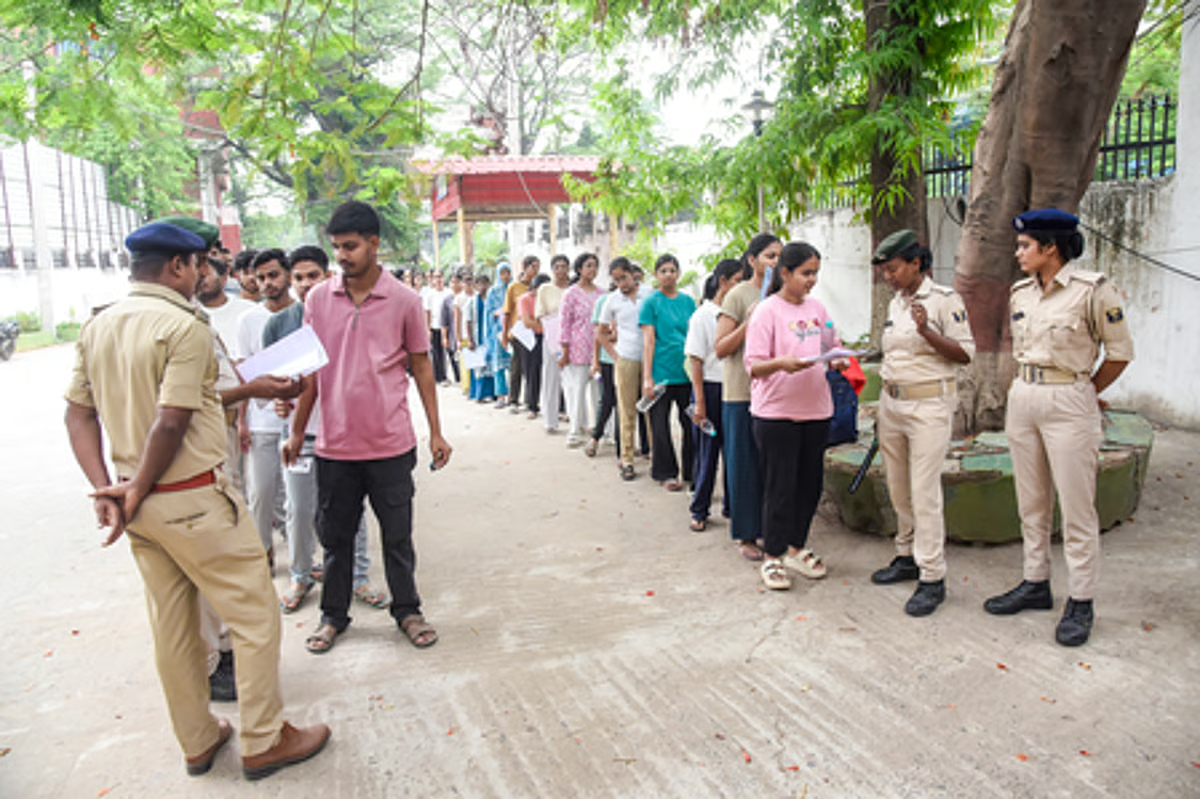
The Delhi High Court on Friday upheld the Centre's decision to temporarily restrict access to Telegram until June 22, backing the Centre's argument that extraordinary measures were necessary to curb the spread of fake NEET (UG) 2026 re-examination papers and exam-related fraud ahead of the June 21 re-test."Government order on emergency ban does not suffer from non-application of mind," the high court said, dismissing the petition filed by Telegram. "Government's order is well founded. A platform can be banned under Section 69A of the IT Act," observed Justice Tejas Karia, noting there are “sufficient” reasons to temporarily ban the app ahead of the re-tests.Also Read | Telegram temporarily restricted in India ahead of NEET re-exam; NTA welcomes Centre's moveA day earlier, the high courty had reserved a verdict and raised concerns over the Centre's decision to temporarily restrict access to the Pavel Durov-owned app ahead of the major all-India re-examination.It had further asked whether the rights of millions of users could be curtailed to safeguard the interests of a smaller group of examinees.Hearing a petition filed by the Dubai-based company challenging the temporary restriction until June 22, Justice Karia observed that the government would need to justify why a platform used by nearly 150 million people in India should face a blanket curtailment."The question is, can you block somebody else's rights to protect someone else's rights?" the judge had remarked, while reserving the order and asking both sides to suggest alternatives that could tackle concerns over paper leaks and misinformation without imposing broad restrictions.Defending the government's move, Solicitor General Tushar Mehta argued that Telegram's architecture poses unique challenges for law enforcement.Also Read | NEET re-test on June 21 will be conducted in a fair and well-organised manner: PradhanHe said the platform's bot ecosystem allows rapid creation of multiple channels, making it difficult to curb the spread of leaked material or misinformation effectively.According to Mehta, a single Telegram account can create up to 40 bots, unlike other messaging platforms that impose stricter limitations. Even if one bot or channel is removed, several others can quickly emerge under different identities, he said.The Solicitor General also argued that Telegram's cloud-based structure makes it difficult for investigating agencies to trace individuals involved in unlawful activities. "Even if we block content and someone commits mischief, the law enforcement agency cannot easily reach that person," he told the court.He added that the government does not face similar challenges with other major messaging platforms and maintained that the temporary restrictions were imposed under emergency powers in view of the exceptional circumstances surrounding the examination.What happened and why Telegram was restrictedTelegram has been temporarily restricted in India until June 22 as part of the PM Modi government's efforts to curb the circulation of fake NEET (UG) 2026 re-examination papers and exam-related fraud ahead of the June 21 re-test.The National Testing Agency said the Ministry of Electronics and Information Technology (MeitY) acted on its recommendations and issued directions under Section 69A of the Information Technology Act to restrict access to Telegram for a limited period covering the examination and its immediate aftermath.The ministry has also asked Telegram to disable its message-editing feature in India for already posted content until June 30.According to the NTA, the feature had been misused in previous examinations to create fabricated evidence of paper leaks by editing older messages after exams had concluded.The agency said cheating rackets had been using Telegram channels, groups and bots to spread misinformation and lure candidates with false promises of access to leaked question papers.It further identified several channels carrying names such as "Re-NEET 2026", "Private Mafia" and "REE NEET MAFIAA", which allegedly demanded money from students and parents in exchange for fake exam papers.The NTA maintained that no examination paper was available outside the secured system and warned candidates against falling prey to such fraudulent claims. It added that the temporary restrictions were imposed only after coordinated takedowns of channels and accounts failed to adequately contain the spread of misinformation.
Telegram ban: Delhi HC upholds India's temporary ban on Whatsapp rival ahead of NEET re-test
The Delhi High Court has backed the government's decision to temporarily restrict Telegram access until June 22. This measure aims to stop the spread of fake NEET 2026 re-examination papers and related fraud. The government cited Telegram's architecture as a challenge for law enforcement. The National Testing Agency recommended the ban to the Ministry of Electronics and Information Technology.
TL;DRAI
Delhi HC ha confermato ban Telegram (22 giugno) per frodi esami NEET; architettura permette 40 bot/account, impossibile controllare leak a livello nazionale. Per stack tech: rivela i limiti dell'enforcement di Stato su platform decentralizzate—CTO in geo-critical deve preferire governance-by-design piuttosto che bot ecosystem aperto.
661 words~3 min read