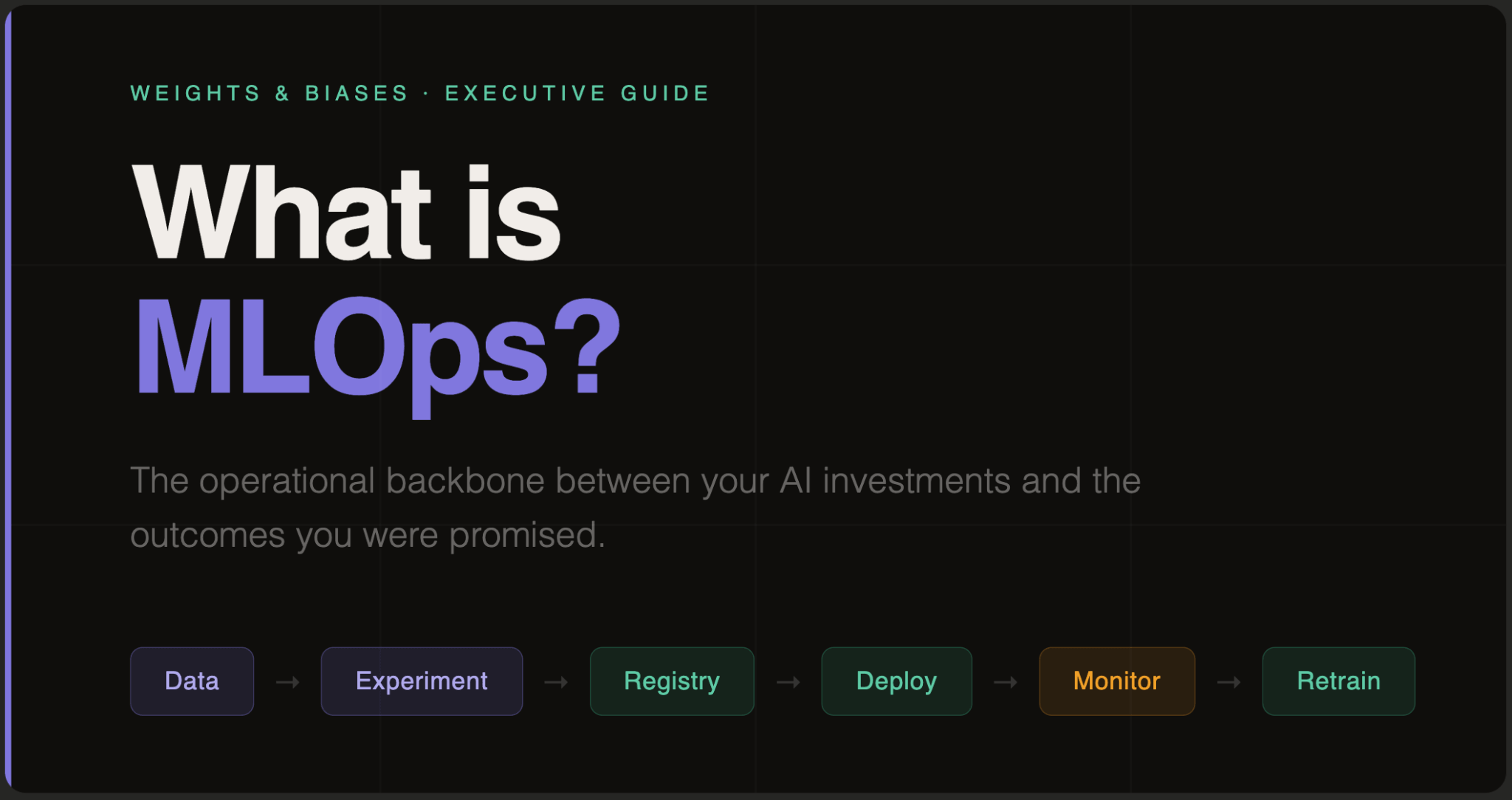
A practitioner’s guide to machine learning pipeline architecture, MLOps maturity and the tooling that closes the gap between experiment and production.
The major cloud providers converge on the same definition: a repeatable flow composed of defined steps, dependencies, inputs, and outputs rather than a one-off script. Azure Machine Learning, Amazon SageMaker Pipelines, and Google Vertex AI Pipelines each offer managed orchestration with this foundation.
How an MLOps pipeline differs from a data pipelineA data pipeline moves and transforms data from source systems into a warehouse or lake, cleaning and structuring it so analysts can query it. It cares about completeness, freshness, and schema correctness. That is the right scope for a data pipeline.An MLOps pipeline sits atop a data pipeline and extends beyond it. It trains models on that clean data, evaluates their statistical behavior, versions the artifacts produced, deploys them into the serving infrastructure, and monitors their behavior as the world changes. It introduces concepts that a data pipeline has no mechanism to handle: model versioning, hyperparameter tracking, bias evaluation, drift detection, and model approval workflows.The most damaging failure mode at this boundary is training-serving skew. This occurs when the feature computation logic at training time produces different values than the same logic at inference time. Training typically runs as a batch Python job against historical data. Inference runs as a real-time microservice, often in a different language or framework. Differences as small as timezone handling, null value imputation, or floating-point rounding can shift feature distributions enough to cause significant loss of accuracy. Google’s own Rules of ML documentation cites training-serving skew as a source of dramatic performance setbacks: fixing a single feature discrepancy in Google Play improved app install rates by 2% at scale.A mature MLOps pipeline either enforces shared feature computation code across training and serving or routes both environments through a feature store that guarantees numerically identical outputs. A data pipeline has no reason to care about this distinction. An ML pipeline must enforce it.Data pipeline vs. MLOps pipelineDimensionData PipelineMLOps PipelinePrimary outputClean, queryable dataTrained, versioned, deployed modelsVersioning concernSchema and table versionsDataset, feature, model, and run versionsFailure modesMissing data, broken transformsAbove + drift, bias, and accuracy degradationGovernance needsLineage, access controlAbove + model approvals, audit trails, explainabilityTypical ownersData engineersML engineers, MLOps engineers, data scientistsContinuous training?NoYes: models retrain as data and concepts evolveTraining-serving skew?Not applicableA primary failure mode requiring explicit preventionFor leaders making staffing and tooling decisions, owning a mature data platform provides a strong foundation, but it does not deliver an ML pipeline. The survey by Paleyes, Urma, and Lawrence, published in ACM Computing Surveys (2022), found that data management issues and deployment-stage problems are the most frequently cited challenges in real-world ML deployment case studies. Both categories require ML-specific controls that data engineering alone cannot provide.