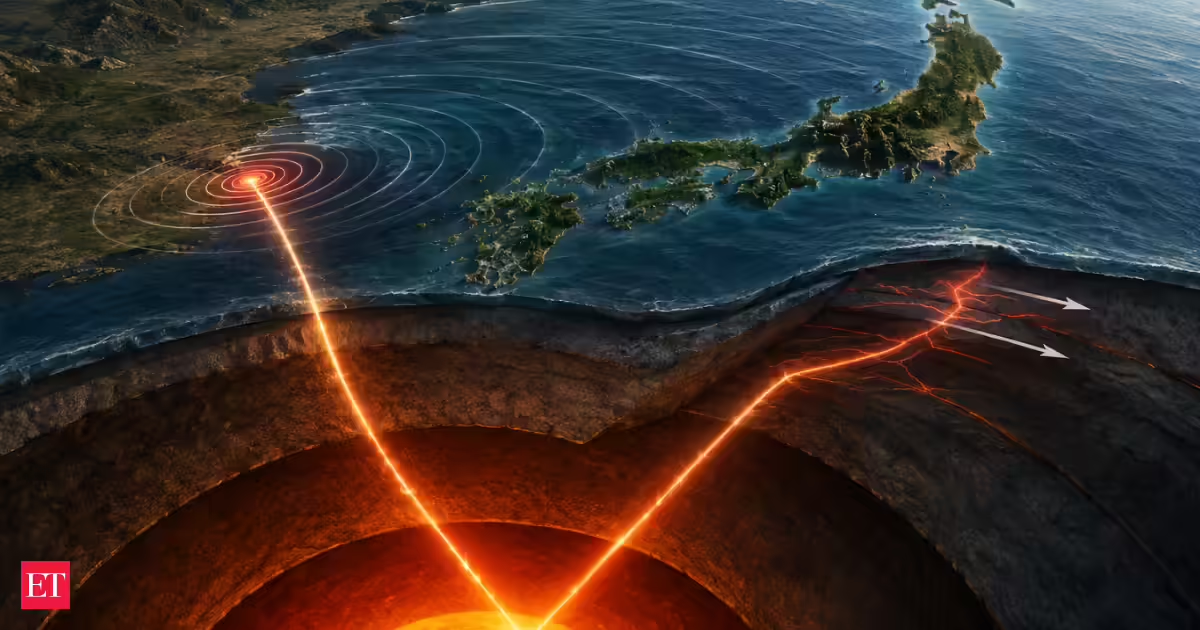
When the magnitude 9.0 Tōhoku earthquake struck off the coast of Japan in 2011, its seismic shivers did more than ripple through the planet.At least one wave traveled 2,900 kilometers (1,800 miles) down to the boundary between Earth's mantle and liquid outer core, where it was reflected right back to the surface.And there, according to a new analysis of earthquake data from across Japan, it may have done something scientists have never identified before.GPS observations from the time of the earthquake showed that parts of Japan shifted eastward by up to 5 to 6 millimeters.The reflected wave, says a team led by seismologist Sunyoung Park of the University of Chicago, may be what gave Japan that eastward nudge.Quakes are among the most devastating natural disasters our planet can experience, and the Tōhoku earthquake, which generated the tsunami that triggered the Fukushima Daiichi nuclear disaster, was one of the most powerful ever recorded.The largest earthquakes in recorded history. (USGS)It occurred when the Pacific Plate suddenly slipped beneath the plate carrying northern Japan, generating a devastating tsunami and sending seismic waves racing through the planet.The Tōhoku earthquake remains one of the most closely studied natural disasters in history. Scientists are still combing through the observations it generated, searching for clues about how major earthquakes unfold and what happens in their aftermath.The event was so enormous that it produced an unusually clear ScS signal in Japan's GNSS Earth Observation Network System (GEONET). That's a designation that means a shear wave (S) that is reflected at the core-mantle boundary (c), and returns as another shear wave (S). The amplitude of this ScS wave was so large that it was even detectable in China.That's interesting in itself because GNSS measures ground movement, not seismic waves directly. It's not a traditional seismometer.So, the researchers were poking around with this signal to see what it could tell us about the quake itself. That's when they noticed something … odd.After a seismic wave passes through, the ground is expected to return to its starting position. However, the researchers noticed that some GPS stations in Japan appeared to have shifted slightly eastward compared to their starting positions.The obvious explanation is that it's a glitch – maybe an artifact of data processing.But when the researchers took this into account and tried to correct for it, the shift persisted, suggesting that it was both real and permanent. Nor could it be readily explained by other possibilities, such as a large underwater landslide or the known mainshock rupture.
A Giant Seismic Wave Bounced Off Earth's Core And May Have Shifted Japan
When the magnitude 9.0 Tōhoku earthquake struck off the coast of Japan in 2011, its seismic shivers did more than ripple through the planet.
850 words~4 min read