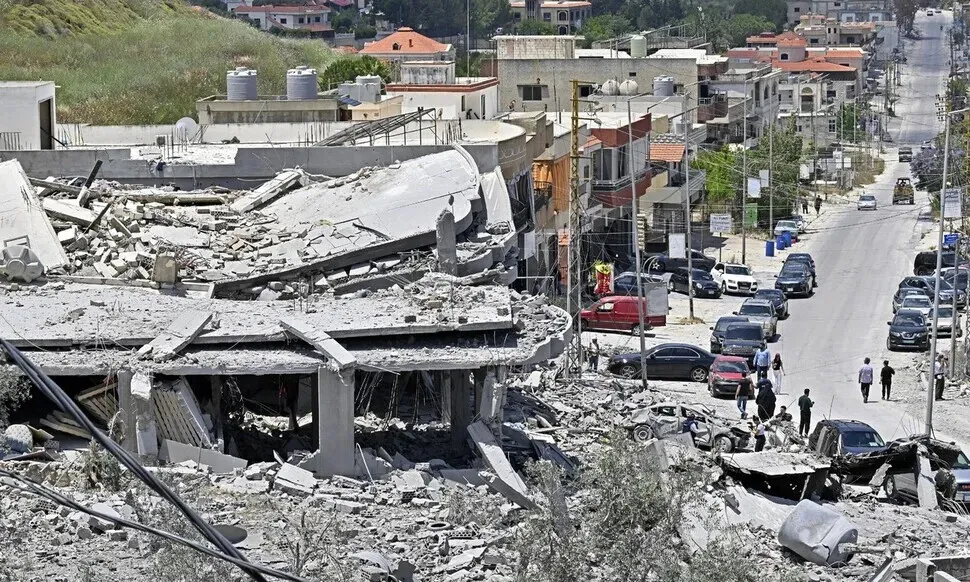
On June 16, 2026, people walk past the ruins of a building in Shehabiye in southern Lebanon that was hit by Israeli strikes. (EPA/Yonhap)
A private fund for Iran’s reconstruction with a reported scale of US$300 billion is turning into a focus of controversy as Washington and Tehran sign a memorandum of understanding to end their conflict.The reported vision for the fund involves drawing investments from companies in Persian Gulf states and allies such as South Korea and Japan. Critics are accusing the US of trying to pass the costs of postwar recovery and regional stability off on other countries despite being the party responsible for starting the war.The administration of President Donald Trump has stressed that no US government funds will be going into the program. But the issue has drawn a growing outcry in the US, where many view it as problematic to grant such a large amount of economic compensation to Iran, whatever the source.A Reuters report on Tuesday quoted a source as saying that investment had already been committed for over half the fund, with companies mentioned from South Korea, Japan, Singapore, Malaysia, and the US. But the actual company names were not made public, nor was any information about the scale of the pledges or the actual legal obligations.The fund will reportedly be called the “Reconstruction and Development Fund” and include investment in areas such as energy, distribution, manufacturing and transportation.Global capital market access to Iran has been largely restricted by sanctions from the US and international community since the 1979 Islamic Revolution. If a final agreement is reached and sanctions are actually eased, Iran will gain the opportunity to attract large-scale foreign investment for the first time in more than four decades. From a long-term perspective, this could be seen as a major carrot in terms of encouraging Iran to move in a preferred direction.The origins of the fund appear to lie with Tehran’s demands for compensation to cover losses due to the war. Reuters reported that it initially demanded US$400 billion from the US for war compensation, which Washington rejected. The idea of a Reconstruction and Development Fund amounting to US$300 billion emerged after that, the report said.The US news website Axios reported that Qatar first proposed the idea of a “prosperity fund” based on investment from the private sector and allies, with related discussions taking place between the US and Iran over the weeks after that. For this reason, some are suggesting Iran could accept the fund as amounting to compensation for war losses.In response to the growing controversy, US Vice President JD Vance asserted in an interview on “The Megyn Kelly Show” on Tuesday that the US was not giving any money to Iran directly.“Let’s say that [the United Arab Emirates] want to invest in a nuclear power plant in Iran. They really can’t do that without us lifting some of the sanctions that exist in the global financial system to make that possible,” he said.He went on to say that the approach would be entirely conditional, in the sense that it would only lower barriers for other countries to invest in Iran’s reconstruction if Iran changes its behavior by permanently abandoning nuclear weapons and disposing of its highly enriched uranium.But according to a draft MOU version that was obtained and reported on by The Wall Street Journal, Bloomberg, and other sources on Tuesday, the US would be easing sanctions on Iran and allowing petroleum exports upon its signing. It would also permit the use of banking, transportation, and insurance services necessary for petroleum transactions.The arrangement effectively gives Iran economic incentives upfront, without tying them to concrete outcomes from follow-up negotiations, such as dismantling its nuclear program. Hard-liners in the US Republican Party and others were up in arms over what they saw as excessive concessions.In response, Trump stressed on Wednesday that the agreement terms reported on in the press were “not final.”“It’s a memorandum of understanding, and if I don’t like it, we’ll go back to shooting at [the Iranians], dropping bombs on their head,” he added.By Kim Won-chul, Washington correspondent; Cheon Ho-sung, staff reporterPlease direct questions or comments to [english@hani.co.kr]