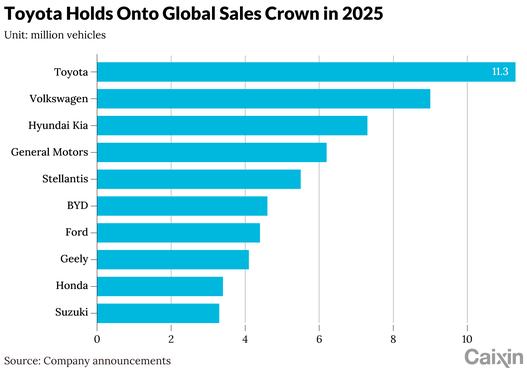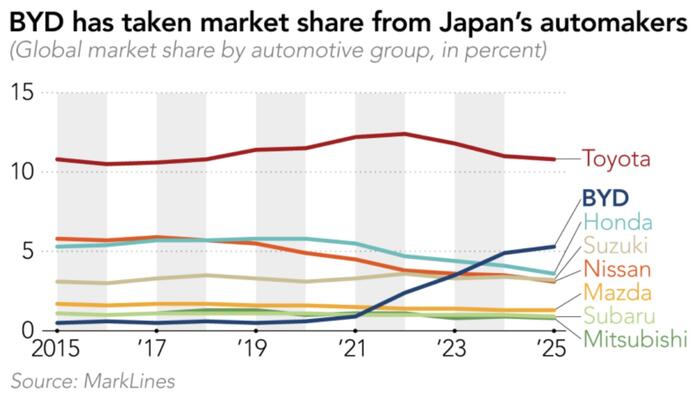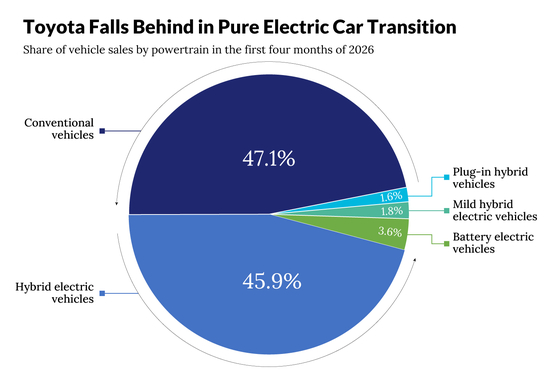
1. Toyota Motor Corp. held its position as the world's largest carmaker by sales for a sixth consecutive year in 2025, supported by robust demand for its conventional and hybrid vehicles. [para. 1]2. The company faces significant challenges in China due to the country's rapid shift toward new-energy vehicles (NEVs). Toyota's 2025 China sales were essentially flat at about 1.78 million, most of which were internal combustion engine cars, which are losing appeal. [para. 2][para. 7] Sales fell 10% year-on-year to around 477,000 vehicles in the first four months of 2026, partly due to supply chain disruptions from the U.S.-Israel-Iran war. [para. 8] During that period, domestic Chinese brands captured a 70% share of passenger car sales, while overall sales of fossil fuel cars and NEVs fell 24.7% and 20.2%, respectively. [para. 9]3. There is a consensus among carmakers that NEVs will dominate China's market, supported by expanding charging infrastructure and Beijing's green energy push. [para. 10] Zhou Xing, deputy general manager of Lynk & Co., predicted battery EVs will soon account for half of China's passenger car sales. [para. 11]4. Toyota responded by making China the centerpiece of its 2025 EV strategy, announcing plans for a Shanghai plant to produce electric Lexus models and granting its Chinese engineering team greater R&D authority. [para. 13] This followed the failure of the bZ4X electric SUV to win over Chinese consumers. [para. 14] The Chinese-led bZ3X electric SUV, launched in March 2025, became the best-selling NEV from an international-local partnership in China in 2025. [para. 16][para. 17] Toyota is expected to finalize a plan to bring China-developed products to other markets by end of 2026 and is considering a joint venture with a Chinese self-driving firm. [para. 19]5. Beyond China, Toyota faces increasing competition from Chinese automakers expanding overseas through exports. China has been the world's largest auto exporter since 2023, and in the first quarter of 2026, NEV shipments grew four times faster than conventional vehicles. [para. 21][para. 22] The China Association of Automobile Manufacturers expects vehicle exports to hit 10 million in 2026. [para. 23]6. While the EU and US have imposed tariffs and sourcing requirements on Chinese EVs, the main battleground is in emerging markets. [para. 24] In Thailand, five Chinese automakers entered the top 10 in 2025, threatening Toyota's leading position of 230,000 vehicles sold. [para. 25][para. 26] Toyota also saw its vehicle sales drop 5.5% and 22.1% year-on-year in Latin America and Australia, respectively, in the first four months of 2026. [para. 27]AI generated, for reference only
Analysis: Toyota Shifts Gears to Fend Off China’s EV Upstarts
The Japanese auto giant has lost ground to Chinese carmakers as electrification challenges its core conventional and hybrid vehicle lineups
420 words~2 min read