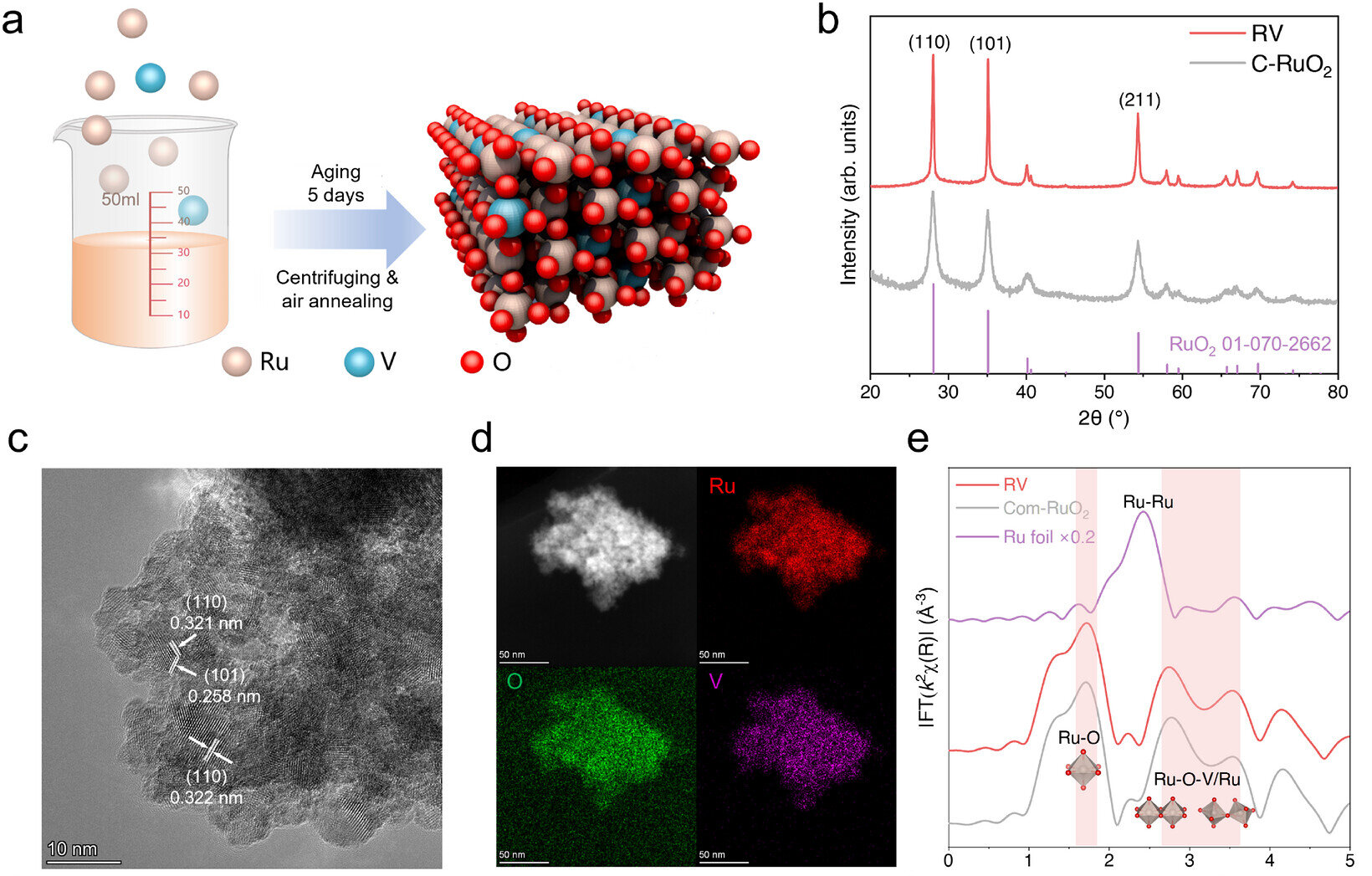
Synthesis and structural characterization of the V-doped RuO2 catalyst, showing uniform incorporation of Ru, V, and O in rutile RuO2 nanoparticles. Credit: Zhongliang Liu, Heng Liu, Kai Zhou et al.
Why settle for a trial-and-error approach, reviewing an almost endless number of combinations, when you can systematically narrow the list to something more manageable using established data and knowledge?
A team of researchers from Tohoku University and East China University of Science and Technology showed how to make informed decisions when screening for the ideal catalyst by using experimental data and scientific theories. The findings were published in Angewandte Chemie International Edition.
From vast search to shortlist
This screening process can narrow a staggering number of chemical combinations to several dozen promising catalyst candidates that can then be tested in the lab. Their recent findings show the benefits of this workflow and how it applies well to a certain ruthenium-based (Ru) catalyst. The resulting catalyst was highly efficient and showed promising practical, real-world transferability.