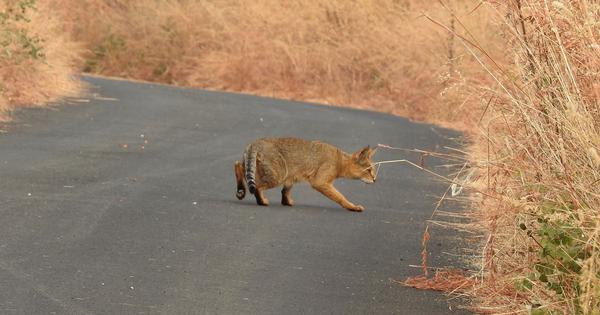
A new nationwide study mapping jungle cats’ distribution and estimating their population at a national scale finds that India has the potential to support more than 300,000 jungle cats. “We didn’t know much about jungle cats – their habitat associations, population status, interactions with tigers and leopards, or their role in illegal wildlife trade until this study,” says Kathan Bandyopadhyay, the study’s lead author.Drawing on more than 6,000 verified records, researchers mapped suitable habitat for jungle cats (Felis chaus) across India, largely using data from tiger surveys. The study has been published in Scientific Reports.The study found that jungle cats prefer warm, semi-arid regions with moderate rainfall and some human presence. Roughly 545,000 square kilometres of suitable habitat has also been identified. States such as Madhya Pradesh, Rajasthan, Odisha, Chhattisgarh, Maharashtra, and Gujarat are likely to support large populations.Senior principal scientist at the Salim Ali Centre for Ornithology and Natural History, Shomita Mukherjee notes, “Most researchers would not put in this kind of effort for a relatively common and small species.”A cat in the scrub and grassJungle cats favour open habitats such as grasslands, scrublands, wetlands, and agricultural mosaics, while avoiding dense forests and urban areas. Their long legs and lean bodies help them move through tall grass, and their colouring blends into dry terrain. “The morphological features of the jungle cat clearly indicate that it is a scrub-dwelling cat,” Mukherjee says, though the species is often described as a generalist in their habitat preference.Estimating their numbers is challenging since, unlike tigers, jungle cats do not have unique markings that make them easily identifiable. Researchers used data from GPS-collared animals to estimate space use and combined it with habitat maps to arrive at a population estimate of about 308,000 individuals, though with wide uncertainty. “This is the first time we’ve attempted this. It’s something we need to revisit in 15-20 years to assess population trends,” Bandyopadhyay says. Mukherjee, however, cautions that the reliance on tiger survey data may miss some habitats. “Models are only as good as the data behind them,” she says.
India’s jungle cats thrive in open landscapes, shows mapping study
The small carnivores play important ecological roles, yet they do not attract enough attention from scientific community and conservation planners.
812 words~4 min read