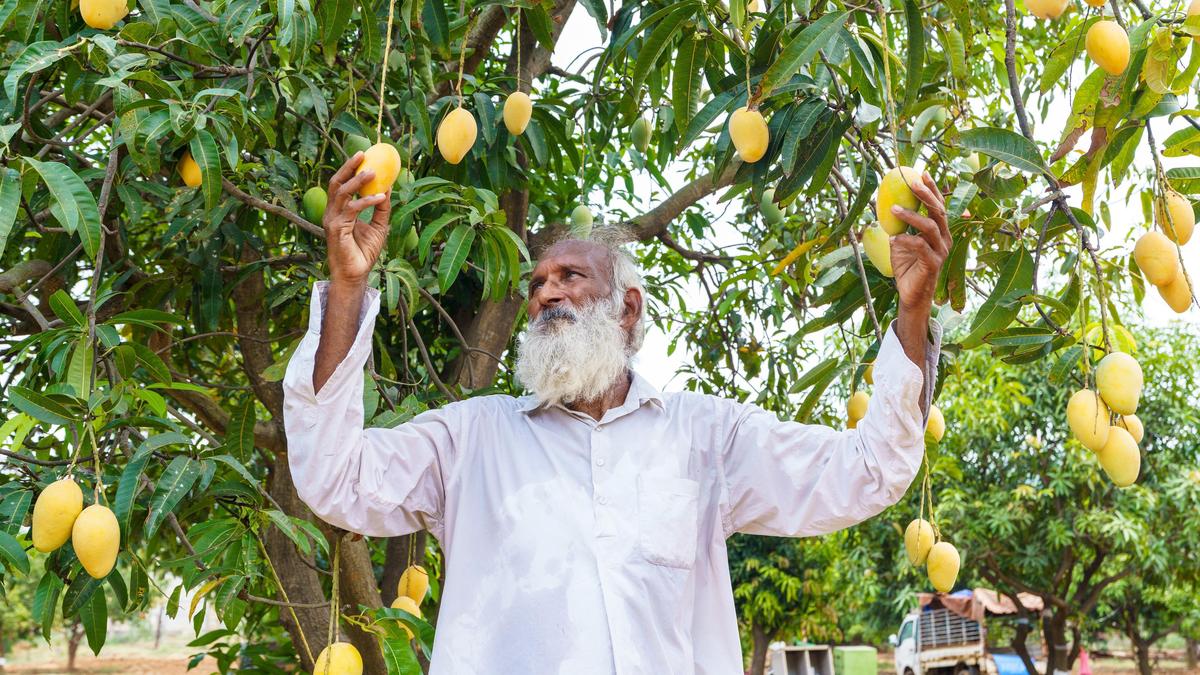
Sankaran Namboothiri, Palakkad, Kerala
Sankaran Namboothiri amidst his mango trees
| Photo Credit:
Special arrangement
My favourite is a native mango variety, which as children, we called ‘chakkarakodayan’ since it was as sweet as chakkara (jaggery). I enjoyed sucking the juicy pulp from these small mangoes. It is no longer found in backyards of homes now. So I eat another local variety, Moorthy 1, from a four-decade tree which I named after our ancestral home, Moorthiyedathu Mana. Adapted to the local weather, this fruit grows in clusters. Each mango weighs around 100 grams, with a Brix level (sugar content) of 23, which is quite high for a ripe mango.I have eight indigenous varieties in my 4.5 acre farm, which is home to over 700 varieties of mangoes and several native trees. Farming has been a part of my life for as long as I can remember. Growing up in rural Sreekrishnapuram in Palakkad, I enjoyed plucking and eating the umpteen mango varieties from our backyard. Back then, I dreamed of growing them someday, a dream which was fulfilled once I became an organic farmer.It has been heart-breaking to see several native mango varieties from Kerala getting lost over the years. Determined to try and conserve what is left, I started learning about mangoes, and eventually could identify 443 local varieties, which I planted in my farm. I found that each district has its preferred variety: kottoorkonam in Thiruvananathapuram, karpooram in Kollam, and kuttiyattor in Kannur, etc. I have managed to collect most of these. I also have 17 out of the 22 Indian mangoes with GI tags, including kuttiyattoor from Kerala. Aroor olor from Kozhikode, which will soon get the GI tag, is next on my list.The diversity is exciting, from the flavour to the size, weight and shape of the leaves. I have a variety that bears fruits weighing five kilograms each, which I got from Tamil Nadu and have named Sree, and another with mangoes weighing just 25 grams, which I call manjakadukka.Arun Sogathur, Bengaluru, Karnataka