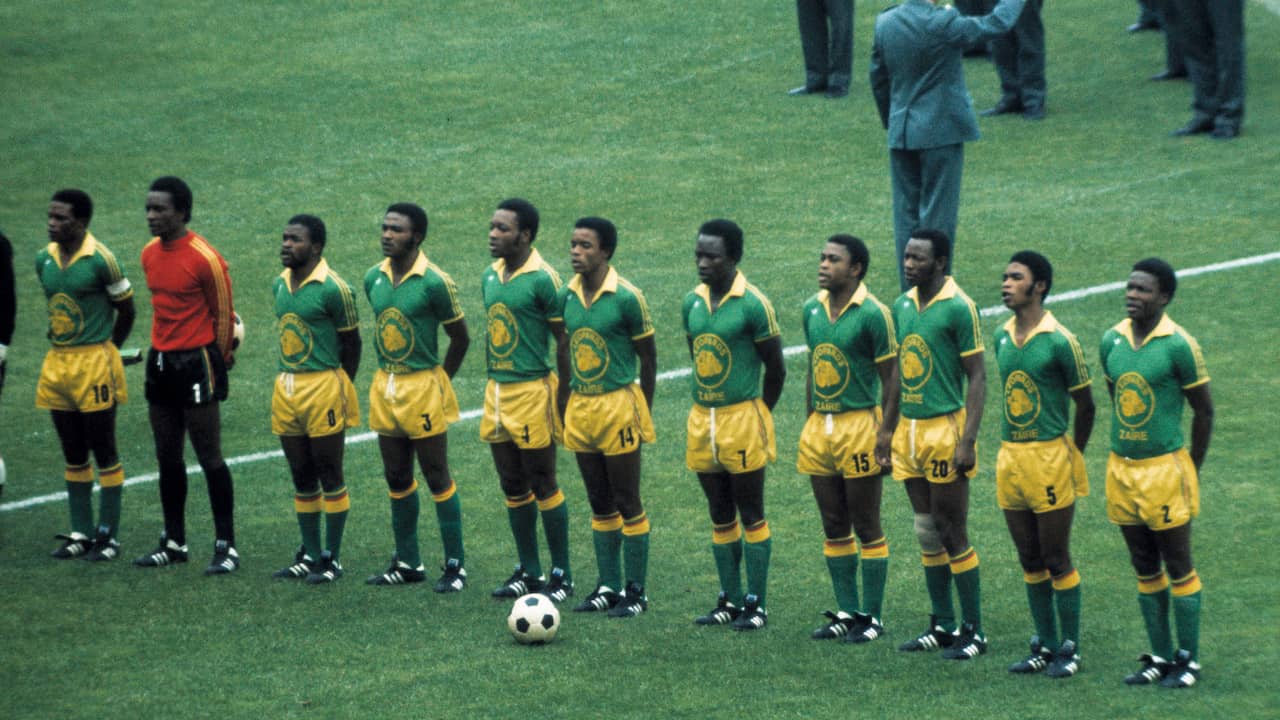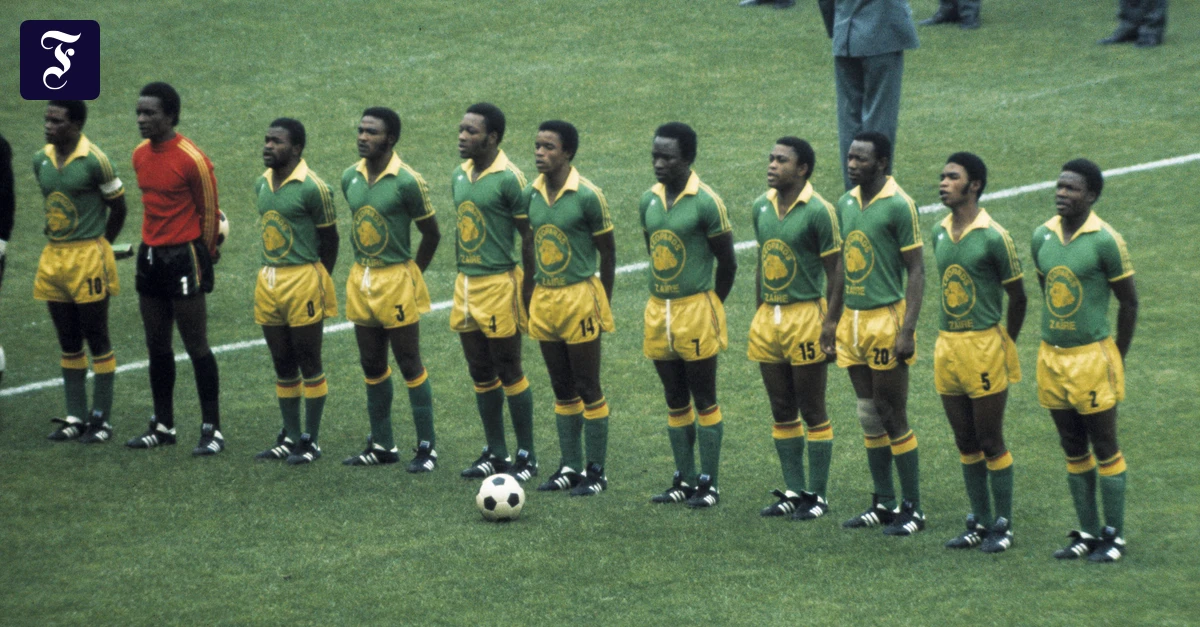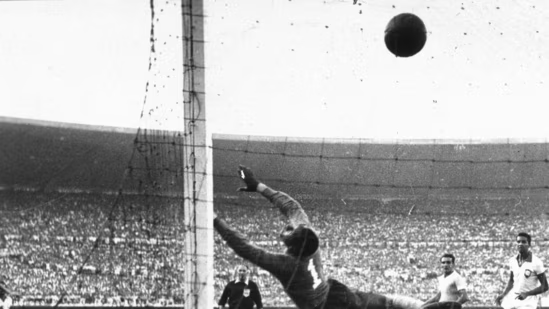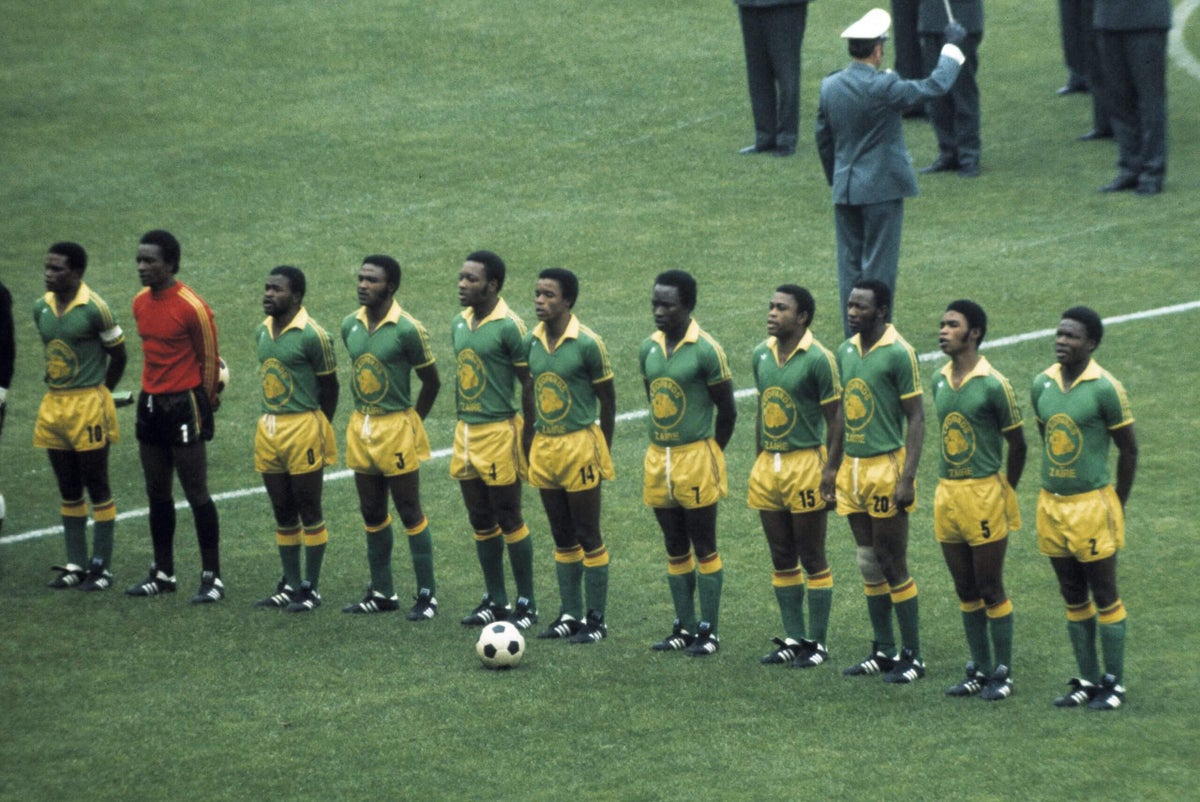
Get free access to the most comprehensive World Cup coverage in The Athletic app.“What on earth did he do that for?”It is one of those things most will know through compilations of bloopers, or listicles about football’s wackiest moments.Brazil have a free kick about 25 yards from goal. Referee Nicolae Rainea blows his whistle. The Brazilians aren’t quite ready to take it yet. Rivellino speaks to his other two team-mates standing over the ball. But while he’s talking, the player on the far right of the Zaire wall breaks off. He charges towards the ball and launches it downfield.Everyone looks pretty baffled at what Mwepu Ilunga has done, not least his team-mates. And the referee, who gets it together in time to brandish a yellow card. The player briefly attempts to protest, but it’s one of the more pointless arguments you’ll see.On the English commentary, John Motson declares his own confusion as to why Ilunga did what he did. Motson would later describe it as a “bizarre moment of African ignorance”, and that’s how it would be characterised for years to come, called things like “African amateurism” and “clowns of football“. It was a staple of football blooper compilations.The implication, or often outright assertion, would be that Ilunga was not aware of the rules of the game, that he just saw a football and launched it to the other end of the pitch, an assumption laced with colonialism and racism.But that was most certainly not the case. Ilunga was an experienced player who had won a number of domestic, continental and international titles, including the 1974 Africa Cup of Nations. He first played for Zaire in 1971. It was absurd to suggest he was ignorant of football’s basics.“I knew the rules very well,” he told the BBC in 2010. “I did that deliberately.”This took place in the final group game Zaire played in 1974. They didn’t qualify for another World Cup for 52 years… until this year, when DR Congo, as the country is now known, made this edition. That means this is the last thing many people will remember about them at a World Cup, this apparent moment of comedy.But the true story behind it is a dark, sad and overall pretty confusing one.Mobutu Sese Seko knew the value of sport. Between 1965 and 1997, he ruled as a brutal and oppressive dictator of his country, changing the name from Congo to Zaire in 1971. Sport was international PR, nominally for the nation, but more realistically for him. His most successful gambit was the ‘Rumble in the Jungle’, the fight held in Kinshasa in 1974 between Muhammad Ali and George Foreman. Staged alongside it was a three-day music festival featuring James Brown, B.B. King, Celia Cruz and The Pointer Sisters.So when Zaire became the first country from sub-Saharan Africa to qualify for a World Cup in 1974 — with a 100 per cent record, capping that by winning the Africa Cup of Nations in March — he was delighted. The whole squad was invited to the presidential mansion for an audience with Mobutu. By this stage, he rarely left this residence, such was his paranoia about being assassinated.The squad were simultaneously in awe, and ill at ease. “You have to remember that for many of us, who’d been raised in poverty, meeting Mobutu was like meeting a god,” Ilunga told the author Jon Spurling for his book Death Or Glory: The Dark History Of The World Cup, also saying that they noticed Mobutu’s staff becoming agitated at the promises made to the team.Mobutu spoke of great achievements, the pride at being the first Black African team at a World Cup, even how good the Zaire yellow shirts (which Mobutu apparently had a hand in designing) looked against their skin. Grand promises were made. Brand new cars for the squad. Houses. $20,000 (£15,000 at today’s rates) in cash. “Most of us left feeling giddy,” Ilunga told Spurling.Zaire in their yellow kit against Scotland at the 1974 World Cup (Peter Robinson – PA Images via Getty Images)Perhaps more importantly than that, they were promised plentiful resources while they were in West Germany for the tournament. They flew there on a chartered plane, were collected from the airport in brand-new Mercedes buses, taken to their luxury hotel and promised a generous stipend to fund their time there.The problem was that plenty of officials from both the government and national association wanted in on the glory, piggy-backing on the team for a jolly trip to the World Cup. And among the security staff, assorted suits and other hangers-on, the money promised to the players disappeared. To the point that when the players asked for their per diems so that they may experience some of the country, they were told by the team’s coach, Yugoslav Blagoje Vidinic, to stay in their rooms at the hotel. “Morale was low,” the defender Tshimen Bwanga told So Foot magazine. ”There were things we’d been promised that weren’t happening.”The other problem was that the team were simply not that good. Or at least, nowhere near as good as Mobutu thought or hoped they were. They were only part-time, for a start. They weren’t helped by the presidential decree that the national team’s players must remain in Zaire, saying: “Zaire must not become a cradle in Africa for Europe’s mercenaries.” In reality, as Ilunga pointed out, that simply meant “too few of the squad had any real experience of playing non-African sides”.They struggled in pre-tournament friendlies against Italian and Swiss club teams, then lost the opening game 2-0 to Scotland. Given the Scottish team featured Kenny Dalglish, Denis Law, Billy Bremner and Joe Jordan, that was a relatively respectable result.But by this stage, morale in the camp was through the floor. Before their second group game against Yugoslavia, government officials gave an extraordinary pre-match press conference, in which they claimed Vidinic had been got to by apparatchiks from his native land. “We have reason to believe that Yugoslav authorities convinced our coach to reveal our game plan,” they are quoted as saying, adding chillingly: “We have placed him in isolation and will make some changes.”Furthermore, the realisation that the money they thought was coming their way had been siphoned off caused the squad to hold a meeting the night before the game, debating whether to boycott the fixture. Several players, as many as eight, were in favour of going on strike, but in the end they decided to play. Although they might have ultimately reasoned that they need not have bothered.The preparation was hardly ideal, but even with that in mind, the game couldn’t have gone much worse. They were 3-0 down by the 18th minute, at which point Vidinic (who had eventually been allowed to take charge of the match) made the extraordinary decision to substitute goalkeeper Kazadi Mwamba, even though none of the goals were really his fault.It didn’t work. It was 6-0 at half-time, by which point Zaire were down to 10 men, but in keeping with their tournament in general, even that was laced with farce, because the wrong man had been sent off. In a fit of pique after the fourth goal, Ilunga had kicked Colombian referee Omar Delgado in the backside, but quickly scarpered, so that by the time the justifiably annoyed official had turned around, he wasn’t aware who delivered the offending boot. So he sent off forward Ndaye Mulamba instead, despite the protestations from the wronged player, backed up by two Yugoslav players who pointed to the real guilty party.There was an element of damage control, in that they only conceded three goals in the second half, but a 9-0 defeat was considered an unacceptable humiliation. After the game, the team were addressed by a group of government officials who, according to Ilunga at least, threatened them with extreme consequences if things went really badly in their game against Brazil. As Ilunga tells the story to Spurling, they were told that if they lost by more than three goals, they would “never see Zaire or your families again”.Zaire were beaten 3-0 by Brazil in the 1974 World Cup (VI Images via Getty Images)So what was the real reason Ilunga did it?Well, that’s an interesting question, the answer to which seems to be: it depends when you asked him. He gave several explanations before he died in 2015, which weren’t entirely unrelated and it could have been a combination of them all, but the many different reasons he put forward only underline what a complex situation it was.For example, he told the BBC in 2010 that he was trying to get sent off as an act of protest against the officials who had spent the team’s money.“I did that deliberately,” he said. “I was aware of football regulations. I did not have a reason to continue getting injured while those who will benefit financially were sitting on the terraces watching.”This was broadly in line, but slightly different, from his account given to L’Equipe in 2014.“We were really unhappy,“ he told the French newspaper. “We had just spent two months far from our families, without anyone by our side. There weren’t the same forms of communication as there are today. And they take our money? You don’t do that.“At the same time, it was also an opportunity that I took to provoke the referee. I wanted him to give me a red card. I said to myself: ‘I’m not playing anymore.’ Why would I stay on the field and take the risk of not returning home when the others — the people who took our money — are watching us peacefully from the stands?”But the same year, he suggested in an interview with the French magazine So Foot that it was more a momentary act of petulance and frustration than a predetermined protest.“We lost the first two games,” he said. “We had nothing left to play for, we were just going through the motions, nobody was motivated, and the Brazilians kept arguing when the referee blew the whistle. That irritated me, so I left the wall and kicked the ball away. I wanted to be sent off, but the referee only gave me a yellow card.”And perhaps most seriously, and most differently, in his interview with Spurling for ‘Death Or Glory’, published in 2009, Ilunga claimed his motivation was more about survival. In a very literal sense.He said then that, after the thrashing at the hands of Yugoslavia, government officials had told them that another humiliation would come with grave consequences.“They’d come with a message from Mobutu,” he said. “‘He says you have all brought shame on to the country of Zaire. You are scum, and sons of whores. The great leader says that if you concede more than three goals against Brazil in the final match, you will never see Zaire or your families again. Your leader is disgusted in all of you’. They ranted on at us for around 30 minutes, before leaving the room. There wasn’t anyone inside that room who doubted that those men meant every last word of what they said.He recalls seeing Rivellino prepare to take the free kick, the score 2-0, and made a snap decision. “I panicked. Everyone knew what he was capable of from that distance and I thought that if we went 3-0 down now, we were massively in trouble. I thought I could waste some time if I kicked the ball away before the referee instructed Brazil to take the kick. So I kicked it away.”Ilunga’s team-mates were just as confused as the rest of those watching. “I have no idea what went through his head,” the striker Etepe Kakoko told FIFA.com in 2014. “He probably thought the ball was in play, but he never really explained himself, and it remains a mystery to us.” Bwanga told So Foot: “ I didn’t understand it at the time! After the match, I went to ask him. ‘But why did you do that?’ He told me he thought the Brazilians were taking far too long, and he, as usual, was in way too much of a hurry!”Mohamed Kalambay, one of the goalkeepers in the squad, told the BBC’s Sporting Witness podcast: “He was a nervous type of guy. It was an abnormal reaction. He shouldn’t have behaved like that. People weren’t happy because… can you imagine? We were at the World Cup.”Furthermore, Kalambay casts doubt on the idea that Ilunga was fearful for his own or his family’s life. “We didn’t see these threats. People can say anything after a defeat, but it doesn’t mean Mobutu could do anything just to punish us.”Many of his team-mates were annoyed, but for some at least that annoyance faded: Kakoko would joke about it years later, and would only talk about that World Cup in fond terms to his son, Yannick, who would also go on to be a professional footballer and now manages Differdange in Luxembourg.Ilunga’s successors tried to reclaim the incident as a moment of humour, too. “Occasionally, when we get a free kick in training, someone will run up and kick the ball away and everyone just starts laughing,” then-Peterborough United defender Gabriel Zakuani told the Guardian in 2014.When the squad got home, they were not given the heroic treatment they were promised. The cars, the houses, the $20,000: none of it materialised. Many drifted into poverty. Some left Zaire, settling in Europe: Kakoko went to work in a Mercedes factory in Stuttgart and from there carved out a decent lower-league football career; Bwanga settled in France; midfielder Mafu Kibonge in the Netherlands; Ilunga’s children live in the UK.But many ultimately died largely forgotten by the state that said it would glorify them. “Many of us live like tramps,” Ilunga told Spurling. “If I could do it all again, I’d rather have worked hard at becoming a farmer.”This isn’t a story with an altogether happy ending. But it’s also not the story that the listicles, and the banter TV programmes, and the mindless jokes would have you believe.
Zaire, that World Cup free kick and the sad story behind one of the World Cup’s strangest moments
There is a deeper, darker background to this story than is evident from simply watching Mwepu Ilunga kick the ball away at a free kick
2,344 words~11 min read