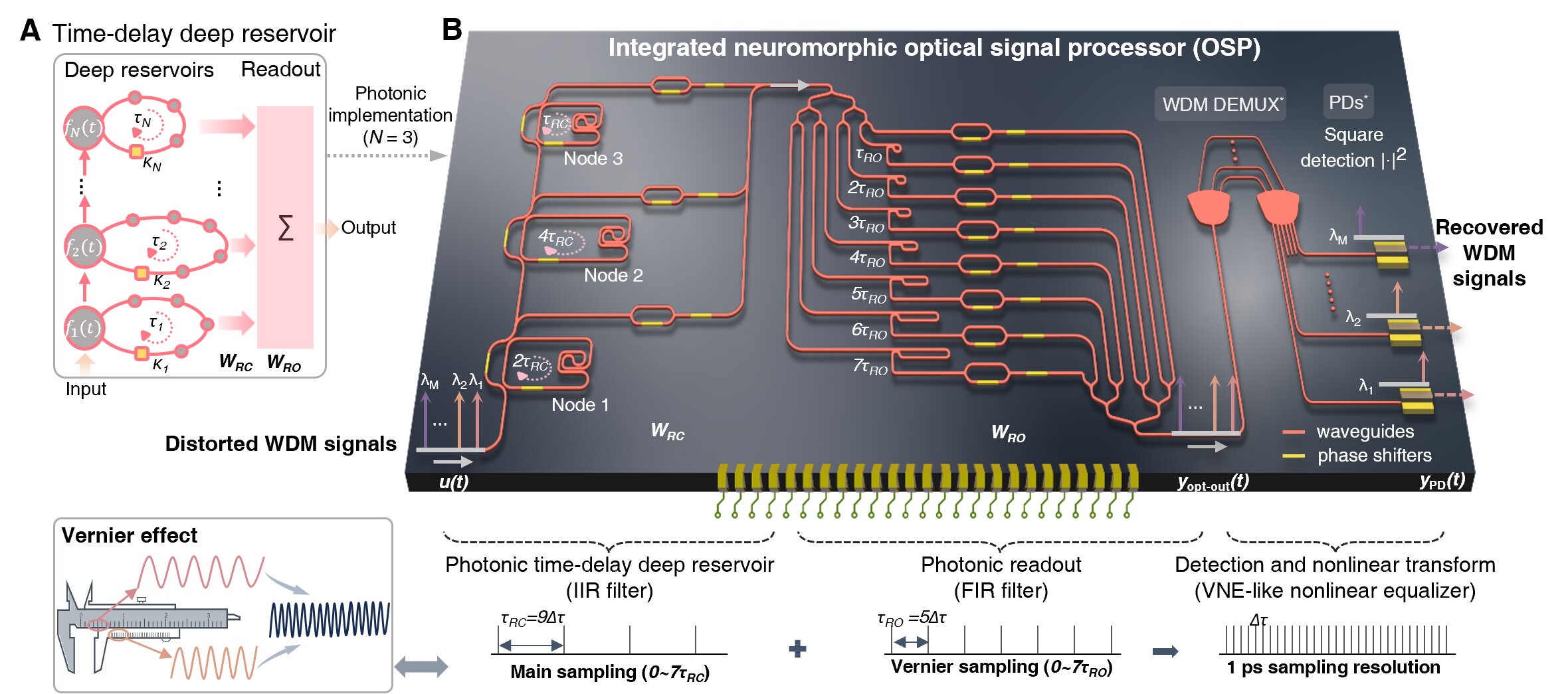
The OSP architecture comprises three photonic reservoirs and eight readout channels. By precisely tuning the optical delay lines on the chip, the research team enables the system to achieve extremely high temporal sampling resolution, allowing it to process high-speed optical signals more effectively. Credit: The Chinese University of Hong Kong
A research team led by The Chinese University of Hong Kong (CUHK) has developed a novel integrated all-optical signal processor (OSP) to address the massive data transmission demands of next-generation AI systems, particularly for high-speed links between multiple data centers.
Built on a silicon photonic chip, the OSP can correct signal distortion in real time while the optical signal is still in the form of light, without first converting it into an electrical signal for processing. In other words, it can handle signal impairments in high-speed transmission faster and more efficiently, helping improve communication efficiency between servers and data centers in large-scale AI systems.
Experimental results show that the OSP can perform real-time processing at an aggregate data rate of 1.6 Tb/s (terabits per second), with a latency below 60 picoseconds (one-trillionth of a second) and extremely low energy consumption of only tens of femtojoules per bit. This achievement helps overcome the bottlenecks of conventional digital signal processing (DSP) technologies in terms of speed, latency and power consumption, offering a disruptive solution for ultra-low-latency and green AI supercomputing. The findings have recently been published in the journal Science.