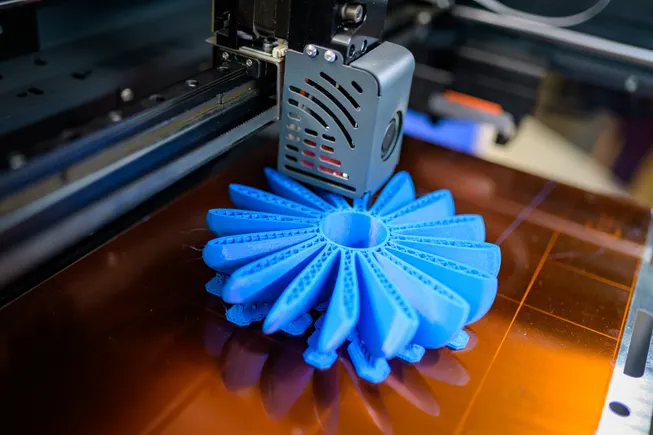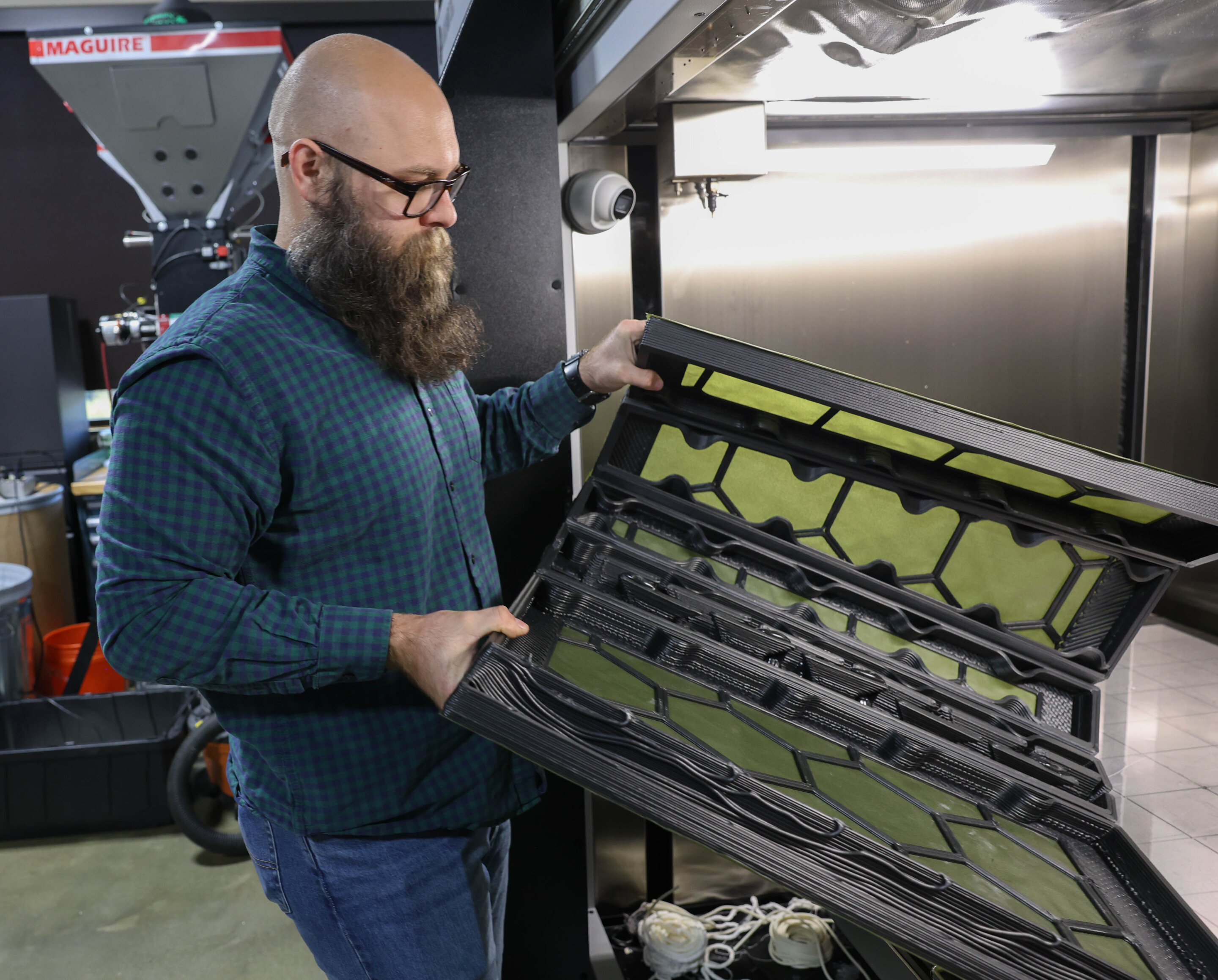
ORNL's Steven Guzorek demonstrates the lab's hybrid 3D printing method, which deposits an integration layer and composite material directly onto flexible nylon fabric, creating a mold-free, flat-to-foldable structure that reduces production costs and increases design flexibility. Credit: Amy Smotherman Burgess/ORNL, U.S. Dept. of Energy
Researchers at the Department of Energy's Manufacturing Demonstration Facility at Oak Ridge National Laboratory have introduced an innovation in additive manufacturing by integrating origami-inspired 3D printing techniques with hybrid composites—materials made from mixed reinforcing components. By eliminating the need for molds to fabricate a part, this process produces lightweight, cost-efficient structures with faster build times and greater adaptability.
Traditional composite manufacturing, while highly effective for producing strong, durable components, can involve long lead times and high mold costs that limit design flexibility. The ORNL method uses hybrid materials in an additive process without molds to produce flat-to-foldable structures that merge flexible and rigid components into a single design.
"This pioneering method redefines advanced manufacturing by fusing material science with transformative design principles," said ORNL's Steven Guzorek, lead researcher on the project. "By applying origami-inspired principles to hybrid composites, we are improving the efficiency and scalability of large-structure manufacturing and achieving forms unattainable with traditional additive approaches—advancing robust, cost-effective solutions for a broad range of applications."