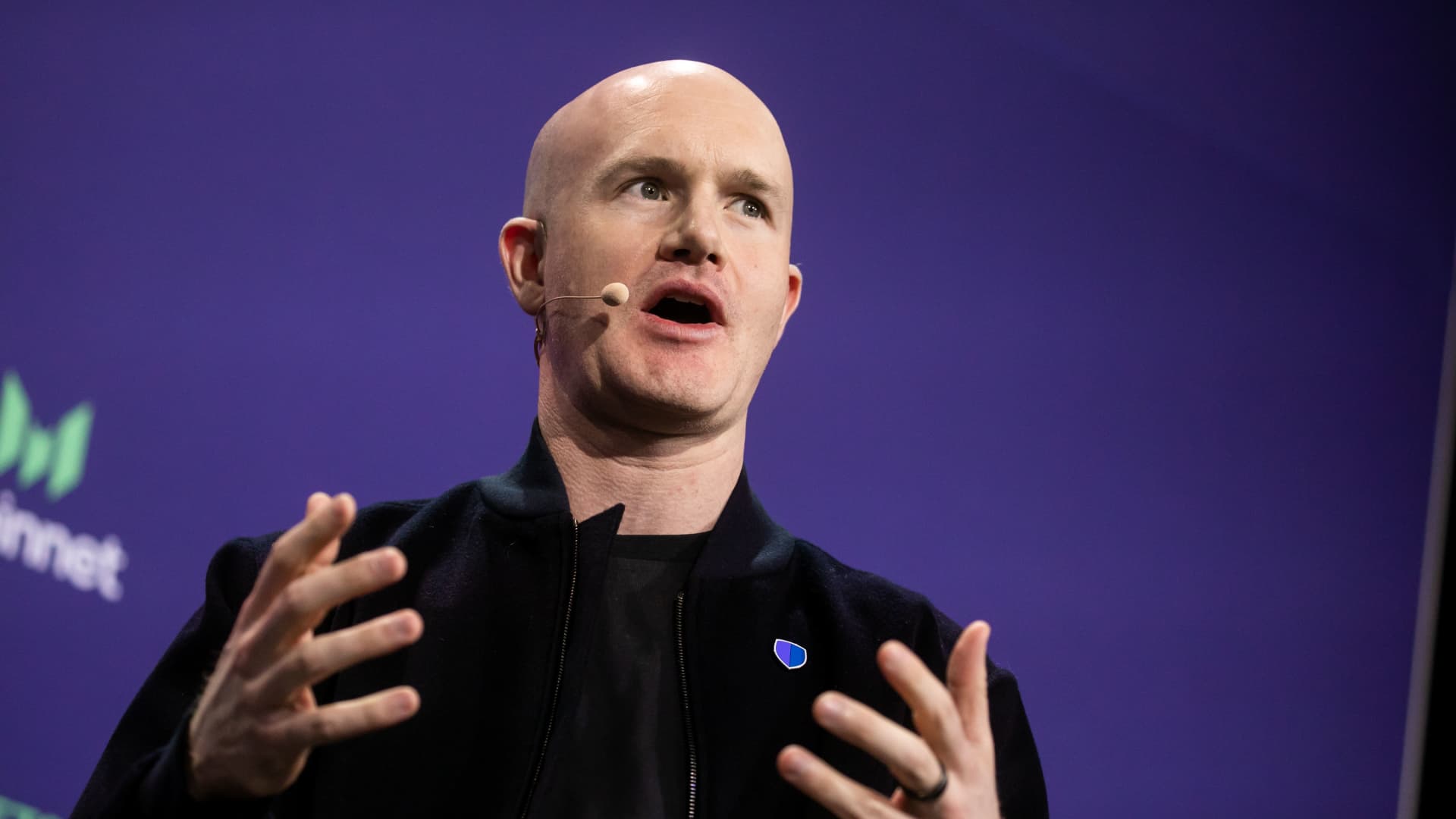
Brian Armstrong, cofounder and CEO of Coinbase.Jamel Toppin for ForbesCoinbase is moving fast to transform itself into a one-stop trading platform for the next generation of investors.On Tuesday, the company unveiled a slate of new products, including options trading for stocks and crypto, thematic index perpetual futures, support for agentic trading and new types of prediction-market contracts. The rollout is part of Coinbase’s broader “Everything Exchange” strategy, announced in December, which aims to expand the platform beyond crypto trading into all asset classes.“We’ve now caught up to a lot of the basics and started to accelerate past where a lot of traditional platforms are,” says Max Branzburg, Coinbase’s head of consumer products. “For example, our ability to offer these thematic index perpetual futures products (e.g. AI, China, Defense) is a totally new kind of equities trading that's not available anywhere else. The ‘everything exchange’ is not your parents' brokerage. This is an entirely new kind of financial platform that's really pushing beyond what was possible in the past.”Other new features include crypto binaries, which let users make “up or down” bets on cryptocurrencies over periods ranging from 15 minutes to a year. Coinbase is also adding “combos,” trades that bundle multiple predictions across categories into a single position. Similar products have recently been announced by prediction markets including MEXC and Polymarket.The expansion pushes Coinbase further into a crowded battle for young traders set to inherit baby boomer wealth, where Robinhood has long held the retail edge and offshore crypto exchanges have dominated derivatives. Robinhood has also fared better in the recent crypto selloff, with its shares down 18% since January versus a 65% decline for Coinbase. In 2025, the company posted $1.3 billion in profit on $7.2 billion in revenue. In the first quarter of 2026, however, it reported a $394 million loss on $1.4 billion in revenue as crypto prices declined.But Coinbase, traditionally stronger with institutions, has been accelerating its diversification while continuing to grow its core crypto business. Despite a nearly 40% decline in overall crypto trading activity last quarter, according to CoinGecko, Coinbase reached an all-time high of 8.6% in global crypto trading volume market share. And it could grow further as Coinbase moves deeper into derivatives. In May, the Commodity Futures Trading Commission cleared Coinbase to become the first and only regulated Futures Commission Merchant authorized to give U.S. clients access to global crypto perpetual futures and options through Deribit, the Dubai-based derivatives exchange Coinbase acquired for $2.9 billion last year.“We are unifying our global liquidity in a single place where both U.S. customers and non-U.S. customers can trade,” says Branzburg. “This is a really big step that has taken many years to build up toward, with lots of technology investments, M&A and regulatory developments. We’re now bringing the products that were historically only available offshore, such as options and perps, to U.S. clients, and our international clients will get the benefit of all the liquidity from U.S. trading.”Wall Street is taking notice. “We regard Coinbase at this point as less of a cyclical crypto brokerage and more of a foundational infrastructure platform for the emerging onchain economy,” wrote Mark Palmer, an analyst at Benchmark, in his recent research report. Palmer noted that the company now has 12 separate product lines generating more than $100 million in annualized revenue, including derivatives and prediction markets, which launched in December and have since become one of the company’s fastest-growing segments.Beyond trading, Coinbase has two other advantages that could help support that infrastructure thesis. The first is its early position in AI agent commerce. The company created x402, one of the leading standards for agentic payments, and operates Base, the blockchain that handles nearly all agentic payment activity, according to crypto analytics firm Artemis. Though volumes remain small: since October 2025, Base has processed less than $20 million in agentic payments.The second is stablecoins. Coinbase receives 50% of the revenue from USDC, the second-largest digital dollar, under its agreement with issuer Circle, where Coinbase acts as a primary distributor. Regulation could provide another boost—particularly the passage of the CLARITY Act, which would create a comprehensive framework for digital assets in the U.S. One of the main sticking points is whether crypto firms should be allowed to reward customers for holding stablecoins. Banks argue that such incentives could accelerate deposit flight from traditional financial institutions and that companies offering bank-like products should face comparable regulatory oversight. Crypto firms counter that such restrictions would protect incumbents and blunt one of the most important uses of stablecoins.The bill’s prospects remain uncertain, with bettors on Polymarket recently assigning it a 51% chance of passage.
Coinbase Expands Into Agentic Trading, New Prediction Markets Contracts And Derivatives
The largest crypto exchange in the U.S. is rolling out a flurry of new features as it races Robinhood and offshore rivals to win over young traders.
771 words~4 min read