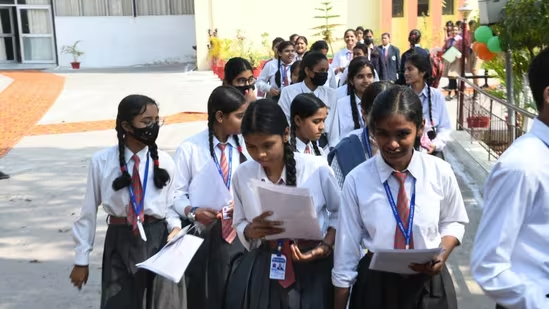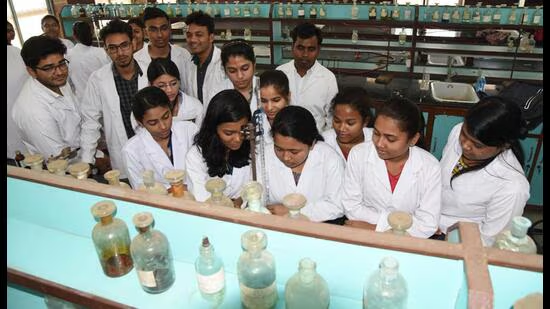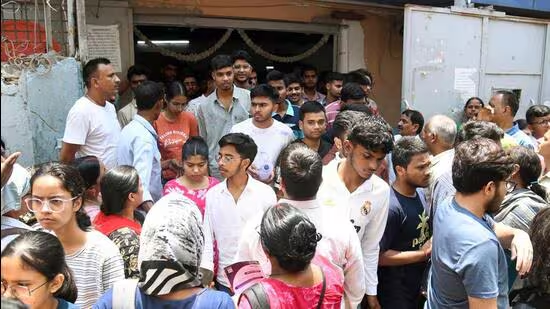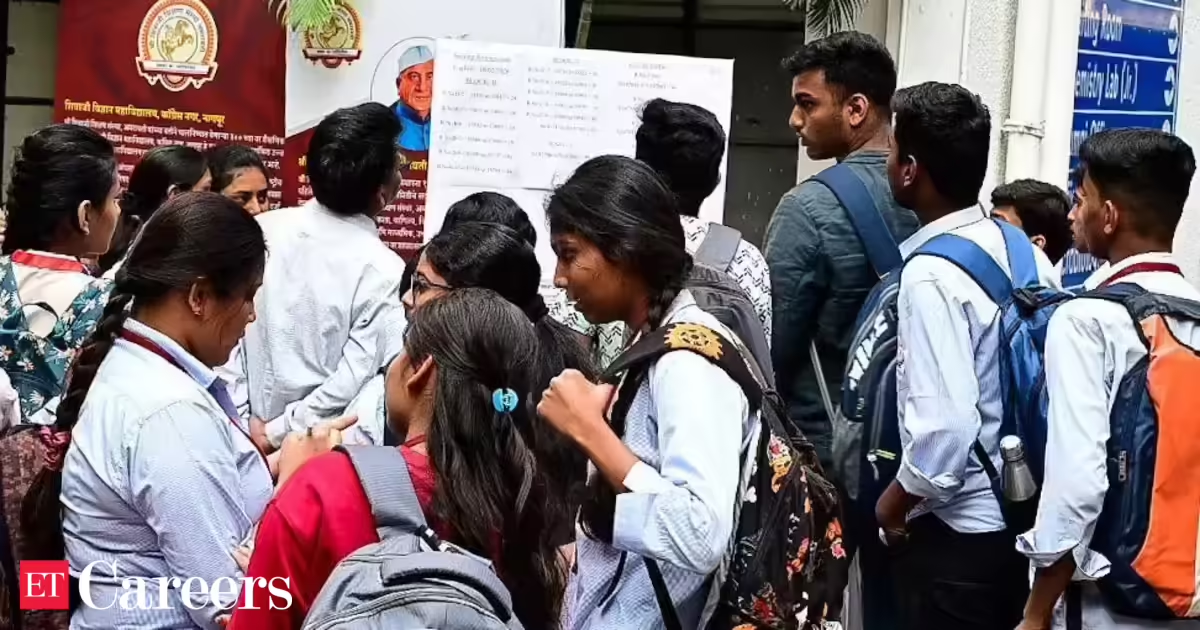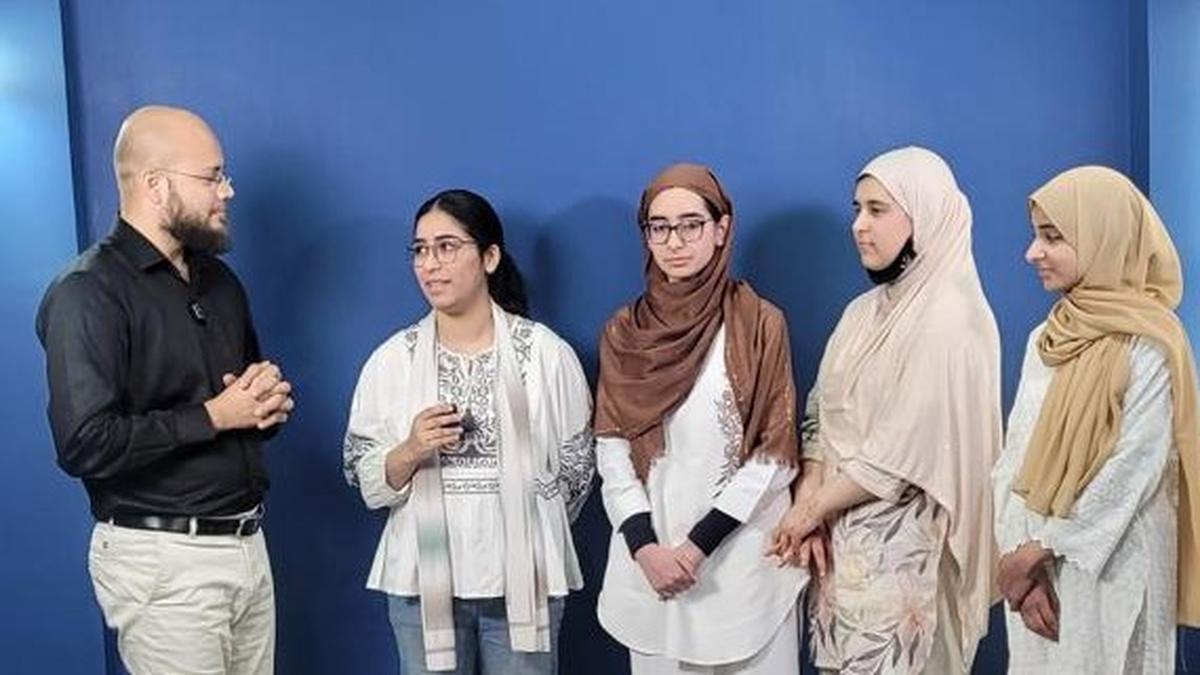
On June 1, IIT Roorkee announced the results for JEE Advanced 2026 and about 18 students, including six girls, from Jammu and Kashmir qualified for IITs. While this result made headlines and was hailed as an exceptional achievement of the students, excelling in education is not an anomaly in the valley anymore.(Sign up for THEdge, The Hindu’s weekly education newsletter.)Recent years have seen a significant growth in people’s approach towards education. Rather than focusing solely on school-level examinations and board results, parents and students are prioritising competitive exams that promise clearer career pathways.Mubeen Masudi, one of the founders of RISE institute, spoke about this shift laying emphasis on greater awareness and the inspiration from role models. “People earlier had no role models to mirror and there was a lack of awareness. The last 10-15 years saw a change on a relative scale, a lot of difference has been made. Students are not only dreaming, they are aiming for it,” he said.For many educators, the rise of competitive exams represents a broader shift in aspirations. Education is increasingly viewed not only as a means of learning but also a pathway to higher education, professional opportunities and social mobility.When girls leadThe growing ambition is also reflected in increasing participation and success of girls in competitive examinations.Mr. Masudi pointed to last year’s breakthrough when three female students from the institute secured admission to IITs. They joined IIT Delhi, IIT Bombay and IIT Kharagpur each. “These achievements show how possible all of it is and this year, six girls qualified, showing that last year was no fluke,” he added.According to Prof. Javeed ul Aziz, Assistant Professor of History at Kashmir University, changing social attitudes and improved access to education have contributed significantly to this trend. “Earlier, emphasis was put on morality, ethics and empathy. Teachers decided the curriculum. There was no concept of a standardised syllabus. Approach to education changed when people saw functional utility in it, when they could see it as a means for employment post 1947,” he said.Prof. Aziz also cites land reforms of the 1950s as reason behind the growth of education in the valley. The land reforms laws were passed on October 17, 1950 under the Prime Minister, Sheikh Abdullah’s Naya Kashmir framework. “These reforms improved the financial status of people and, subsequently, they were able to enroll their children in schools’, he said.“People’s inhibitions were removed. Moreover, infrastructural development also added to enrolment; in rural areas, accessibility became less of an issue and gave confidence to parents since schools were opened in the vicinity,” Prof. Aziz expressed.According to the latest ‘Digest of Statistics’, issued by the J&K government, 2023-2024 saw 12.40 lakh female enrolments from pre-primary to higher secondary levels. The data further revealed that the number of girls enrolled in schools rose from approximately 10.67 lakh in 2013-14 to 12.40 lakh in 2023-24, showing a 16.24% increase.Moreover, at higher levels of education, girls surpassed boys in total enrollment. In government degree colleges, 84,135 girls were enrolled compared to 77,160 boys. This extends to teaching departments at University level as well where 18,074 girls are enrolled compared to 14,419 boys.Performance wise too, girls have been surpassing boys in the valley. In the 12th-standard examinations, girls achieved a pass percentage of 64%, significantly higher than the 55% achieved by boys. Prof. Aziz expressed the same. “In recent years there has been a visible change, and girls are doing better than boys, stereotypes and notions are broken,” he said.A culture of learning, reimaginedThe inclination of Kashmir’s people to learning however, is not a recent development. Kalhana, the 12th-century historian and author of Rajatarangini, celebrated as the earliest account on the valley, described Kashmir as a land deeply devoted to knowledge.He wrote, “Learning, lofty homes, saffron, ice water and grapes; things that in heaven are difficult to find are common here.” Similarly, Hiuen Tsang, the Chinese pilgrim who visited Kashmir in 631 A.D., noted that the people of the valley “love learning and are well-cultured.”Traditionally, more focus was put on religious and cultural teachings and it was mainly due to colonial intervention in the 1890s that education became a central component, and the reorganisation of the school curricula on modern lines was done to integrate a westernised model of education that would eventually translate into employment for the public in the government.The 2023-2034 Union Ministry of Education’s (MoE) Periodic Labour Force Survey (PLFS) data revealed that literacy rate in J&K is 82%, which is more than the national average of 80.9%.The data further revealed that more than 15 districts in the valley achieved over 95% literacy rate. The survey was conducted under Understanding of Lifelong Learning for All in Society (ULLAS)- Nav Bharat Saksharta Karyakram (NBSK), also known as the New India Literacy Programme (NILP).Currently, the shift of education is inclined more towards competitive exams. Success in exams such as JEE, JEE-Advanced, NEET, UPSC, CUET, CAT is increasingly becoming the benchmark through which academic achievement is measured. Students who qualified in major exams this year are a part of the broader transformation, one that combines Kashmir’s historic culture of learning with aspirations of a new generation.(Shyma Rauf is a freelance journalist and former sub-editor at Deccan Herald, currently pursuing an M.A. in Convergent Journalism at AJK Mass Communication Research Centre, Jamia Millia Islamia.)
How education aspirations are driving JEE success in Kashmir
Explore how rising education aspirations are fueling JEE success and transforming academic achievement in Kashmir.
882 words~4 min read