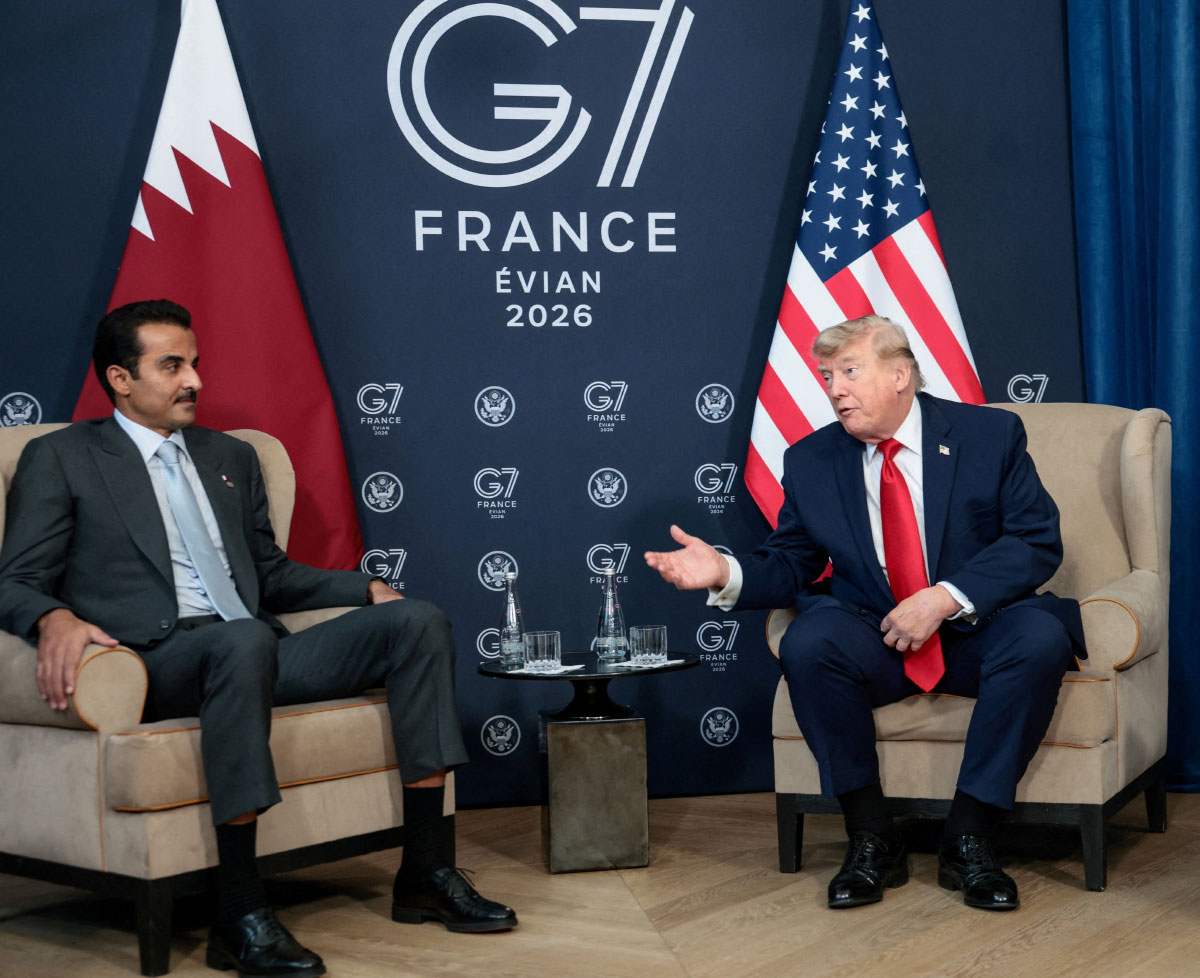
What better way to celebrate a peace deal than with a cage fight on the White House lawn? Donald Trump has always had a strong preference for performative conflict over prolonged violence. Now, he finally has his long-heralded agreement to end the war with Iran.But any peace is likely to be fragile. However Trump chooses to sell it, the deal that is scheduled to be signed in Geneva on Friday is not a permanent settlement. It is an extension of the current ceasefire for 60 days — allowing the Strait of Hormuz to reopen gradually and the US blockade on Iran to be lifted. There is a promise to resolve nuclear issues through negotiation linked to a pledge for a phased lifting of sanctions on Iran.It is easy to see how it could all break down. The Israeli government is unhappy — in particular about the announcement that its campaign against Hizbullah in Lebanon will have to end. With elections looming — and cross-party condemnation of the peace deal in Israel — Binyamin Netanyahu may feel the need to resume attacks on Hizbullah, particularly if it shells northern Israel. Iran might then respond with strikes on Israel.Lebanon is just the most obvious flashpoint. A gradual reopening of the Strait of Hormuz — while talks begin over the thorny issue of Iran’s nuclear programme — leaves plenty of room for disputes and misunderstandings. Under the circumstances, a gradual relaxation of tensions — punctuated by occasional bouts of violence — may be more likely than a complete cessation of hostilities.With no outright victor in the war, any peace deal had to be a compromise. The best sign is that hardliners on all sides are unhappy with it.American hawks wanted regime change in Tehran or, at the very least, a complete dismantling of the Iranian nuclear programme. But regime change now seems further off than when the war began. And Iranian promises of future co-operation on nuclear issues will be treated with deep scepticism by many in Washington.The hawks are also worried that unfreezing Iranian assets and lifting sanctions would allow the Islamic republic to rebuild its military and regional proxies. Last week, Senator Lindsey Graham, a leading Republican hardliner, was still pressing Trump to escalate the war by following through on his threat to seize Kharg Island, which is Iran’s major oil export hub. But Trump’s military advisers will have warned him that any US occupying force would be sitting ducks for Iranian counter-attack. The deal that he has now struck reflects the failure of the military option.The Israeli government is particularly unhappy. Amit Segal, a journalist close to Netanyahu, responded to the announcement of the deal by posting a quote from Henry Kissinger: “It may be dangerous to be America’s enemy but to be America’s friend is fatal.” The Israelis worry that Iran has successfully linked the opening of the strait to a ceasefire in Lebanon — tying Israel’s hands in a war on its own borders. More broadly, they fear that Iran, their most dangerous rival, has emerged strengthened from the conflict.But Iranian ultra-hardliners also seem angry. News of the impending deal provoked demonstrations in Tehran and regional cities — with slogans chanted against Abbas Araghchi, the foreign minister, and Mohammad Bagher Ghalibaf, the speaker of parliament. Critics of the proposed deal in Iran say Tehran is trading the opening of the strait for a promise of sanctions relief that the US might not deliver on — particularly since it could be blocked in Congress.There will also be mixed feelings in the Gulf states. Countries such as Saudi Arabia, Qatar and the United Arab Emirates badly need a settlement that allows the free flow of energy exports through the strait — and restores confidence in the region’s stability.But a fragile peace that is punctuated by occasional drone strikes or missile attacks may not be enough to reassure tourists and expatriate workers. Some of the damage done to key infrastructure, such as the Ras Laffan liquefied natural gas facility in Qatar, could take several years to fix.The Gulf states will also have to do some soul-searching about their future geopolitical positioning. Many decision makers in the region remain angry that the US and Israel launched a war on Iran against their advice. But they are also outraged that Tehran targeted them for retaliation, despite the fact that they did not participate directly in the initial US-Israeli offensive.In the coming months and years, the Gulf states will be faced with a profound choice. Do they double down on their relationship with the US — with some moving even closer to Israel — on the grounds that there are no plausible alternative security partners? Or do they decide that modern America is just too capricious and unreliable as an ally — and quietly begin to seek an understanding with Iran?Trump himself has a long record of repackaging failure — whether it is a bankrupt casino or a lost election — as success. He will move swiftly to do the same with this failed war for regime change. But to do that, he will need a long period of quiet in which Iran and the Middle East slip from the headlines. That may be too much to ask for.- Copyright The Financial Times Limited 2026
A war without victors: Trump’s Iran deal delivers fragile peace with many faultlines
However Trump chooses to sell it, the agreement is not a permanent settlement
TL;DRAI
Trump secures 60-day Iran ceasefire with Strait of Hormuz reopening and sanctions relief tied to nuclear talks. Fragile peace signals energy instability; enterprises must reassess Middle East infrastructure and regional partner reliability.
881 words~4 min read