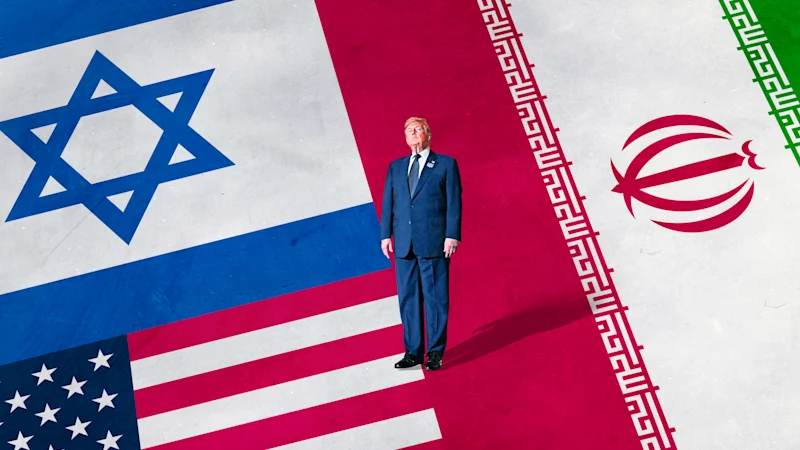
The agreement between the United States and Iran fits with a pattern from Donald Trump where the signing of a deal appears to be the major goal and the details often seem a distant secondary consideration.Overall, this war has been a disaster. More than 3,400 people have been killed, tens of thousands of homes damaged or destroyed, and havoc wrought across the globe through reduced food and energy supplies, particularly in some of the poorest parts of the world.It has also been a disaster for Trump. It's been hugely unpopular with Americans, even with some of his own working-class constituency who have been hit hard by higher petrol and food prices.With this new Iran deal, it's worth remembering this is the same president who hosted the first meeting of his new Board of Peace on February 19 this year.Nine days later, on February 28, the inaugural host of the Board of Peace chose to begin a war against Iran that engulfed many in the Middle East.He made that choice on the claim that Iran posed "an imminent threat" to the US. That's a claim that many prominent figures in the US, including Trump's now-former director of national intelligence, Tulsi Gabbard, have since distanced themselves from or refused to endorse.Enormous damageAt that Board of Peace meeting Trump claimed that he had got pledges from member countries for billions of dollars in aid for Gaza.The details of any reconstruction of Gaza are still confused. Gaza remains a humanitarian catastrophe after Israel rendered it largely unliveable from more than two years of heavy bombing.It appears that once Trump brokered that deal on Gaza he moved on, with Gaza now largely left to fend for itself.A pattern has emerged: what appears to matter for Trump is the "announcement effect" that comes with a signature on a deal. The substance takes second place.Months after Donald Trump convened his Board of Peace, plans to help Gaza remain confused. (Reuters: Denis Balibouse)In terms of this new deal with Iran, it is, of course, a good thing that the US and Iran have signed a memorandum of understanding and agreed to cease the war. There was a ceasefire of sorts in place, but it was a fragile one.This memorandum amounts to a real ceasefire so that in the subsequent 60 days the details can be negotiated.Under the deal, Iranian funds which have been frozen by the US will be released in phases. If, for example, Iran enables the retrieval of its remaining supplies of enriched uranium then Tehran will be rewarded by a partial lifting of sanctions.It's good that parties are hopeful that this might signal a new era in which Iran becomes part of the international economic and diplomatic community.But it's important to keep it in perspective. President Trump and Israeli Prime Minister Benjamin Netanyahu started this war, which has caused enormous damage to Iran, Israel, the Gulf states, the Middle East more generally, the global economy and America's standing and credibility around the world.Aims not reachedSo today when we look across the landscape of the Middle East upon the signing of this deal, what do we see?The Iranian regime has not been replaced, as Israel had wanted, but hardened. In fact, it's arguable that the new supreme leader, Mojtaba Khamenei, is more hardline than his father, Ali Khamanei, who was killed early in this war.Ali Khamenei was close to the Islamic Revolutionary Guard Corps (IRGC), the military hardliners who largely run the country, but Mojtaba Khamanei actually served in the IRGC. He is in part a product of the IRGC and their ruthless culture that any dissent within the country must be put down in whichever way is necessary.Iran's overall military capability has been reduced, but the war — which some independent analysts estimate to have cost the US as much as $US1 billion a day — has also seriously depleted US and Israeli supplies of munitions and missile interceptors.Iran's ballistic missile capability has not been destroyed, as was one of the aims of the US and Israel, and Iran's proxies through the region, particularly Hezbollah in Lebanon and the Houthis in Yemen, still have military capability.And the big one: Iran's nuclear program has not been ended, which was the aim constantly stated by Trump.This memorandum makes no commitment on behalf of Iran. Rather, it means that for the next 60 days the US and Iran will negotiate over this.The trend is in: The first 18 months of Trump 2.0 shows that this president is certainly good at signing deals and executive orders, but when it comes to difficult international issues he either cannot resolve them as he promised he could (such as the Ukraine war, which he said during his presidential campaign that he would solve in 24 hours) or he postpones rather than resolves them, such as Gaza and Iran.Continuing occupationOn the Gaza ceasefire Trump claimed that he'd done something that others had not been able to do for thousands of years, bring peace to the Middle East.That was, of course, nonsense. He didn't bring peace to the Middle East.Firstly, he didn't bring any sort of resolution between the Israeli and Palestinians. And not long after, he started a new war with Iran.He put his own Trumpian hyperbole on that Gaza deal, but he did not address one of the underlying causes of the ongoing conflict in that part of the Middle East: Israel's insistence that it continues its military occupation of the West Bank and Gaza.That Israeli military occupation is, of course, not the only cause of conflicts in the Middle East, but for anyone who has studied the region and is able to look objectively at Israel's occupation it feeds so much of the conflict through the region.Jasmine El-Gamal has advised the Pentagon on the Middle East. She's regarded as one of the leading analysts on the region.She told me for a Four Corners program, The Big War, in 2024: "What we know is that Iran and all of its proxies use that conflict. Whether it's disingenuous or not, it doesn't matter. The fact is, they use that conflict as justification for their aggression in the region, for their actions. Israel will never be safe as long as it continues the occupation."Former Australian prime minister John Howard came to a similar view. He said in 2006 that the war between Hezbollah and Israel was not the root cause of conflict in the Middle East. He said: "Australians want the fighting to stop and Australia also wants everybody to address the root cause of the problem, and the root cause of the problem is still, in the whole of the Middle East, is still the settlement of the Palestinian issue."Leaders clashOne of the interesting consequences of the war has been the serious strain in the relationship between Trump and Netanyahu.In recent weeks Trump has had ferocious phone calls with Netanyahu.In one, the details of which Mr Trump confirmed, he told Netanyahu that "you're f**king crazy" and that "you'd be in prison if it weren't for me".The "prison" comment was a reference to corruption charges against Netanyahu, which Trump has publicly tried to pressure Israeli authorities to drop.Vice-President JD Vance is also reported by Israeli media to have yelled at Netanyahu over the surge in violence by Jewish settlers against Palestinians in the West Bank.Aaron David Miller, a former US government adviser on the Middle East, said the public comments were "quite extraordinary"."No US president has ever talked about an Israeli prime minister in the way that Trump has," he recently told US media."It's worth remembering that Donald Trump is still more popular than Netanyahu in Israel."Israelis regard their relationship with the US as their most important one.The fact this war has seen such public criticisms by the US president against their own prime minister will only increase anxiety.And so Trump has captured another signature, another deal. But as with Gaza, the underlying issues remain unresolved.It's possible that over the next 60 days a deal is struck that brings Iran into the international community. But for the moment, many will see this as all about Donald Trump cleaning up a mess he made.
US-Iran 'deal' reinforces Trump trend
The ceasefire agreement fits a pattern from Donald Trump where the signing of a deal appears to be the major goal and the details often seem a distant secondary consideration.
1,359 words~6 min read