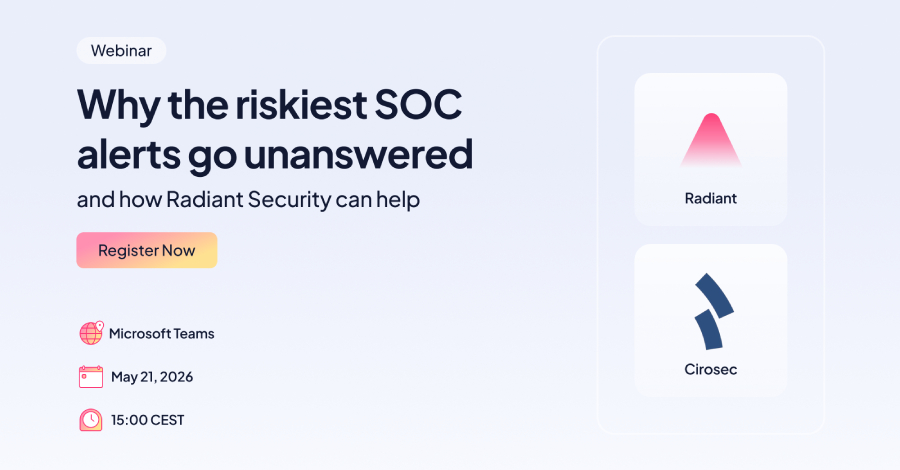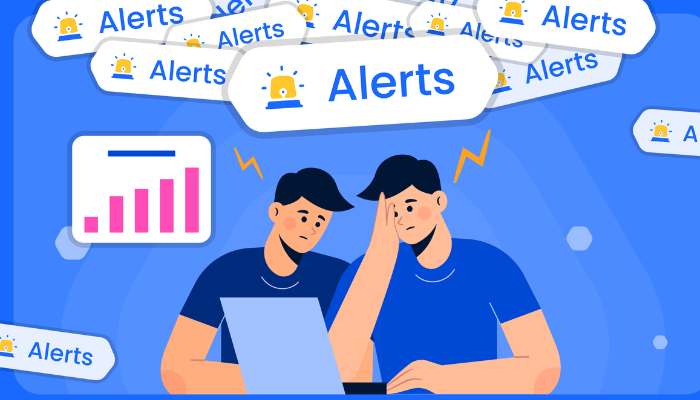
Some alerts never get triaged: WAF anomalies, supply chain warnings, dark web access listings, cross-domain authentication patterns that only look wrong when you line up three systems at once. These are the alerts that sit at the edges of what in-house SOCs can investigate, that MSSPs quietly escalate back to you, and that AI SOC tools weren't trained to evaluate. In this recorded webinar, Radiant Security CEO Shahar Ben-Hador breaks down how Radiant is the only AI-SOC platform that triages the high-risk alerts no one else covers. Where most AI SOC tools are optimized for routine, high-volume detections, Radiant's agentic AI follows any alert, across any domain, with no ceiling on coverage. That's what makes it the only platform that can close the blind spots this webinar exposes, not by adding headcount, but by reasoning through the alerts your current stack treats as exceptions. Want to learn more about how AI SOC can help you triage all your alerts? Book a demo here. Author Bio: As a former CISO at Imperva, Shahar Ben-Hador saw firsthand how alert fatigue breaks even the best security teams. After nearly a decade at Imperva, rising from IT Admin to their first CISO, and leading product at Exabeam, one thing became clear: the problem isn't the people. It's the tools. Playbook-driven automation that requires constant maintenance. AI bolted onto legacy stacks and sold as transformation. Neither actually solves the problem. That's what drove Shahar to found Radiant Security alongside his long-time colleague Barry Shteiman. Radiant is AI-native from the ground up. No playbooks. No tuning. Just accurate, autonomous triage.
The Riskiest Alerts No One Triages
Radiant Security explains how AI SOC triages WAF, supply chain, and dark web alerts that traditional SOC tools often miss.
TL;DRAI
Radiant Security's AI-SOC platform triages high-risk alerts—WAF anomalies, supply chain warnings, cross-domain patterns—that existing stacks skip. AI-native approach without playbooks or tuning reduces alert fatigue and cuts CISO team costs, closing blind spots competitors leave open.
294 words~1 min read