Google Sheets recalculates cells twice as fast after shifting its compute engine to WebAssembly. Figma cut initial load time by 3x. Shopify executes custom checkout rules compiled from Rust to Wasm at the CDN edge - all in production, serving millions of users every day.
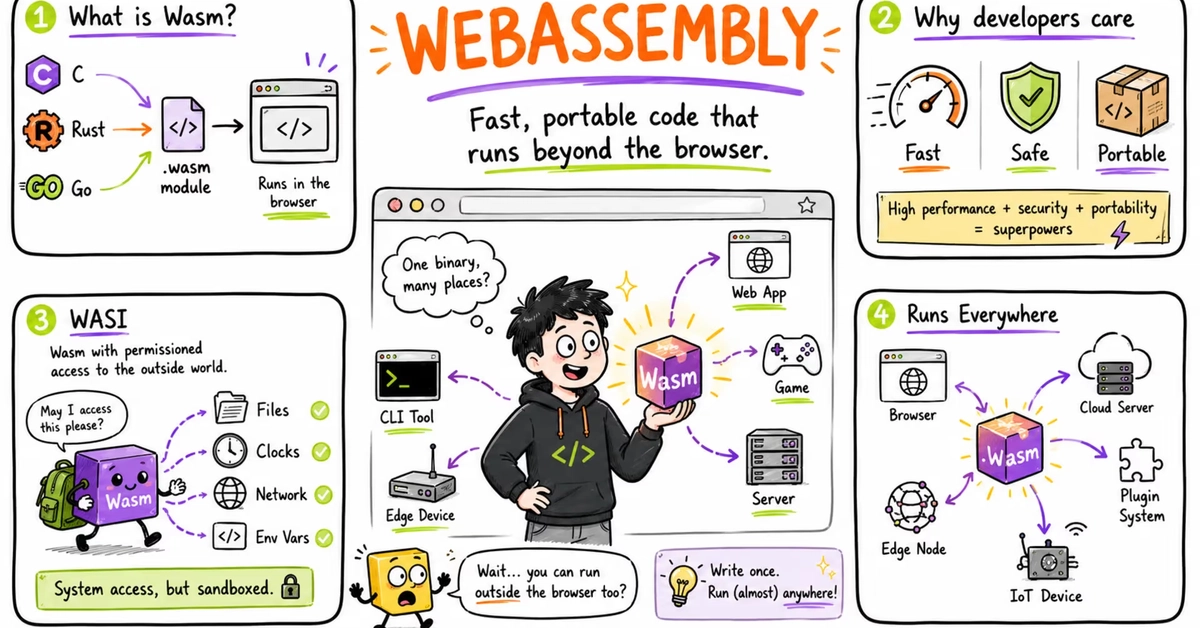
WebAssembly started as a way to bring C++ into the browser. Today, in 2026, it is a universal binary runtime that executes in browsers, edge networks, serverless functions, and even AI inference pipelines. The W3C ratified Wasm 3.0 as a formal standard in September 2025, and WASI Preview 2 is now stable. The tooling has matured to a point where it genuinely works.
Over 70% of developers now evaluate or actively use Wasm outside the browser, per CNCF survey data. This is no longer a niche experiment.
What Is WebAssembly?
WebAssembly is a compact binary instruction format designed to run inside a sandboxed virtual machine. That VM is embedded in every major browser, in standalone runtimes like Wasmtime, and on cloud platforms from Cloudflare Workers to AWS Lambda.