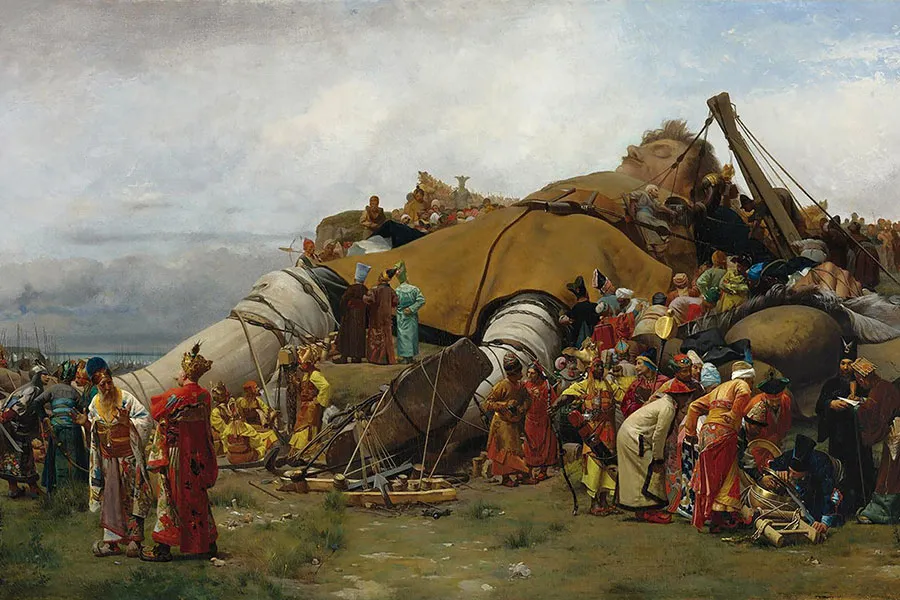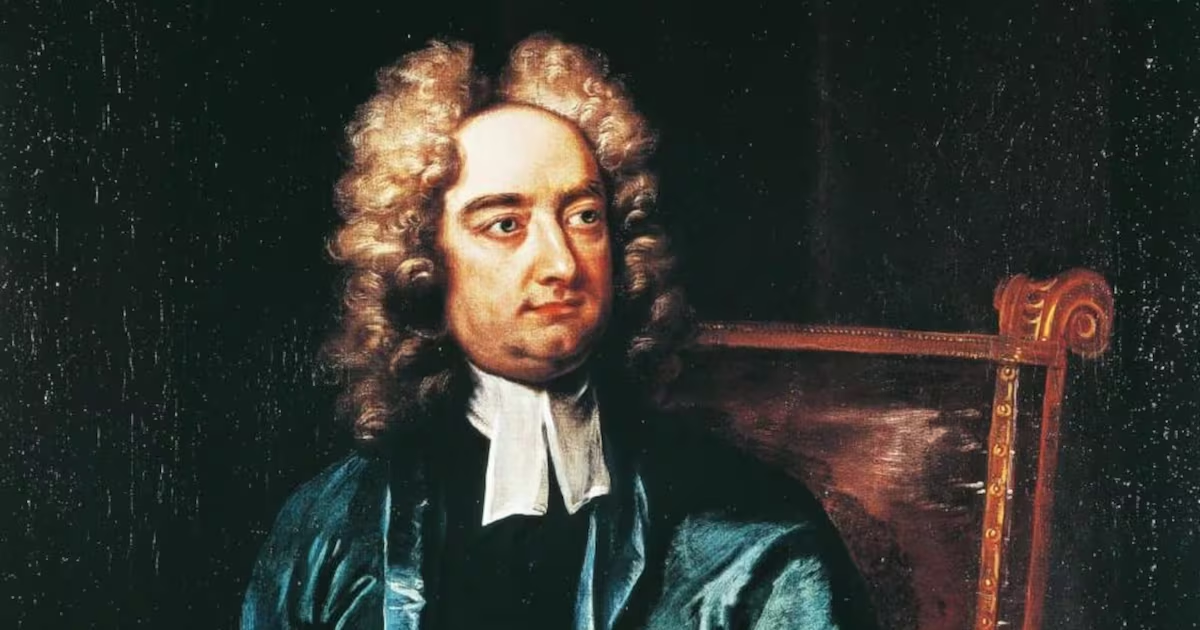
It was this time 300 years ago that Jonathan Swift left Dublin for London, to find a publisher for the masterpiece we now know as Gulliver’s Travels.The book’s title would actually be Travels into Several Remote Nations of the World, but who would he say was the author of the book? In the 1700s, writing could be a dangerous occupation, and almost everything Swift ever wrote was published anonymously. This new book would be his most controversial, and Swift’s name would not appear on it.In time, the book’s author was identified as a Lemuel Gulliver and one theory holds that Swift got the idea of his pseudonym as he passed through an English town whose innkeeper was Samuel Gulliver.Through Gulliver’s journeys, Swift held a mirror to show the cruelty and foolishness of British society. In Lilliput, Gulliver finds two factions warring over a trivial matter: the correct way to break open a boiled egg. It is a war between the Big-enders and the Little-enders, a reference perhaps to the decades of wars in Europe between Catholics and Protestants that had claimed the lives of hundreds of thousands of men.In Gulliver’s next voyage, he proudly tells the king about how his people use gun powder, how they can lay siege to a city, and in firing cannon balls could “rip up the pavement, tear the houses to pieces, burst and throw splinters on every side, dashing out the brains of all who came near”.The king is horrified that societies exist that use such a substance on other humans. He told Gulliver that he would rather lose half his kingdom than use it against his fellow men. He commanded Gulliver to never mention gunpowder again on his island.The 1700s was a time when the British empire was expanding, and the leaders were proud of their ability to subdue people in far-off places, and steal their land and other property, and with the approval of Swift’s own church.Through Gulliver, Swift described the brutal process of establishing a colony, saying: “a crew of pirates ... see a harmless people, are entertained with kindness; they give the country a new name; they take formal possession of it for their king; ... they murder two or three dozen of the natives, bring away a couple more, by force ... Here commences a new dominion acquired with a title by divine right. Ships are sent with the first opportunity; the natives driven out or destroyed; their princes tortured to discover their gold; a free license given to all acts of inhumanity and lust, the earth reeking with the blood of its inhabitants: and this execrable crew of butchers, employed in so pious an expedition, is a modern colony.”[ In praise of Jonathan Swift: A prolific writer and moralist with ferocious witOpens in new window ]An essential part of the colonialisation process was, of course, slavery. And in Gulliver, Swift seemed to refer to how the Irish had become slaves to the English.During the summer of 1723, Swift went on a long tour of Munster, during which he encountered the absolute poverty of the rural poor in Tipperary. The Catholic population was suffering under the penal laws, which stripped them of land, education, political rights and economic power.Swift wrote to a friend about what he saw: “filthy cabins, miserable tattered half-starved creatures, scarce in human shape.” He wondered if the Irish peasantry had been so long brutalised that they were no longer fully human.In the winter following this great tour, Swift wrote Gulliver’s fourth voyage about a land where the dominant species is a form of horse. Their slave animals are a form of brutalised humans called Yahoos, which he describes in ways similar to how he had described the unfortunate people he saw in Tipperary.There is a grand assembly on the island, during which the horses describe the Yahoos as filthy animals, and consider exterminating them all. This was written more than a century before Ireland’s great hunger, and two centuries before the world learned the phrase “final solution”. Swift was warning us that when whole populations are dehumanised and reduced to cruel stereotypes, it becomes easier to justify mass violence against them.In time, these political messages would be overlooked. The book’s title would be shortened to Gulliver’s Travels, and it would be best known as a children’s book including just the journey where Gulliver is a giant. This version has sold more copies, and has been adapted more times for screen, than any other Irish book.[ In the World Cup of ideas, Jonathan Swift should play for IrelandOpens in new window ]But we overlook Swift’s messages at our peril. His commentary about warfare, genocide, suppression of human rights, and the invocation of divine word to justify it all, are as relevant today as they were this time 300 years ago.Gerry Mullins’s musical – Jonathan Swift, Savage Indignation – will be performed in Howth Castle, Co Dublin, on June 20th. Tickets from www.howthcastle.ie
Why Gulliver’s Travels is still relevant 300 years on
We overlook Jonathan Swift’s messages at our peril. His commentary is just as meaningful today
826 words~4 min read