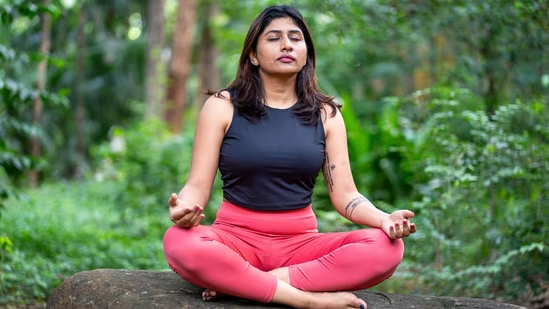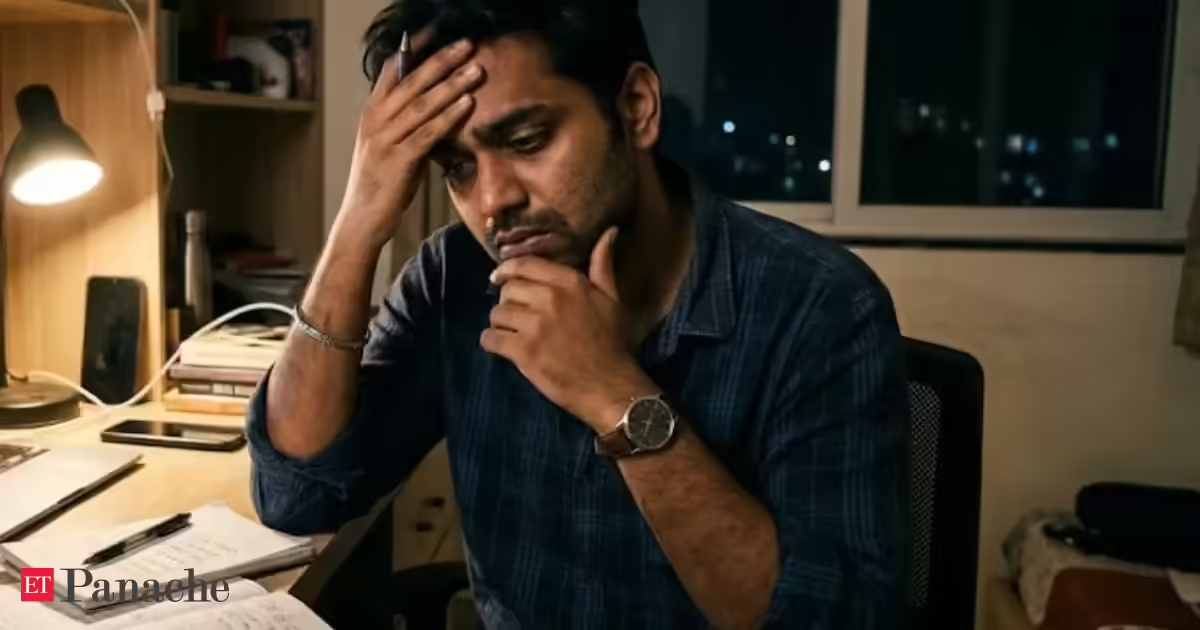
Have you ever stepped out of the shower and wondered whether you actually washed your hair because you were so busy overthinking – perhaps even catastrophising – about the day ahead?Or left the house, realised you had forgotten something, gone back inside, and then forgotten what it was you were looking for?Or felt a pang of guilt when a loved one shared something difficult that happened in their day and, moments later, found yourself asking: “Sorry, what did you say?”If so, you’re perfectly normal.In 1914, James Joyce wrote in Dubliners that Mr Duffy “lived a little distance from his body”. More than a century later, in our always-on digital world of information overload and endless social media feeds, many of us can feel as though we are living on another continent from our bodies.Surely one of our deepest human longings is to feel fully alive – to be present to our lives as they unfold, and to the people we love. Yet, the Deloitte Ireland Digital Trends survey found 70 per cent of us believe we spend too much time on our devices. The truth is that we are up against powerful forces competing for our attention.We live in an attention economy, in which social media companies are incentivised to capture and retain our focus and attention for as long as possible. Often this means keeping us absorbed in what matters least: dancing cat videos, celebrity gossip and the latest online controversy. The cost can be what matters most: our sense of presence, peace of mind, wellbeing and connection with those closest to us.Do you remember waking as a child on a summer morning? The smell of freshly cut grass. The feeling of the ocean breeze against your face. The excitement of a day full of possibility stretching ahead.[ Your Wellness ‘Drama can offer every child an opportunity to explore their imagination’Opens in new window ]For many people today, that vivid aliveness has been replaced by a subtle numbness – a feeling of detachment from life itself. Hyper-stimulation and constant distraction leave little room for us to experience genuine presence.Thankfully, this is not inevitable.It is possible for us to cultivate a deeper sense of presence and, through it, discover our capacity to live with greater groundedness, ease and joy.Interestingly, the same survey mentioned above found 74 per cent of respondents check their phones immediately upon waking.Therein lies both the problem and the beginning of the solution.Today, most of us are conditioned to prioritise external activity and accomplishment. We spend our lives trying to get things right “out there”, believing this will eventually deliver happiness and fulfilment.[ A quick summer survival guide for parents of Irish teenagersOpens in new window ]This external focus can certainly help us create materially comfortable and outwardly successful lives. But the quality of our lives depends less on what we accomplish and more on the state of mind we bring to our lives.Ultimately, it is about how we feel at the end of the day.In our pursuit of external goals, responsibilities and entertainments, we often neglect our inner lives. Yet every one of us has an inner life, whether we acknowledge it or not. It consists of all the thoughts, emotions and mental habits that shape our experience of meaning, purpose and wellbeing.Are we living with increasing feelings of anxiety, loneliness and disconnection, or with growing peace, connection and joy?Ignoring our inner life doesn’t make it go away. Instead, it’s like living in a beautiful mansion while neglecting the garden behind it. Without attention and care, weeds inevitably take over.Many of the personal struggles we face today – and indeed many of the challenges we see reflected in society – stem from this neglect of our inner world.So how do we begin restoring balance between external accomplishment and inner wellbeing?It can start with something remarkably simple: setting aside 10 to 15 minutes each day for meditation and reflection. Is your inner voice saying “I don’t have time for that, I’m too busy”?Maybe you can pause and reflect, busy with what?From almost three decades of personal practice and more than 20 years of teaching others, I have found this to be a truly powerful and reliable way to restore that balance between outer activity and inner experience and develop an enduring wellbeing.The ideal way to begin is first thing in the morning with a simple breathing meditation.Before reaching for your phone – your portal to the external world – breathe yourself into the present moment.Too often we start the day lost in worries, plans and imagined scenarios. Then we reach for our phones and immerse ourselves in someone else’s life on social media or the latest troubling news from elsewhere in the world.As a result, many of us begin the day caught in cycles of anxiety, worry and rumination before we’ve even left our beds. We’ve already lost touch with our inner state of mind.A different approach is possible.Pause.First, become aware of how you feel. Whatever is present, simply acknowledge and accept it without judgment. It is your experience in this moment.This is not always easy. Many of us have become accustomed to turning away from uncomfortable thoughts and emotions. We keep ourselves busy, distracted and entertained to avoid facing them.Yet there is a simple truth: doing difficult things tends to make life easier over time.When we learn to turn towards our minds rather than away from them, we develop the capacity to experience difficult emotions without being overwhelmed by them. In doing so, we discover our potential for deeper peace and genuine happiness.The opposite is also true. Doing what is easy can make life increasingly difficult. Constantly distracting ourselves may provide temporary relief, but it often deepens the agitation beneath the surface. Like scratching an itch, it feels satisfying in the moment but ultimately intensifies the discomfort.[ Daring to recognise the potential of loneliness to cause harm – and of connection to healOpens in new window ]Second, gently bring your attention to your breath as it enters and leaves through the nostrils. Return your focus to your breath whenever you become lost in thought.As you do, all the mental rewinding, fast-forwarding and distraction will subside. It is as though you are turning down the volume on the noise of the mind.In that quietening, you become more present and reconnect with a sense of inner calm. You discover something remarkable. That peace is not something that needs to be created; it emerges naturally when the mind settles. And the more peaceful we become, the naturally happier we feel – not only in meditation, but increasingly in everyday life.Over time, we develop greater familiarity with our inner resources and greater confidence in our potential to live from that place of presence, peace and joy.Third, in that space of peace and presence, bring to mind someone you love. Reflect on one way in which they contribute to your happiness and wellbeing and allow yourself to feel gratitude for it.Notice what happens.Gratitude naturally gives rise to warmth, affection and connection. This simple practice can deepen our inner wellbeing and strengthen our bonds with others.You can extend this practice to more people over time, enriching the quality of all your relationships.Perhaps the kindest thing we can do for ourselves and others is to reclaim that most precious and endangered commodity of our time: our attention. When we bring it back to the present moment, we rediscover something many of us have been searching for all along – the capacity to live with greater peace, genuine happiness and connection.Kadam Adam Starr will be leading a meditation workshop on June 20th at Tara Kadampa Meditation Centre, Dublin, entitled, Feeling Present, In A Digital Age
Before reaching for your phone in the morning, breathe yourself into the present moment
There are some simple steps you can take to develop an enduring wellbeing and drown out the external noise
1,281 words~6 min read