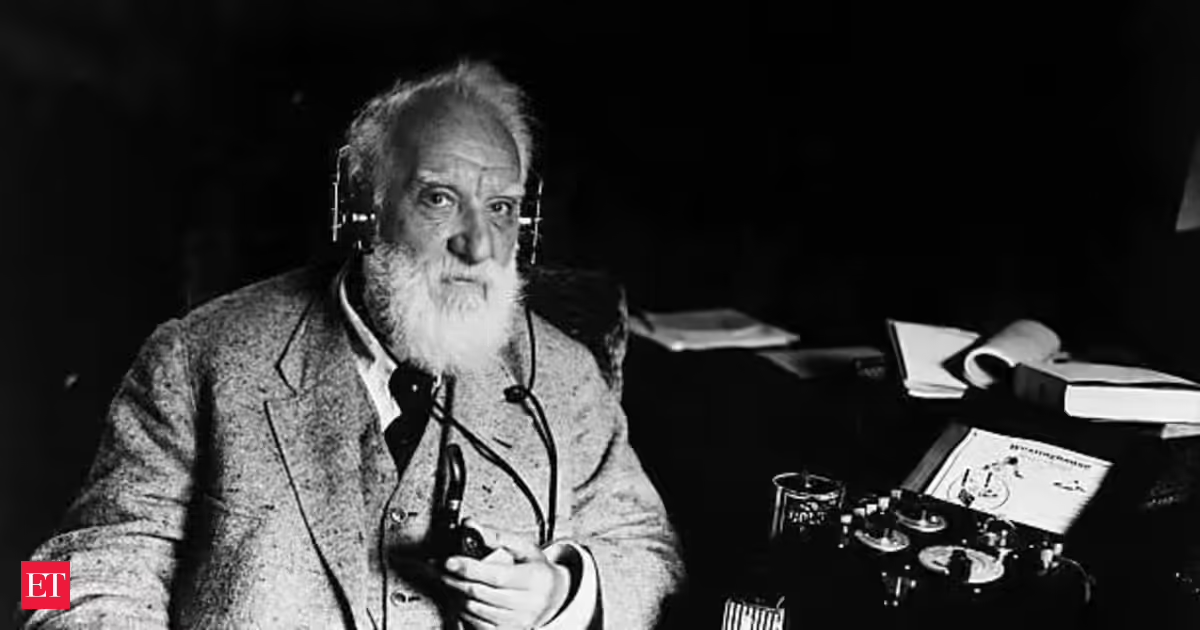
The quote of the day reveals how modern life sometimes leaves very little room for silence. People wake up and immediately begin scrolling through phones, checking messages, planning the day, worrying about work, replaying old conversations and imagining future problems before breakfast is even over. In the middle of this constant mental noise, one quote by Alan Watts still feels surprisingly relevant decades after it was first spoken.The quote of the day by Alan Watts is: “A person who thinks all the time has nothing to think about except thoughts. So, he loses touch with reality, and lives in a world of illusions.”This quote came from Alan Watts’s discussion on overthinking and the human tendency to become disconnected from the real world while staying trapped inside the mind. In the same explanation, Watts described thoughts as “chatter in the skull—perpetual and compulsive repetition of words, of reckoning and calculating.” His argument was not that thinking itself is bad. Instead, he believed problems begin when thinking becomes endless and uncontrollable, when people stop experiencing life directly and only analyze it from a distance.What Watts was trying to explain is something many people today quietly struggle with. A person can spend hours replaying situations, imagining outcomes, calculating risks, or worrying about what others think, but still never actually feel present in their own life. According to Watts, this creates a kind of illusion where people mistake thoughts for reality itself. They stop noticing nature, relationships, emotions, and simple experiences because the mind never stops talking. His philosophy suggested that thinking should remain a useful tool, not something that takes over human existence completely.Where the quote came fromThe quote is widely connected to Watts’s 1966 book The Book: On the Taboo Against Knowing Who You Are. The larger discussion focused on how modern societies become obsessed with symbols, labels, measurements, and mental calculations while forgetting the actual experience of living. Watts often argued that people confuse ideas about reality with reality itself. He used examples like money, status, and social identity to explain how humans become attached to concepts created by the mind.You Might Also Like:His lectures and books became popular because they did not sound overly academic or difficult. Watts explained philosophy in a conversational style that ordinary readers could understand. Even complicated ideas connected to Buddhism, Daoism, Hindu philosophy, and psychology were presented in a direct and approachable way. Alan Watts and his fascination with Eastern thoughtAlan Watts was born on January 6, 1915, in Chislehurst, Kent, in England. From childhood, he developed an interest in Asian culture and philosophy. According to accounts from his autobiography, his mother had received Oriental prints and tapestries from missionaries returning from China and Japan, and those objects deeply fascinated him while growing up.He studied at King’s School in Canterbury and became interested in Buddhism at a young age. By the time he was still a teenager, Watts had already joined the Buddhist Lodge in London. At just 18 years old, he published his first written work, An Outline of Zen Buddhism. This early passion would later shape the rest of his life and career.You Might Also Like:Although he was academically talented, Watts did not attend Oxford University because he failed to secure a scholarship. Reports about his examination suggest that he wrote in the style of German philosopher Friedrich Nietzsche, which apparently did not impress evaluators at the time. Without the financial means to continue formal education, Watts worked different jobs while continuing independent studies in philosophy and religion.Move to America and spiritual journeyIn 1938, Watts moved to the United States and began studying Zen Buddhism more seriously in New York. However, he later became dissatisfied with formal Zen instruction and left before becoming an ordained monk. His intellectual interests then moved toward theology, leading him to study at Seabury-Western Theological Seminary near Chicago.He earned a master’s degree in theology in 1945 and became an Episcopal priest. During this period, Watts tried to build connections between Christian mysticism and Eastern philosophy. His thesis later became the basis for the book Behold the Spirit: A Study in the Necessity of Mystical Religion.Still, Watts eventually stepped away from church ministry. By 1950, he officially left the Episcopal Church and relocated to California, where he joined the American Academy of Asian Studies in San Francisco. There, he taught subjects connected to Asian philosophy, Japanese culture, and Chinese calligraphy.You Might Also Like:The voice that introduced Eastern philosophy to the WestOne reason Alan Watts became so widely known was his ability to speak to Western audiences without sounding rigid or preachy. During the 1950s and 1960s, interest in spirituality and alternative philosophy was growing among younger generations in the United States and Britain. Watts arrived at exactly the right time.His radio programs in Berkeley gained a loyal audience, and his public lectures attracted students, artists, writers, and people searching for different ways of understanding life. His bestselling book The Way of Zen, published in 1957, became one of the most influential introductions to Buddhism for Western readers.Watts also explored subjects like meditation, consciousness, psychology, identity, and human connection with nature. He wrote more than 25 books throughout his career. Some of his well-known works include The Wisdom of Insecurity, Psychotherapy East and West, and The Book: On the Taboo Against Knowing Who You Are.A major theme across his writings was the idea that humans are not separate from the universe around them. He often criticized extreme individualism and argued that the ego creates an artificial feeling of separation. Watts described personal identity as a kind of “game of hide-and-seek” between the self and the universe.Criticism and complicated personal lifeEven though Watts became highly respected for introducing Eastern philosophy to Western audiences, his life was not without controversy or criticism. Some scholars and Buddhist practitioners argued that his understanding of Zen lacked discipline and depth because he never completed rigorous monastic training.Others believed he simplified complex traditions too much for mainstream audiences. Critics also pointed out the gap between some of his teachings and his personal behavior. Watts struggled with alcohol addiction and openly admitted to personal flaws during his lifetime. He was married three times and had seven children.Despite these criticisms, many readers and listeners continued to connect with his work because his ideas felt accessible and deeply human. He did not present himself as a perfect spiritual figure with all the answers. Instead, he often spoke honestly about confusion, suffering, identity, and the pressure people place on themselves.Decades after his death in 1973, Alan Watts’s words still spread widely across social media, podcasts, and online discussions. In a world where people constantly consume information and rarely disconnect from screens or mental stress, his warning about compulsive thinking feels more relevant than ever.You Might Also Like:
Quote of the day by Alan Watts: 'A person who thinks all the time has nothing to think about except thoughts. So, he loses touch with reality...' - How constant overthinking can quietly disconnect people from real life explained by the British-American writer
Modern life keeps people constantly occupied with thoughts, worries, notifications, and endless mental noise, which is why Alan Wattss quote of the day about overthinking still resonates. His idea suggests that when people become trapped inside continuous thinking, they slowly lose touch with real experiences, emotions, relationships, and the present moment itself.
1,127 words~5 min read