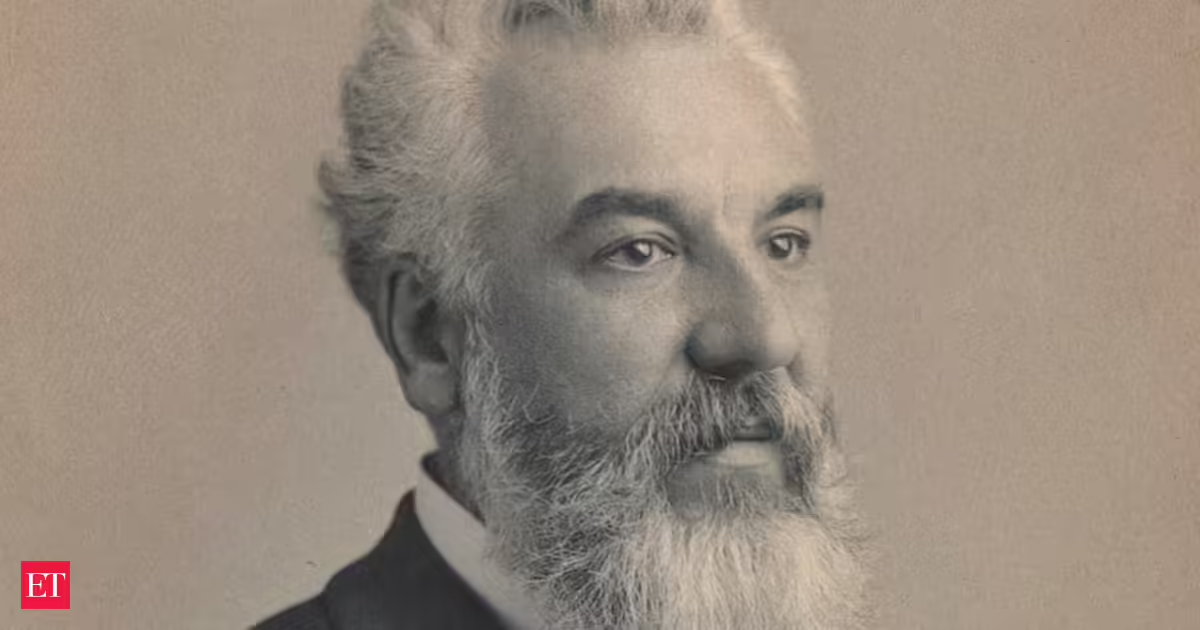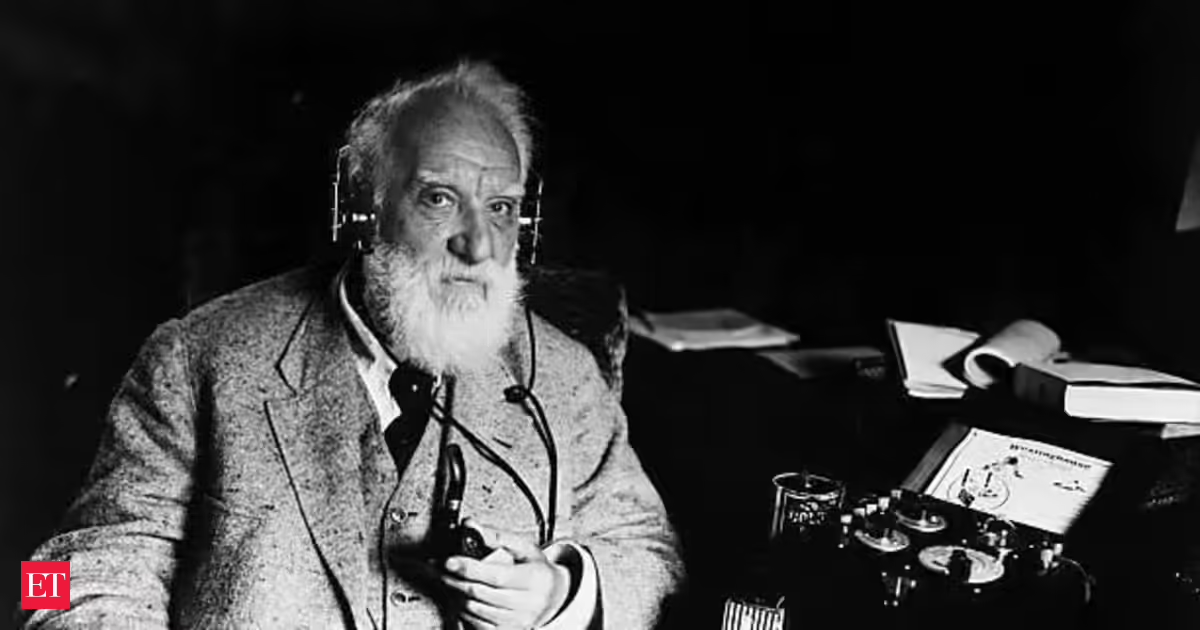
Quote of the day: Few inventors transformed everyday life as profoundly as Alexander Graham Bell. Long before smartphones, video calls and instant communication became routine, Bell imagined a world where human voices could travel across wires and oceans. But beyond his revolutionary inventions, Bell also left behind ideas about discipline, concentration and purpose that feel strikingly relevant in an age consumed by endless notifications and constant distraction.Born in Scotland in 1847, Bell grew up in a family deeply connected to speech and communication. His mother was nearly deaf, while his father worked as a teacher of elocution. Those early experiences shaped Bell’s lifelong interest in sound, language and human connection. After moving to Canada and later the United States, he taught deaf students while pursuing scientific experiments that would eventually lead to the invention of the telephone in 1876. Yet despite becoming internationally famous, Bell remained obsessed not with fame itself, but with the process of focused work. That mindset is reflected in one of his most enduring observations about success and achievement.That line forms part of one of Bell’s most widely shared quotes:“Concentrate all your thoughts upon the work at hand. The sun's rays do not burn until brought to a focus.”Though written more than a century ago, the quote resonates strongly today, especially in a culture where multitasking is often mistaken for productivity.You Might Also Like:Quote of the day meaningAt its core, Bell’s quote is about the extraordinary power of concentration. Sunlight is everywhere, but it becomes powerful enough to ignite something only when focused through a single point. Bell believed the human mind works in much the same way.The quote suggests that scattered attention weakens effort. When energy is divided between too many worries, goals or distractions, progress slows. But when thoughts, time and discipline are directed toward one purpose, even difficult achievements become possible.In modern life, Bell’s words feel almost prophetic. Many people move through their days interrupted by social media alerts, emails, streaming content and constant digital noise. Productivity experts frequently argue that attention has become one of the most valuable resources of the modern era. Bell’s quote cuts through that chaos with remarkable simplicity: focus creates power.The message is not merely about career success. It also applies to relationships, creativity and emotional wellbeing. People often struggle because they divide themselves between past regrets, future fears and present responsibilities. Bell’s philosophy encourages complete engagement with the moment and the task directly in front of us.You Might Also Like:A life shaped by obsession and persistenceBell’s own career reflected the philosophy behind his quote. His invention of the telephone did not appear overnight. It emerged from years of experiments involving sound transmission, harmonic telegraphs and acoustic frequencies.While competitors chased similar breakthroughs, Bell remained intensely committed to his ideas. In fact, he famously filed his telephone patent only hours before inventor Elisha Gray submitted a similar claim. That narrow timing changed technological history forever.Bell’s focus extended beyond the telephone. He later improved sound recording technology through the Graphophone, experimented with aviation and developed the photophone, an invention that transmitted sound using light. He even worked on an early metal detector after U.S. President James Garfield was shot in 1881.What stands out about Bell is not just the range of his inventions, but the consistency of his curiosity. He approached problems with patience and deep concentration, traits increasingly rare in fast-moving modern culture.You Might Also Like:Why the quote still resonates todayBell’s words continue circulating widely online because they speak to a universal frustration: the feeling of being overwhelmed. Many people today struggle not because they lack talent, but because their attention is fragmented.Students attempt to study while scrolling through videos. Employees juggle meetings, emails and notifications simultaneously. Creative people often abandon projects halfway because newer distractions appear more exciting. Bell’s quote reminds readers that mastery usually requires sustained attention over time.Psychologists have repeatedly linked deep focus with improved learning, creativity and performance. The idea behind “flow state,” where a person becomes completely immersed in a task, mirrors Bell’s philosophy closely. In that state, distractions disappear and productivity increases dramatically.There is also an emotional truth hidden inside Bell’s words. Anxiety frequently grows when people overthink problems that have not yet happened or divide their energy between too many concerns. Focusing on one meaningful step at a time can reduce mental exhaustion and restore clarity.More than an inventorAlthough Bell is remembered primarily for the telephone, his broader legacy includes education, scientific advocacy and support for innovation. He helped improve the lives of deaf students, funded research and served as president of the National Geographic Society.Later in life, he devoted considerable attention to aviation experiments and scientific exploration in Nova Scotia, Canada. Even after becoming wealthy, Bell remained driven by curiosity rather than comfort.That may explain why his quote continues to inspire entrepreneurs, students and artists alike. It does not promise instant success or easy rewards. Instead, it highlights a quieter truth: meaningful work demands patience, discipline and concentration.The lasting lesson behind Bell’s wordsAlexander Graham Bell lived during a time of extraordinary technological change, yet his advice feels even more relevant now than it did then. In a world where attention is constantly pulled in different directions, his quote serves as a reminder that focus itself is a form of power.The inventor who helped humanity communicate across vast distances also understood something deeply personal about the human mind: brilliance often comes not from doing everything at once, but from giving full attention to what truly matters.And perhaps that is why Bell’s words continue to endure generations later. Like sunlight gathered into a single beam, focused effort still has the power to change lives.
Quote of the day by Alexander Graham Bell: ‘Concentrate all your thoughts upon the work at hand. The sun's rays do…’ Timeless lesson on focus exposes why modern minds feel exhausted and stuck
Quote of the day: Alexander Graham Bell lived during an era of extraordinary technological transformation, yet his advice feels even more relevant today. In a world where attention is constantly fragmented and pulled in countless directions, his quote serves as a powerful reminder that focus itself can become a form of strength.
941 words~4 min read