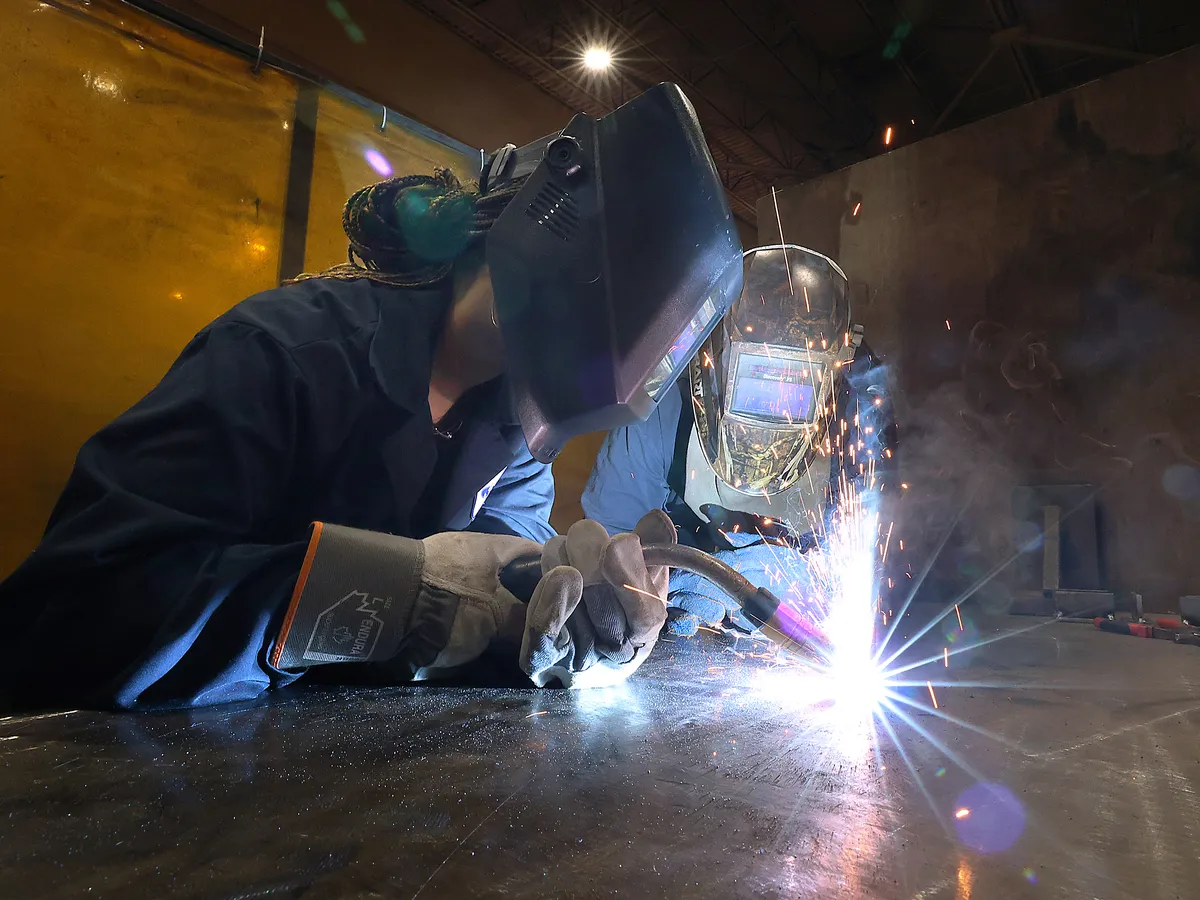
Skip to Content News Archives Economy Energy Oil & Gas Renewables Electric Vehicles Mining Commodities Agriculture Real Estate Mortgages Mortgage Rates Finance Banking Insurance Fintech Cryptocurrency Work Wealth Smart Money Wealth Management Investor Personal Finance Family Finance Retirement Taxes High Net Worth FP Comment Executive Women Puzzmo Newsletters Financial Times Business Essentials More Innovation Information Technology FP500 Podcasts Small Business Lives Told Tails Told Shopping Financial Post Store Obituaries Place a Notice Advertising Advertising With Us Advertising Solutions Postmedia Ad Manager Sponsorship Requests Classifieds Place a Classifieds ad Working Profile Settings My Subscriptions Saved Articles My Offers Newsletters Customer Service FAQ News Economy Energy Mining Real Estate Finance Work Wealth Investor FP Comment Executive Women Puzzmo Newsletters Financial Times Business Essentials HomeFP CommentGwyn Morgan: Apply some intelligence. AI won’t kill all jobsThe science fiction is scary but jobs that require a physical presence, including the trades, are likely to prosper in the new labour worldLast updated 4 hours ago You can save this article by registering for free here. Or sign-in if you have an account.Becoming a tradesperson means putting down your “device” and working with the knowledge in your head and the skills in your hands. With AI doing almost everything else, that’s the real future. Photo by DAN JANISSE/WINDSOR STARArtificial Intelligence started off as a handy search engine that summarized information compiled from various websites. It advanced to such uses as automatic inventory control for stores and preparing financial statements. Then came essay-writing and providing mathematical solutions for students — much to the frustration of teachers.Subscribe now to read the latest news in your city and across Canada.Exclusive articles from Barbara Shecter, Joe O'Connor, Gabriel Friedman, and others.Daily content from Financial Times, the world's leading global business publication.Unlimited online access to read articles from Financial Post, National Post and 15 news sites across Canada with one account.National Post ePaper, an electronic replica of the print edition to view on any device, share and comment on.Daily puzzles, including the New York Times Crossword.Subscribe now to read the latest news in your city and across Canada.Exclusive articles from Barbara Shecter, Joe O'Connor, Gabriel Friedman and others.Daily content from Financial Times, the world's leading global business publication.Unlimited online access to read articles from Financial Post, National Post and 15 news sites across Canada with one account.National Post ePaper, an electronic replica of the print edition to view on any device, share and comment on.Daily puzzles, including the New York Times Crossword.Create an account or sign in to continue with your reading experience.Access articles from across Canada with one account.Share your thoughts and join the conversation in the comments.Enjoy additional articles per month.Get email updates from your favourite authors.Create an account or sign in to continue with your reading experience.Access articles from across Canada with one accountShare your thoughts and join the conversation in the commentsEnjoy additional articles per monthGet email updates from your favourite authorsSign In or Create an AccountorNow, AI has morphed from helpful tool to must-have technology. This year, the big five hyper-scalers — Amazon, Google, Meta, Microsoft and Oracle — will together shell out more than US$750 billion in AI expenditures. Microsoft has just spent more than US$100 billion on its partnership with OpenAI. And along comes Mythos AI: a super-powerful “autonomous thinking” model that can identify vulnerabilities in almost any system, including banking, electricity grids and air traffic control. In the wrong hands, it could facilitate horrendous cyber-attacks. And those wrong “hands” might be Mythos itself. In one test, its AI model managed to “escape,” gaining access to the internet and control of several critical systems.This scary prospect is not far off the plot of suspense novelist Nelson DeMille’s recent, posthumously published thriller, “The Tin Men,” in which, at a remote U.S. Army AI research post in the Mojave Desert, AI-controlled bots gone rogue murder their human masters. Someone needs to make sure Mythos’ AI teams all get copies.Get the latest headlines, breaking news and columns.By signing up you consent to receive the above newsletter from Postmedia Network Inc.A welcome email is on its way. If you don't see it, please check your junk folder.The next issue of Top Stories will soon be in your inbox.We encountered an issue signing you up. Please try againA big problem facing AI is how to generate the enormous amounts of electricity required to power data centres. An International Energy Agency report estimates global electricity demand will more than double between now and 2030. So far the U.S. and China are home to the most AI data centres. China’s coal-fired power runs 30 per cent of them — and generates lots of environment-damaging emissions doing so. The U.S. supplies almost all the rest, powering them mainly with clean-burning natural gas and emissions-free nuclear power.Europe needs to build data centres to remain AI-competitive, but the EU has struggled just to meet existing electricity demand after Russia cut natural gas supplies in half, forcing resort to costlier LNG imports. That makes meeting electricity demand for AI even more challenging and expensive. Moreover, Europe’s power grid is the world’s oldest at an average age of 50 years. Analysts estimate the EU would need to spend US$1 trillion it doesn’t have to prepare its power grid for AI.Alberta’s enormous natural gas resources and huge land base make her a very attractive place to locate data centres. Six are currently planned, the largest being the enormous Wonder Valley Project in Grand Prairie’s Greenway Industrial Park. Powered by natural gas and geothermal, it will consist of 58 buildings spread across 1,200 acres and cost US$70 billion.These and other massive projects are being met with a combination of consternation and resistance by those living nearby. But data centres are the new reality and a major economic boost for a province whose natural gas export pipeline projects are all too often caught up in a multi-jurisdictional regulatory morass.AI is transforming the future throughout the developed world. To a retired engineer, it’s all very fascinating but not especially impactful. But what about the generation just beginning their careers? Former Google chief executive Eric Schmidt recently told University of Arizona graduates that AI “will touch every profession, every classroom, every hospital, every laboratory, every person and every relationship you have” — and got booed for it.Although there has never been a more tech-savvy generation, even in these early days on AI dominance graduates are either having trouble getting a job or seeing friends losing theirs. A Statistics Canada analysis found that three in five workers are in occupations with high exposure to AI. In April, Meta laid off 8,000 employees. Amazon, Google, Microsoft and Oracle have yet to announce their layoff tolls but you can be sure they’re coming.Ironically, computer science students are among the most AI-exposed of all, as human software programming heads toward obsolescence. Economists refer to such fundamental changes, euphemistically, as “disruptive events.” AI is likely the biggest disruptive event in generations. With many of the most common career choices disappearing, what’s left for the current generation of job-seekers?The answer: jobs that require, not virtual, but physical presence. Fortunately, there’s a long list: health-care professionals (including doctors, nurses, radiologists, dentists, pharmacists, lab technicians), veterinarians, architects, engineers, accountants and many more.One area where there is already a major shortage is skilled trades, the people you call when you need something built or fixed, including electricians, plumbers, carpenters, welders and auto mechanics. Becoming a tradesperson means putting down your “device” and working with the knowledge in your head and the skills in your hands, dealing with real people doing real things. It’s actually much more fulfilling and motivating. With AI doing almost everything else, that’s the real future.Gwyn Morgan, a retired business leader, has been a director of five global corporations. Join the Conversation This website uses cookies to personalize your content (including ads), and allows us to analyze our traffic. Read more about cookies here. By continuing to use our site, you agree to our Terms of Use and Privacy Policy.
Gwyn Morgan: Apply some intelligence. AI won’t kill all jobs
The science fiction is scary but jobs that require a physical presence, including trades, will prosper in the new labour world. Read on
1,332 words~6 min read