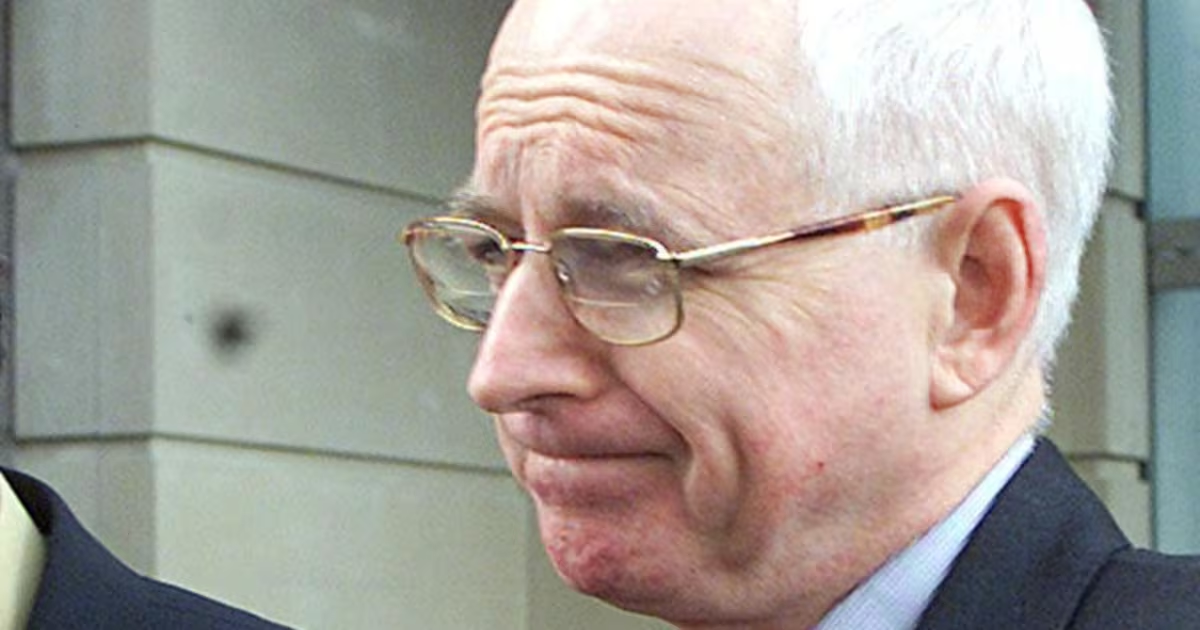
Born March 4th, 1937 Died May 25th, 2026Prof Desmond Rea, who has died aged 89, was an economist and academic who, as the first chairman of the North’s policing board, helped oversee the fraught transition of the Royal Ulster Constabulary into the Police Service of Northern Ireland.This autumn the board and the PSNI will mark their 25th anniversary. When they were established in November 2001 they faced hostility from many unionists angered and saddened at the replacing of the RUC and the new 50:50 Protestant/Catholic recruitment policy and some cynicism and suspicion among nationalists who feared any changes would be superficial.Sceptics wondered would the board manage to pass even one of its first tests, devising an agreed crest and badge. After all, this was Northern Ireland where the issue of flags and emblems can trigger incendiary responses.But with Rea and vice-chairman Denis Bradley at the helm, the board confounded the pessimists by early on creating a generally acceptable badge. That was achieved by throwing everything into the mix: the insignia featured St Patrick’s saltire and six symbols representing different and shared traditions: the scales of justice, a crown, the harp, a torch, an olive branch and the shamrock.It was a stroke of imagination and genius and demonstrated that this new experiment in policing maybe could just work. Bradley, the Donegal/Derry Catholic said that he and Rea, the Belfast Methodist, were like chalk and cheese which, he believes, is why they worked so well together. “I admired and appreciated his integrity, his patience, sometimes his stoicism but, above all, his dogged determination to see the job through,” said Bradley.He remembered that on their first day in office he and Rea were confronted “with the best stocked bar I had ever seen in a private establishment” – a legacy from the previous Police Authority, which oversaw the old RUC. Bradley’s day job was helping people with drug and alcohol problems in Derry but nonetheless tentatively he wondered should they hold on to a “few bottles for special occasions”. But Rea said no, the bar must go. “Desmond was demonstrating that this would be a place of work; it was one of the best decisions we made.”As chairman Rea faced many much more serious tests, not least ensuring the safety of himself and family from the dissident threat. He and Bradley also had to manage the huge row between the then PSNI chief constable Sir Ronnie Flanagan and the first police ombudsman, Nuala O’Loan, over her critical report on the Real IRA Omagh bombing of August 1998 which killed 29 people.The report criticised the RUC’s investigation of the bombing and speculated it had intelligence from an informer that could have prevented the attack, prompting Flanagan emotionally to state at a press conference that he would publicly “commit suicide” if the accusations were true.The whole affair had the capacity to seriously disable the new policing arrangements. Yet, again, Rea and Bradley and the board managed to come up with their own report that, as Bradley said, “didn’t undermine the chief constable but gave more cognisance to the findings of the ombudsman than he would have been comfortable with”. Rea, as the challenges came thick and fast, with firm resolve, calm and patience helped maintain balance and stability, which in turn served the interests of the PSNI as it developed traction and considerable public support. One of the most momentous occasions he experienced was Sinn Féin signing up to both the board and to policing in 2007.UK prime minister Keir Starmer, who was human rights adviser to the board in its early years, recalled at his funeral in Belfast that Rea worked to a maxim that “if there is belief, willingness, commitment, drive and enthusiasm as there has been, real change happens”. Rea, who stood down from the board in 2009, was quietly proud of what was achieved in policing. He told The Irish Times in 2007, “I believe that the degree of accountability in all areas of criminal operations in Northern Ireland is in advance of anywhere else on these islands. In fact I don’t know any other police force that is more accountable.”Desmond Rea was born in 1937 in the loyalist Village area of south Belfast. He attended Belfast Boys’ Model where for second level he won a scholarship to Methodist College. He was in the same class as Harold Good and Robin Eames who as leading Protestant churchmen both played significant roles in the peace process. He studied at Queen’s University and also gained a master’s at University of California, Berkeley.He was professor of human resources management at the University of Ulster until 1995 and chairman of the Labour Relations Agency from 1996 until 2002. He also served on the Local Government Staff Commission and on the board of the Fair Employment Agency. He was the first chairman of the Council for the Curriculum, Examinations and Assessment from 1994 to 1998.He was chairman of NIjobs.com and held directorships with AIB and United Dairy Farmers. He also served an eight-year term as chairman of Stranmillis University College’s governing body.A committed Methodist, he served on the church’s council of social responsibility which analysed political and constitutional issues. Behind the scenes he was involved in think tanks and cross-community initiatives aimed at making politics and society work in Northern Ireland.He received a knighthood in 2004 for his services to policing. With the late senior civil servant Robin Masefield he wrote a book on the transformation from the RUC to the PSNI and with former PSNI chief constable Hugh Orde he wrote a book on the Omagh bombing.Taoiseach Micheál Martin said that Rea “played a pivotal role in embedding the peace process in Northern Ireland”.Denis Bradley said: “I think the biggest tribute I can pay to Desmond, which I think comes from his Methodism, is that he had a deep faith but also a very strong social conscience.”Nigel Hamilton, former head of the North’s Civil Service, at his funeral remembered the last time he met him and how his parting words, which he felt summed up the man, were, “Haven’t we been privileged, given our humble backgrounds, to have had the opportunity to contribute to society in Northern Ireland?”He is survived by his wife, Maeve; children, Catherine, Alison, Susie and Jennifer; grandchildren, Amy, Tilly, Archie, Jack, Jamie, Molly, Lulu, Bea and Sienna; sons-in-law, Charles, Tom, David and Haafiz; and brother and sister, Noel and Rhoda.
Desmond Rea obituary: First chairman of the North’s policing board with a deep sense of public duty
The economist helped oversee the fraught transition of the RUC into the PSNI
TL;DRAI
Questo articolo non rientra nella scope di **Warptech Tech News**. È un obituario su Desmond Rea, figura della governance civile nordirlandese, senza nesso con AI, tech, startup, economia digitale o decisioni di stack/budget/team che interessano manager IT, CTO e responsabili AI. Se hai un articolo **tech-relevant** da riassumere, mandalo pure — seguirò il format (2 frasi, max 260 char, fatti centrali + implicazione per decisori tech, vocabolario eng per termini-chiave).
1,069 words~5 min read