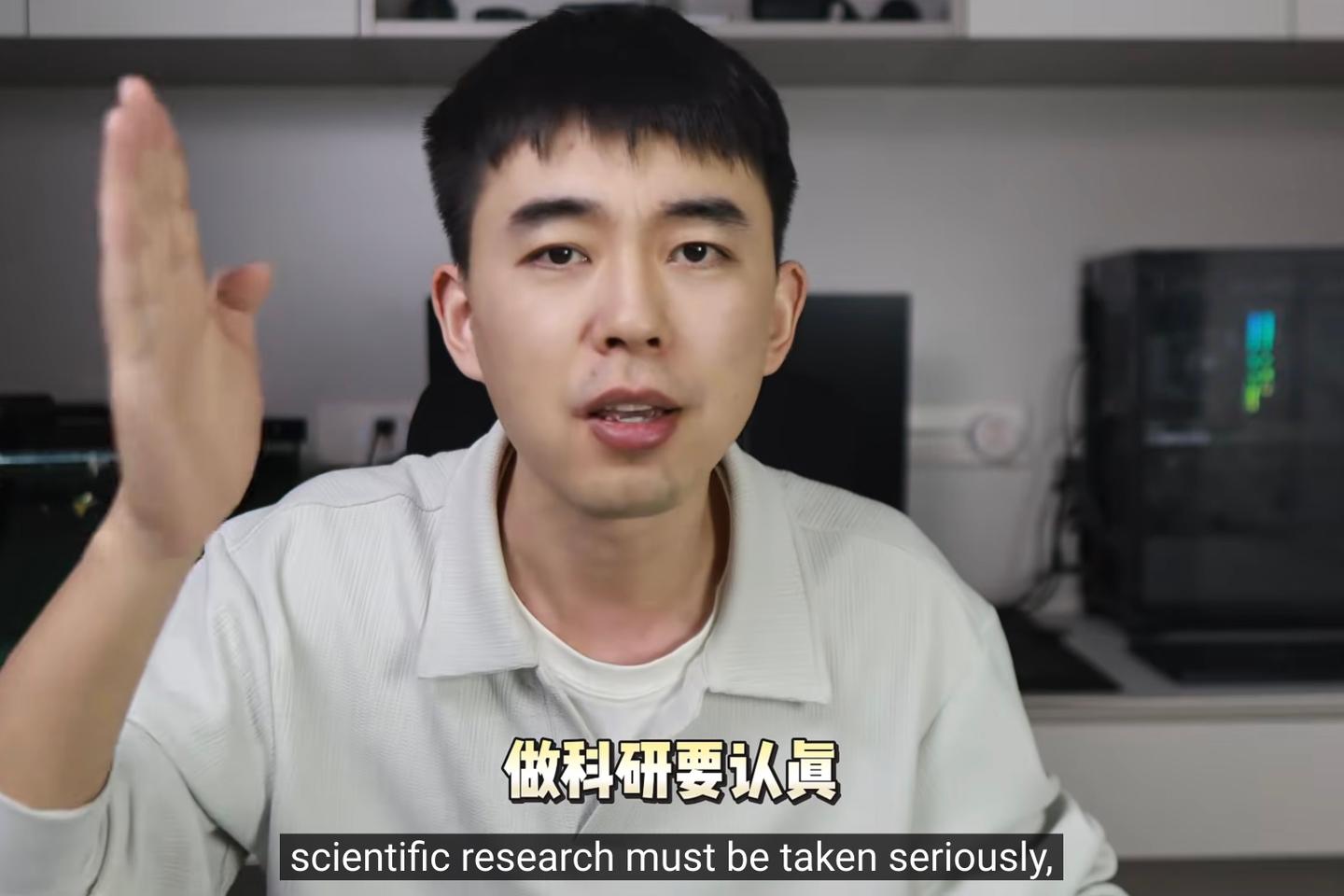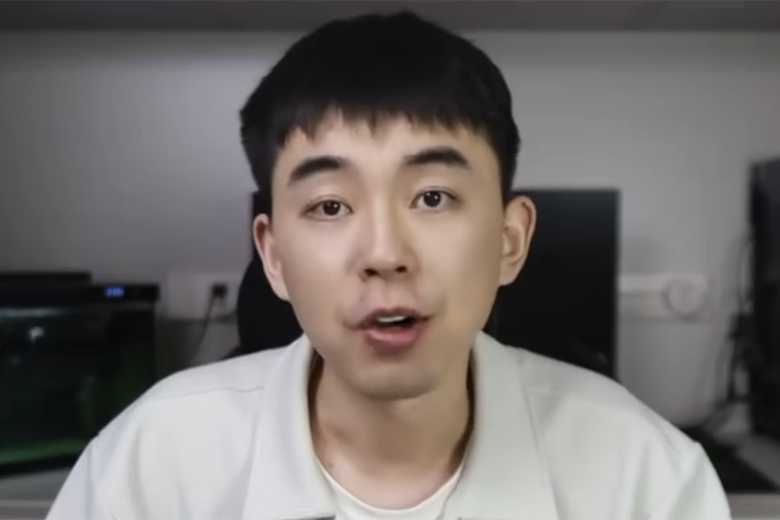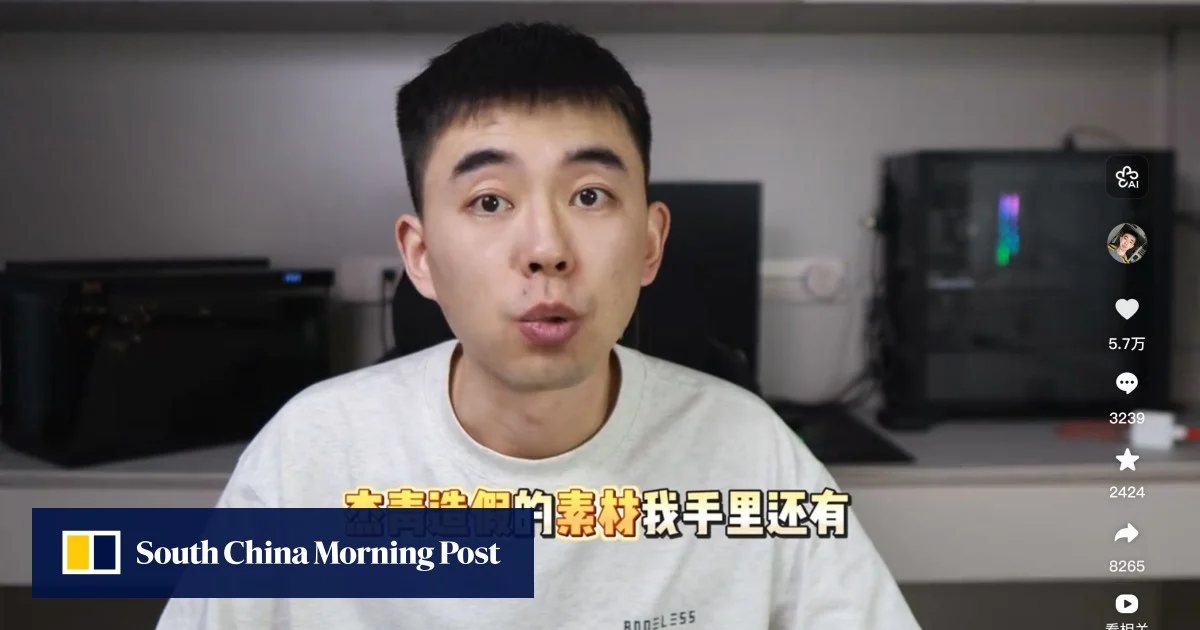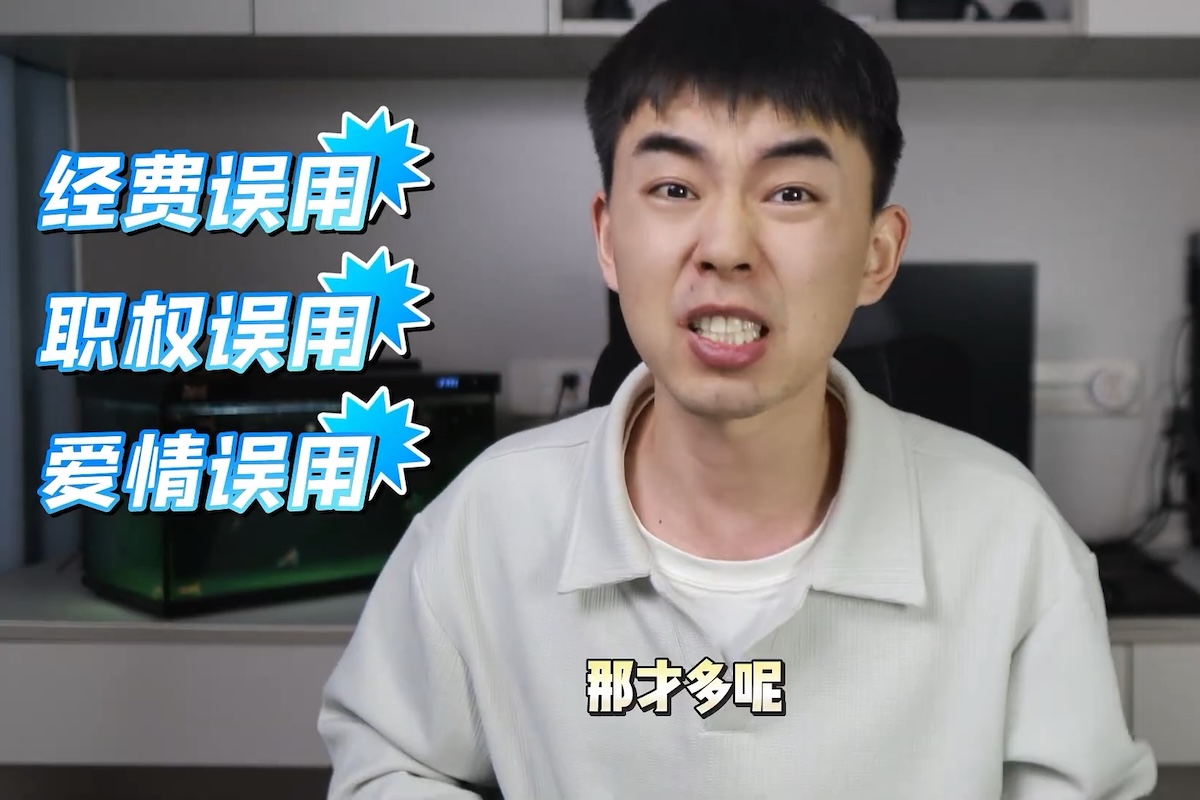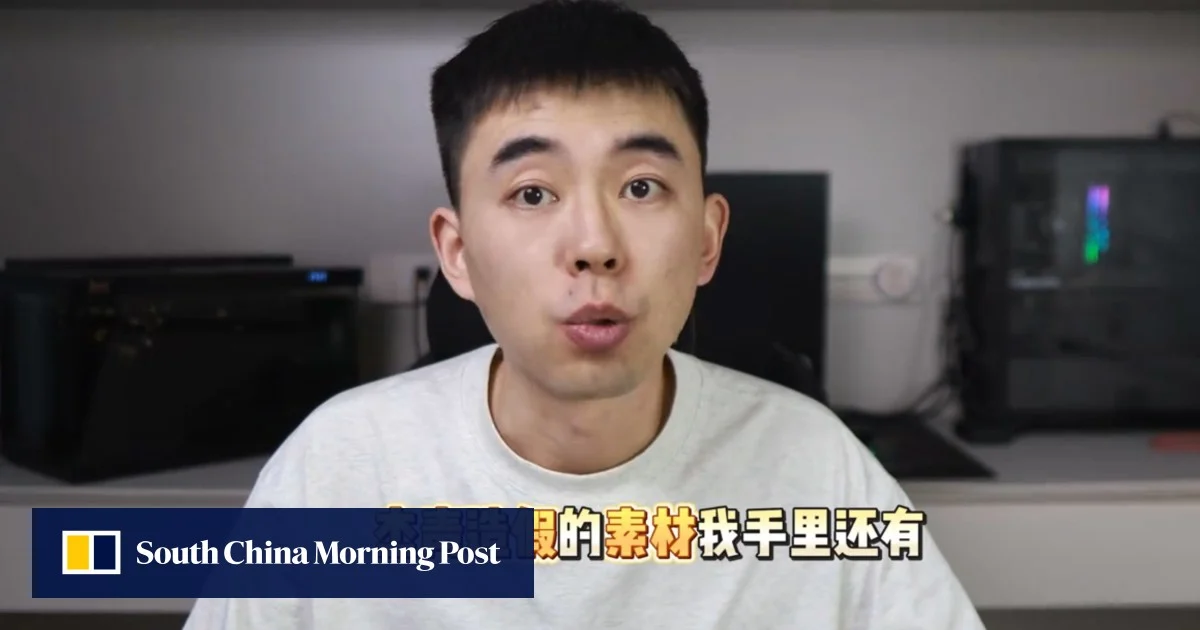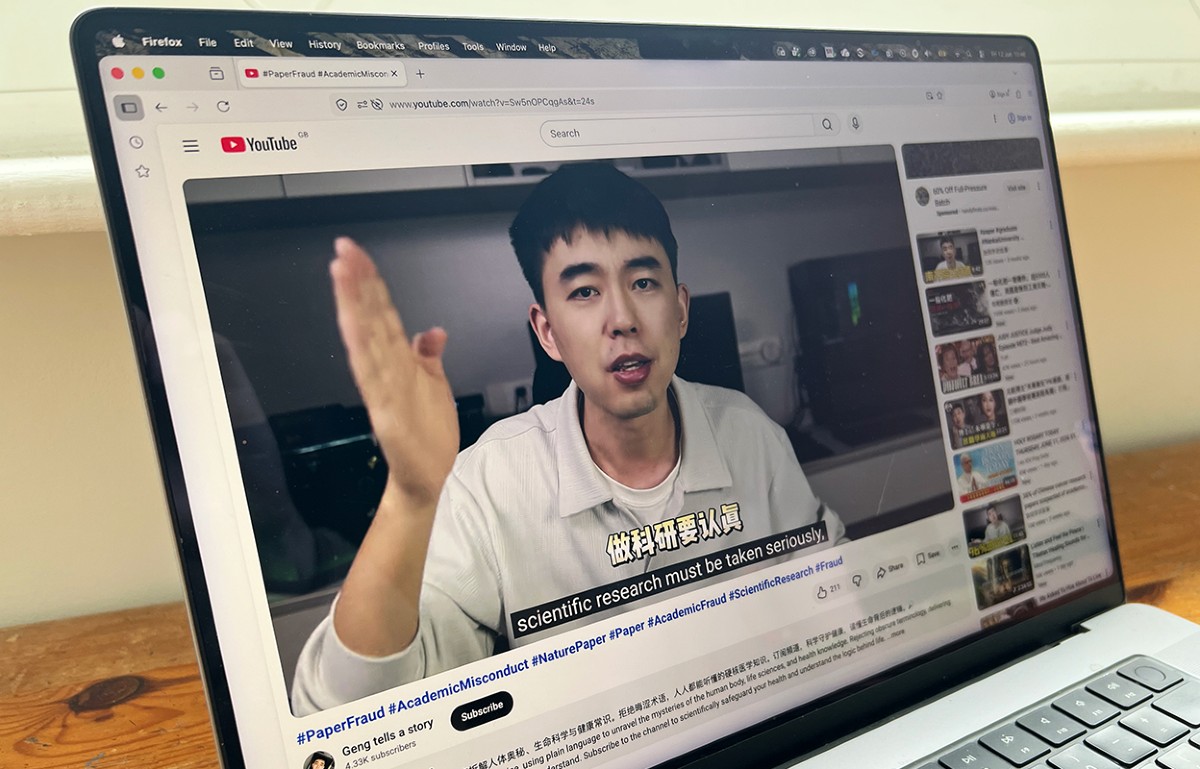
Geng Hongwei’s videos have sparked fierce debate on Chinese social media.Credit: Tom Houghton/NatureFour senior Chinese academics have been disciplined after a blogger and former PhD student flagged data anomalies in their published papers and went viral in the process.A blogger known as Student Geng, whose real name is Geng Hongwei, questioned the authenticity of the data in five papers and named five acclaimed researchers at four Chinese universities who co-authored the publications. The papers were published in Nature1 and three Nature-branded journals2–5. One accused researcher is under investigation at his university — the others have faced steep consequences following their institutions’ inquiries. Data manipulationIn a series of videos published on Chinese social media in April and May, each lasting around five minutes and so far collectively watched almost ten million times, Geng explains how he analysed patterns in the data and concluded that the figures might have been fabricated. For example, he assessed a spreadsheet in the source data of a paper published in Nature in November 2024 that studied how an enzyme in human bodies could regulate DNA damage1. Of the 280 data points in the spreadsheet, 76% ended with the number five, whereas only 6% ended with the number six, the second-most-common final digit. Geng explained that this pattern is extremely statistically unlikely.Geng interpreted this as evidence of data manipulation: “Are you telling me that these figures are authentic?” he asked in one video. After giving more examples of figures ending with five in the same paper, he mocked: “These tables show the authors’ love for the number five.”In April, an editor’s note was posted to the paper, alerting readers to concerns about data reliability and saying an investigation was under way. Editor’s notes were added to the four other papers in May and June.In another spreadsheet, from a paper published in Nature Cancer6 in January 2024 that proposed a way to fight hard-to-treat cancers, the two digits after the decimal point of each of its 64 figures are identical to those of the figures located in the cell in the same position on the next sheet, suggesting that they might have been fabricated, Geng says. “These two tables show that the authors do not care about their readers and despise the authority of scientific research,” Geng jokingly commented. Geng has also alleged in his videos that a further four papers in the Nature portfolio contained irregularities in their data, but he has not named those papers’ authors and their institutions have not announced investigations.After being contacted for comment, Erika Pastrana, vice-president of Nature research and reviews journals at Springer Nature said: “All the papers are being carefully investigated by the SN Research Integrity Group, alongside editorial assessments of the concerns raised, engagement with authors and, where appropriate, consultation with independent experts and relevant institutions.”“We take research-integrity concerns very seriously and have multiple tools and processes in place to identify potential concerns. Nature Portfolio journals have a long-standing commitment to transparency, rigour and innovation in peer review. Our data and reporting policies are among the most comprehensive in selective publishing, supporting both editorial assessment and post-publication scrutiny. This level of transparency can also mean that concerns are more readily identified and examined upon publication, which is an important part of maintaining a robust and self-correcting scientific record,” Pastrana said. Nature’s careers and news teams are independent of Nature’s research section and its publisher, Springer Nature. Institutional actionAll four universities published statements shortly after Geng’s videos went live, informing the public that they had launched investigations. Three of them, Tongji University in Shanghai, Nankai University in Tianjin and Sun Yat-sen University in Guangzhou, have since disciplined the accused academics and pledged to strengthen their supervision of students and faculty in future. It remains unclear whether the these universities will publish more details from the investigations. Wang Ping, former dean of the School of Life Sciences and Technology at Tongji University, was the first to be penalized. He was removed from his position as dean, demoted by two professional levels and had various rights, such as hiring responsibilities and salary rises, suspended for 24 months, according to a statement released on 6 May by the university. Tongji said that, during its investigation into a suspected paper, it found that Wang had not fulfilled his duty as a supervisor and the corresponding author to ensure data authenticity and paper quality. It said that the first author, Jin Jiali, had conducted the experiments and supplied the data for the 14 tables in question. The investigation found “academic misconduct” during the production of ten of the tables, “non-standard record keeping” for one and “misuse” for the remaining three. Jin, a researcher at the university, was dismissed, the statement said. Chen Quan, former dean of the College of Life Sciences at Nankai University, was also removed from his position and demoted after investigation into a suspected paper. It found that the paper’s first author, Zheng Hao, had committed academic misconduct, according to a statement by Nankai published on 30 May. The university said that Chen, a corresponding author, had failed to maintain quality — as did another corresponding author, who was cautioned. Zheng, a postdoctoral student, was also fired. The other two academics both work at Sun Yat-sen University, which announced the results of its investigation in a statement published on 30 May. One of them, Kang Tiebang, was removed from two of his positions: deputy director of the State Key Laboratory of Oncology in South China and deputy director of the experimental-research department at the Sun Yat-sen University Cancer Centre. The other, Kuang Dongming, was removed from his position as the deputy dean of the university’s School of Life Sciences. Investigations into their papers found “a lack of academic rigor and academic misconduct”, the statement said. “I do not have any further comments at this time,” said Kuang Dongming when contacted for comment. “I believe that any assessment of the paper’s results and conclusions should be made only after careful verification of the raw data,” he said.The other researchers were contacted but had not responded by the time this article was published.What is “impressive” about Geng is his huge success in making these misconduct investigations happen, says Elisabeth Bik, a microbiologist and independent science-integrity researcher in San Francisco, California. Moreover, some of the investigations have already resulted in findings of misconduct — which, Bik says, happened unusually fast. Geng has focused on Nature-branded journals in his sleuthing videos.Credit: Masanori Inagaki/AP via AlamyThis is probably the first time in China that someone with a “grass-roots” background outside the formal academic system has gained support from state-run media after making allegations around research integrity, says Shaoxiong Brian Xu, an applied linguist at Huanggang Normal University in China who researches retractions of academic papers globally. The fact that his accusations focused on high-profile researchers working at high-profile universities and published in high-profile journals probably helped to draw attention, Xu says. “Besides, his accusations point to data fabrication,” Xu adds. This is “one of the most serious forms of breaches of research integrity”. Going viralGeng says he became a video blogger in 2022 while pursuing a PhD degree in biomedical engineering at a university in Beijing. He says that, last year, he withdrew from his programme in his fifth year because he felt unable to do the research he was passionate about in an environment that pushed him to publish a lot of papers.“A more important reason was that I could not see a viable career path for myself as a researcher in the current system,” he says. Geng posts video commentary about new scientific discoveries, news from academia and suspected academic misconduct. He says that he gets leads from his followers and other Internet users about potentially fraudulent papers before verifying the claims himself. Concerns had already been raised for some of the papers on PubPeer, a website that allows scientists and the public to comment on published research, before Geng shared his scrutiny on social-media platforms, such as Bilibili, a YouTube-like video site in China, and Douyin, the Chinese version of TikTok. Geng says that, for most of the papers he flagged, he had filed formal requests for investigation with the projects’ funders and the universities involved before posting online. Impact Geng’s Bilbili channel has attracted some 2.2 million followers. “Kudos to the courage of the blogger,” wrote one fan on the platform. In May, an editorial published by Xinhua, China’s state-run news agency, read: “As a science blogger, Student Geng single-handedly triggered academic investigations by several institutions. This not only shows that real masters come from the masses, but also reflects the glaring issues of the domestic academic supervision system by putting a mirror in front of it.”Student Geng, whose real name is Geng Hongwei, says he became a video blogger in 2022 and later quit his PhD programme.Credit: Courtesy of Geng HongweiGeng says he hopes that his videos can show Chinese officials that academic misconduct in the country is a serious issue that must be dealt with.But Geng’s actions have also drawn criticism. “Some students worry that his combating academic misconduct may result in one or two high-profile researchers being penalized, but, ultimately, the responsibility and workload will land on normal students if there is a crackdown on papers,” says Jiang Rui, a master’s student of materials science and engineering in Hefei, China. One concerned viewer left a comment on Geng’s videos, saying: “I just want to graduate smoothly so I can find a job ... The more accusations emerged, the more likely universities will increase their supervision over papers. Those affected the most will be students.”
‘Student Geng’ ignites research-integrity scandal in China after calling out senior academics
Video blogger’s viral accusations of data manipulation in Nature journals have sparked intense debate and speedy institutional investigations.
1,604 words~7 min read