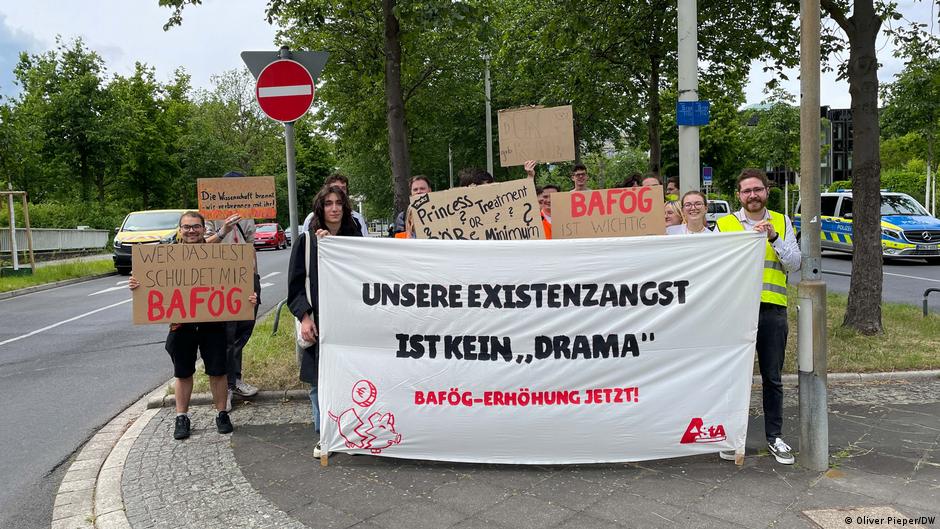
Wiebke Jaeger is 23 and works part-time for 12 hours a week, helping young refugees with job applications. At the same time, she is studying Politics and Society at the University of Bonn. Jaeger is one of the reported 66% of students across the country who work to finance their studies — and at the moment many of them are not particularly pleased with the Federal Minister of Research, a member of the conservative Christian Social Union (CSU) party.
Jaeger explained her position to DW: "I was frustrated, because once again cuts are set to be made in the social sector, and decisions are being taken over the heads of young people. When Dorothee Bär says that students are privileged and do not really need an increase in BAföG [state assistance for studies], that is quite an audacious statement for a federal research minister."
Germany's BAföG reform in jeopardy
What is currently causing considerable frustration among many of the nearly three million students in Germany is, above all, Federal Research Minister Dorothee Bär's reasoning for why the reform of the Federal Training Assistance Act (BAföG), as set out in the governing coalition agreement, is not a priority for her at present.
Bär argued: "It is no tragedy if students take on jobs alongside their studies — many even gain valuable experience for life and their careers in the process." She went on to say that there will be no fully cushioned, all-inclusive course of study, as she termed it, as the situation of students in Germany is in her words "very privileged."