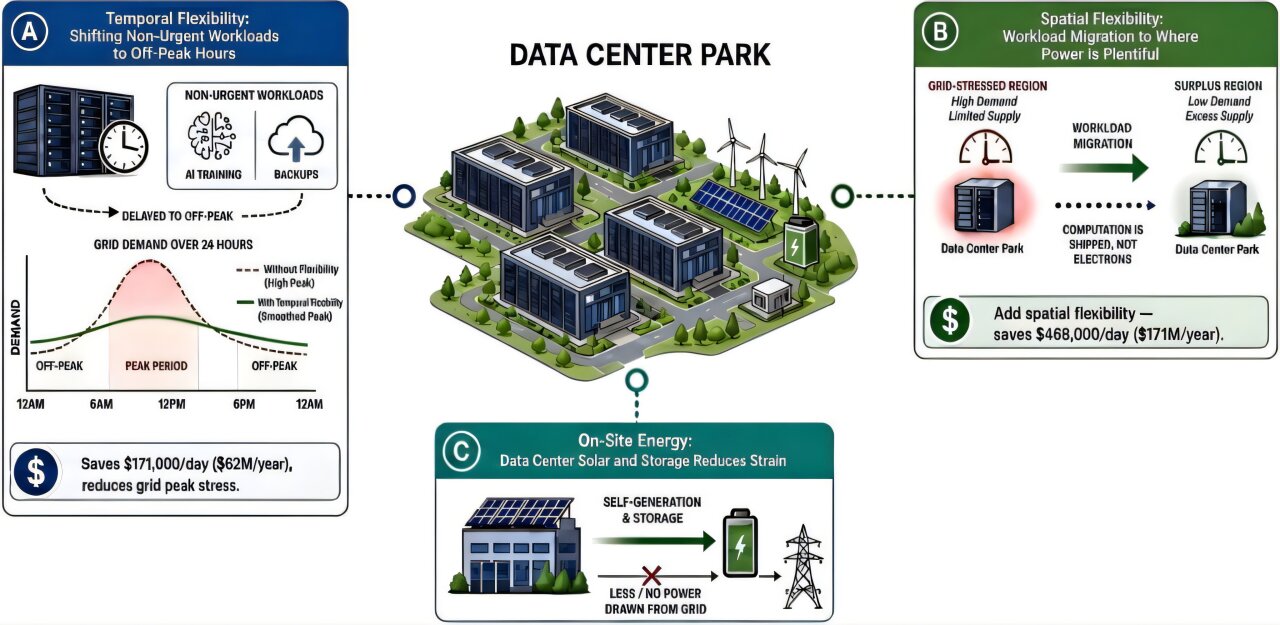
A LUT University study finds that data centers could be powered continuously by intermittent renewables like wind and solar when paired with backup generation and demand-side flexibility. However, achieving firm supply would require major overbuild, significant curtailment, and careful siting to keep costs competitive with other baseload sources.
With appropriate backup power and demand side flexibility measures in place, it is both technically and economically possible for data centers to use intermittent renewables sources like wind and solar to provide continuous baseload power, according to a study by LUT University, Finland, exploring this possibility.
The study concluded that, because data centers have limited ability to adapt to fluctuations in solar generation, they must therefore have access to at least seven times their baseload operating requirements. However, such an oversized supply of solar, or wind, to ensure continuous power availability would also lead to curtailment of excess solar generation during peak production hours. In addition, even with overcapacity and battery storage, wind and solar alone cannot guarantee uninterrupted electricity supply for data centers.
Altti Meriläinen, Junior Researcher at LUT University, told pv magazine that location is a massive factor in determining whether it is cost-effective to power a data center with 100% solar and battery storage. “It depends on the location. According to a recent report by IRENA, solar PV and BESS based baseload supply can reach levelized cost of electricity (LCOE) of less than €100 ($115)/MWh in several locations around the globe,” the researcher said, referencing a recent report on the economics of firm solar and wind by the International Renewable Energy Agency (IRENA),” she stated.