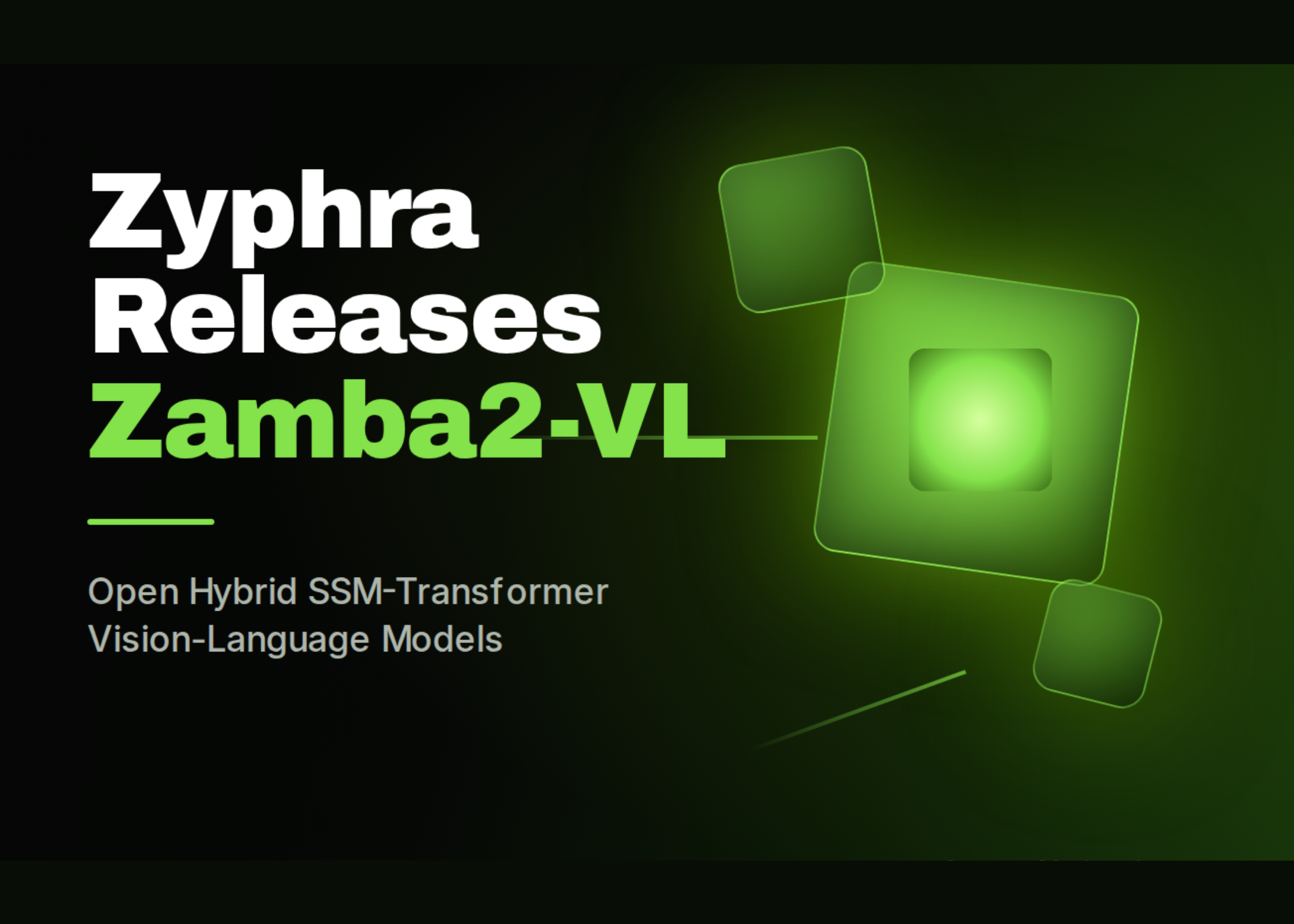
Zyphra has released Zamba2-VL, a family of open vision-language models. The release covers three sizes: 1.2B, 2.7B, and 7B parameters. Each model is built on the Zamba2 hybrid SSM–Transformer backbone.
Vision-language models (VLMs) read images and text together. They answer questions about charts, documents, and photos. Most open VLMs use a dense Transformer as the language model. Zamba2-VL replaces that with a hybrid state-space design. The goal is competitive accuracy at lower latency.
What is Zamba2-VL
Zamba2-VL follows the now-standard LLaVA-style VLM template. A pre-trained vision encoder turns image patches into features. A lightweight MLP adapter projects those features into the language model’s space. The language model then reads an interleaved sequence of vision and text tokens. The models support single and multi-image understanding and grounding.
Zyphra pairs each Zamba2 backbone with the Vision Transformer from Qwen2.5-VL. That encoder was chosen for two specific properties. It uses 2D rotary position embeddings and native dynamic-resolution processing. A two-layer MLP adapter connects the encoder to the backbone.